
ServiceNow launches AI Passport and EmployeeWorks updates for enterprise AI governance
ServiceNow has unveiled new AI agent governance tools, including AI Passport, a cryptographically signed credential for defining and enforcing AI agent permissions. The updates also expand the EmployeeWorks portal, enabling employees to build assistants and automate workflows without coding. These moves aim to address enterprise challenges around AI adoption, including governance, cost tracking, and productivity.

Editor, Lazyfounder
30 SEC SUMMARY
- ServiceNow launched AI Passport, a cryptographically signed credential for governing AI agents in enterprise environments.
- The AI Passport defines agent identity, permitted actions, and accessible systems, issued via ServiceNow’s AI Control Tower.
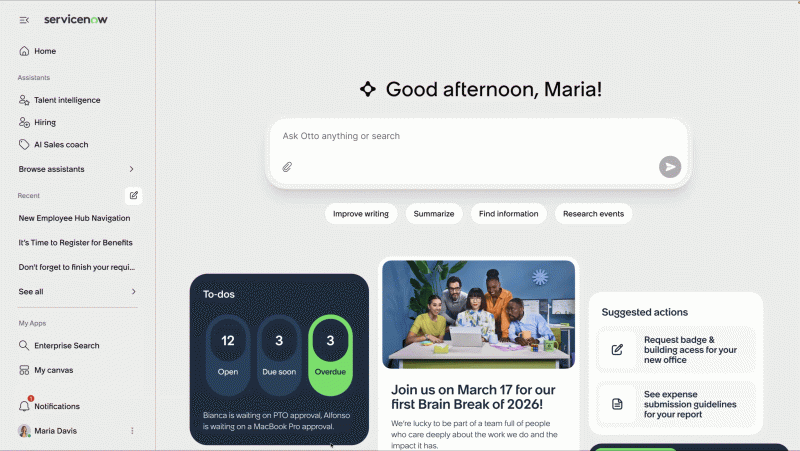
- Updates to EmployeeWorks allow employees to build specialized assistants and automate tasks without coding.
- New features include shadow AI detection, 400+ vendor connectors, and AI cost tracking for enterprise governance.
- AI Passport and related tools will be available later this quarter, with some features in controlled availability.
TABLE OF CONTENTS
KEY HIGHLIGHTS
- ServiceNow introduced AI Passport, a cryptographically signed credential for governing AI agents, issued through its AI Control Tower platform.
- AI Passport defines an agent’s identity, permitted actions, accessible systems, and accountable owner, enabling runtime enforcement of policies.
- ServiceNow demonstrated a third-party agent processing refunds below $25 automatically while rejecting larger requests that required human review.
- Nvidia is a design and launch partner for AI Passport, integrating enterprise policies with enforcement infrastructure.
- New EmployeeWorks updates allow employees to build assistants and automate tasks without coding, using natural-language instructions.
- AI Control Tower now includes shadow AI detection, over 400 vendor connectors, and AI Cost Management for tracking spending.
What ServiceNow announced
ServiceNow introduced AI Passport, a cryptographically signed credential designed to govern AI agents in enterprise environments. According to SiliconANGLE, the credential defines an agent’s identity, permitted actions, accessible systems, and accountable owner. It is issued through ServiceNow’s AI Control Tower, a governance platform that aims to provide centralized oversight for AI deployments.
During a demonstration, ServiceNow showed how AI Passport could enforce policies in real time. A third-party customer service agent was configured to process refunds under $25 automatically, while larger requests were rejected and flagged for human review. This runtime enforcement is enabled by integrating business context from ServiceNow’s configuration management database (CMDB), governance policies, and workflow approvals.
Nvidia is a design and launch partner for AI Passport, which uses open specifications to allow other governance tools, identity providers, and enforcement systems to issue and verify credentials.
Enhancements to AI Control Tower and EmployeeWorks
ServiceNow is expanding its AI Control Tower with new features for discovery, observability, and financial oversight. Additions include shadow AI detection, which identifies unauthorized AI tools, and over 400 vendor connectors for mapping access and monitoring agent behavior. AI Cost Management consolidates spending across frontier models, embedded AI services, hyperscalers, and data center GPUs, linking consumption to business value.
Updates to EmployeeWorks allow employees to build specialized assistants and automate tasks without coding. Key components include Productivity Assistants for job-specific tasks, Productivity Routines for common workflows, ToolSmith, a developer environment trained on over 75,000 APIs, and the Conversations API, which simplifies creating AI-driven workflows from natural-language instructions.
These tools are part of ServiceNow’s broader strategy to embed AI governance into everyday work, targeting productivity and reducing reliance on technical teams for automation.
Availability and adoption timeline
Operational Resilience, a governance and risk management solution for financial institutions, is available now.
AI Passport, shadow AI detection, and AI Cost Management are expected to roll out later this quarter.
The new EmployeeWorks features—including Productivity Assistants, ToolSmith, and the Conversations API—are currently in controlled availability.
Enterprise AI governance: Claims and gaps
ServiceNow markets its AI Control Tower as a comprehensive solution for discovering, governing, and enforcing policies across AI agents, models, and clouds. The company claims the platform can track costs, shut down policy violations, and integrate with existing enterprise systems like ITSM and CMDB. According to SiliconANGLE, over 500 customers have adopted AI Control Tower in its first six months, and ServiceNow reported AI annual contract value (ACV) exceeding $1 billion in Q2 2026, with a full-year target of $1.5 billion.
A field study of 15 ServiceNow customers, cited by SiliconANGLE, revealed gaps in technical governance and runtime enforcement. Key findings include:
-
Runtime enforcement: Fourteen of fifteen customers described enforcement as external, custom, human-mediated, or limited in scope. Most did not view ServiceNow as a universal runtime control plane.
-
Model-specific evidence: Twelve customers identified gaps in validation records, lineage tracking, bias mitigation, and explainability for AI models.
-
Pricing concerns: Twelve customers expressed concerns about pricing, packaging, or total cost of ownership.
-
Implementation friction: Thirteen customers reported significant challenges in configuration, integration, or staffing.
Competitive landscape and market context
ServiceNow’s AI governance tools compete with a range of vendors, including AI governance platforms like IBM, Fiddler AI, and Credo AI; security and compliance tools from Palo Alto Networks, Cisco, and OneTrust; and enterprise software providers like Microsoft and Salesforce.
ServiceNow’s market cap has fluctuated significantly, peaking at $230 billion in late 2024, dipping to $80 billion in April 2026, and recovering to approximately $146 billion. The company’s AI pricing model includes three tiers—Foundation, Advanced, and Prime—with reported price uplifts of 20-30% or more.
What this means
Lazyfounder analysis — our interpretation, not reported fact.
ServiceNow’s launch of AI Passport and EmployeeWorks updates reflects a broader shift in enterprise AI: governance is no longer just about tracking AI assets but enforcing rules in real time. For founders, this signals that AI governance tools are maturing beyond spreadsheets and approval workflows into technical enforcement layers.
The gaps highlighted in ServiceNow’s runtime enforcement claims are a reminder that vendor promises don’t always translate to enterprise-scale solutions. Operators should pressure-test governance platforms in their own environments, particularly around model-specific evidence (e.g., bias tracking) and cost attribution.
The EmployeeWorks updates also show how AI adoption is moving downstream. No-code tools like ToolSmith lower the barrier for non-technical employees to build and deploy AI-driven workflows. Startups should consider how to embed similar functionality into their products to drive engagement and reduce dependency on engineering teams.
Finally, ServiceNow’s pricing concerns underscore a tension in the AI governance market. Vendors are pushing premium tiers with bundled AI credits, but enterprises are wary of opaque costs. Founders building in this space should prioritize transparent pricing and clear ROI metrics to avoid friction during adoption.
Key takeaways
- Enterprise AI governance is shifting from inventory and monitoring to enforceable, runtime controls. Founders should evaluate whether their AI deployments can enforce policies at scale.
- ServiceNow’s model-agnostic approach and integration with enterprise systems like ITSM and CMDB reduce switching costs but may introduce complexity. Operators should assess implementation friction before adoption.
- AI cost management is becoming a critical feature for enterprises. Startups building AI tools should consider how to track and attribute spending by user, department, and runtime.
- Employee-driven automation tools like Productivity Assistants and ToolSmith lower the barrier to AI adoption. Founders should explore no-code/low-code integrations to drive engagement.
- The gap between governance claims and technical enforcement remains a challenge. Operators should validate runtime controls with vendors before committing to enterprise-wide AI rollouts.
FAQ
What is AI Passport, and how does it work?
AI Passport is a cryptographically signed credential issued by ServiceNow’s AI Control Tower. It defines an AI agent’s identity, permitted actions, accessible systems, and accountable owner. The credential enables runtime enforcement of policies, ensuring agents operate within defined limits. For example, an agent could be restricted to processing refunds under $25 without human approval.
When will AI Passport and the new EmployeeWorks features be available?
AI Passport, shadow AI detection, and AI Cost Management are expected to be available later this quarter. The updated EmployeeWorks features, including Productivity Assistants and ToolSmith, are currently in controlled availability.
What are the key gaps in ServiceNow’s AI governance tools?
A field study of 15 ServiceNow customers identified several gaps, including limited runtime enforcement (most customers rely on external or custom solutions), model-specific evidence gaps (e.g., tracking validation records or bias), pricing concerns, and significant implementation friction during configuration and integration.
How does ServiceNow’s AI pricing model work?
ServiceNow offers three pricing tiers for its AI solutions: Foundation, Advanced, and Prime. Pricing combines seat-based licenses with bundled AI credits called 'assists.' The company has reported price uplifts of 20-30% or more, though some customers have expressed concerns about total cost of ownership.
Who are ServiceNow’s competitors in AI governance?
ServiceNow competes with AI governance platforms like IBM, Fiddler AI, and Credo AI; security and compliance tools from Palo Alto Networks, Cisco, and OneTrust; and enterprise software providers like Microsoft and Salesforce.
Related on Lazyfounder
Sources
- SiliconANGLE · 2026-10-15
ServiceNow adds AI agent controls and employee automation tools - SiliconANGLE · 2026-10-17
ServiceNow AI Control Tower: Selling a penthouse while building the frame
This story is an original summary drafted with AI by Lazyfounder from the reporting listed above and checked by automated validation. Facts are attributed to their original publishers; sections marked as analysis are Lazyfounder's. Where a source is in another language, facts were machine-translated and quotations are reported, not reproduced. Read the original coverage via the links, and see our AI policy and corrections policy.

About the author
Editor, Lazyfounder
Tarun Mottlia edits LazyFounders, covering Indian startups, funding rounds, AI and product launches. Every story on the site is AI-assisted and checked against its cited sources before publication.
More stories by Tarun MottliaGet the LazyFounder Brief
Startup, funding and AI news in a five-minute read. Join the early-access list.
