
AIQ Summit: From AI experimentation to execution, leaders emphasize workflows and governance
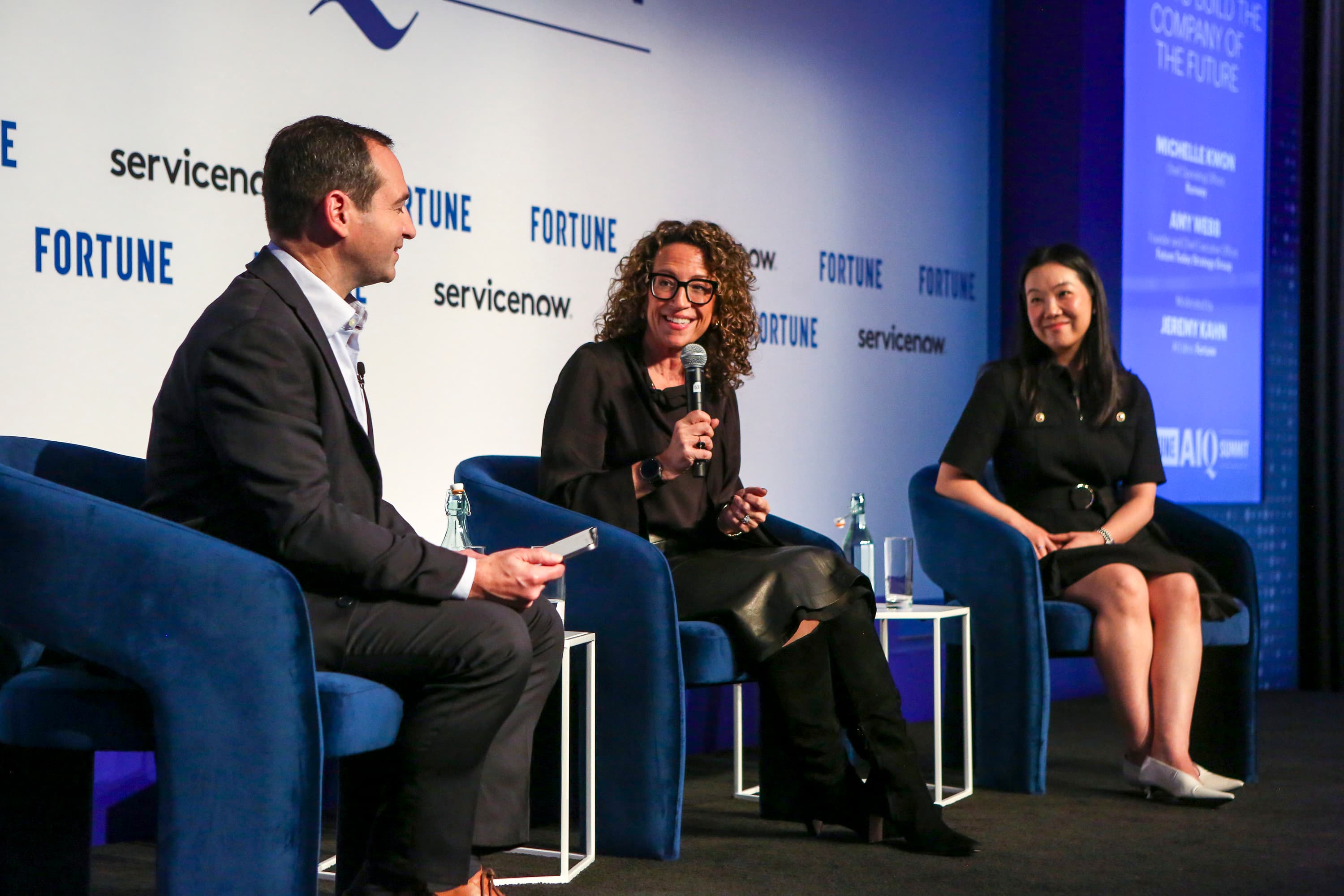
The AIQ Summit at the New York Stock Exchange marked a turning point in AI adoption, shifting the conversation from experimentation to execution. Leaders from ServiceNow, Palo Alto Networks, Bank of America, and other major companies shared how they are embedding AI into workflows, upskilling workforces, and redesigning processes to drive measurable value—while balancing governance and cost discipline.

Editor, Lazyfounder
30 SEC SUMMARY
- The AIQ Summit at the New York Stock Exchange highlighted the shift from AI experimentation to execution, focusing on workflow redesign, talent development, and governance.
- Leaders from ServiceNow, Palo Alto Networks, Bank of America, and others emphasized that AI adoption alone does not guarantee productivity or business value.
- 57% of AI 'pacesetters' invest in upskilling, compared to just 4% of other organizations.
- AI-driven deflection of employee requests at Standard Chartered reached 77%, showcasing tangible efficiency gains.
- Balancing AI ambition with human development, governance, and cost discipline is critical for measurable impact.
TABLE OF CONTENTS
KEY HIGHLIGHTS
- The AIQ Summit, held at the New York Stock Exchange, focused on moving from AI experimentation to execution, with leaders emphasizing workflow redesign, talent development, and governance.
- ServiceNow’s Enterprise AI Maturity Index shows 57% of 'pacesetters' invest in AI upskilling, compared to 4% of other organizations.
- 68% of pacesetters prioritize AI talent acquisition, versus 10% of other companies.
- AI adoption does not automatically drive productivity; training and process redesign are essential for success.
- At Standard Chartered, AI deflected 77% of employee requests, demonstrating efficiency gains.
Why AI execution demands workflow redesign
According to Fortune, the strongest companies in AI transformation are rethinking how work gets done. The focus is no longer on deploying AI tools but on fundamentally changing workflows to integrate them effectively.
ServiceNow’s Diana David highlighted that AI adoption is less about the technology itself and more about process redesign, talent development, and governance. Organizations that treat AI as a horizontal capability—spanning functions like HR, legal, and technology—are seeing the most significant gains.
At Standard Chartered, AI-driven deflection of employee requests reached 77%, a tangible example of how workflow redesign can drive efficiency. Similarly, Palo Alto Networks reported an 83% reduction in IT tickets after implementing a custom AI agent.
Talent and upskilling as the AI divide
ServiceNow’s Enterprise AI Maturity Index reveals stark differences between AI leaders and laggards. While 57% of 'pacesetters' invest in ongoing AI upskilling, only 4% of other organizations do the same. Similarly, 68% of pacesetters prioritize attracting, hiring, and retaining AI talent, compared to just 10% of their peers.
Danielle Gonzalez of Palo Alto Networks emphasized the need to hire and develop adaptable talent—people who can unlearn outdated processes and embrace new ways of working. This aligns with the broader trend of AI adoption becoming a central management responsibility, not just a technical one.
Governance and cost discipline in AI deployment
Governance is emerging as a critical pillar of AI execution. Bank of America evaluates AI projects across 16 risk pillars, including privacy, bias, workforce impact, and intellectual property. This rigorous approach reflects the growing recognition that AI must be deployed with safeguards to avoid unintended consequences.
Amy Webb of Future Today Strategy Group urged leaders to stop anthropomorphizing AI and instead focus on well-designed systems with clear accountability. In regulated industries, reliability is non-negotiable: while frontier AI models may achieve 85% accuracy, industrial customers demand 99.9999% reliability.
Cost management is equally important. Ecolab reduced token costs by roughly 70% to 80% through optimization, and Booking Holdings achieved a 30% increase in code production while lowering customer-service costs. These examples underscore the need for financial discipline in scaling AI.
AI in physical and regulated environments
AI’s role in physical environments, such as manufacturing and industrial operations, is evolving toward a 'semi-autonomous world,' where AI augments human decision-making rather than replacing it entirely. Suresh Venkatarayalu of Honeywell Technologies noted that industrial customers demand near-perfect reliability, making full autonomy impractical in the near term.
Hari Gopalkrishnan of Bank of America added that AI must be embedded into existing workflows with high standards for accuracy and accountability. This approach ensures that AI systems enhance, rather than disrupt, critical operations.
What this means
Lazyfounder analysis — our interpretation, not reported fact.
For founders and operators, the AIQ Summit underscores that AI is no longer a speculative experiment but a core business discipline. The gap between leaders and laggards isn’t just about technology—it’s about reorganizing work, investing in people, and embedding governance from the start. The data points shared—like Palo Alto Networks’ 83% reduction in IT tickets or Booking Holdings’ 30% increase in code production—prove that AI’s value emerges from how it’s integrated into workflows, not just its deployment.
This shift demands a mindset change: AI success relies on treating it as a horizontal capability, not a vertical tool. For startups, this means prioritizing talent who can adapt quickly, redesigning processes to leverage AI, and building guardrails early. For enterprises, it’s about balancing ambition with discipline—scaling AI without compromising reliability, cost, or trust. The takeaway? AI’s promise isn’t in the models themselves but in the organizational muscle to deploy them responsibly and effectively.
Key takeaways
- AI adoption requires more than technology—workforce transformation, process redesign, and governance are critical to achieving measurable value.
- Investing in AI upskilling and talent acquisition separates leaders from laggards, with pacesetters outpacing others by 14x and 6x, respectively.
- Horizontal deployment of AI across functions like HR and legal can drive efficiency gains, as seen in Standard Chartered’s 77% deflection rate.
- Cost discipline matters: Optimizing AI usage can cut token costs by 70-80%, as demonstrated by Ecolab.
- Regulated industries demand near-perfect reliability, highlighting the need for semi-autonomous AI systems rather than full autonomy.
- Trustworthy data and accountable governance are non-negotiable for scaling AI responsibly and maintaining customer trust.
FAQ
What distinguishes AI 'pacesetters' from other organizations?
Pacesetters invest significantly more in AI upskilling (57% vs. 4%) and talent acquisition (68% vs. 10%), according to ServiceNow’s Enterprise AI Maturity Index. They also prioritize workflow redesign and governance to scale AI responsibly.
How can companies measure the ROI of AI adoption?
Measuring AI ROI requires tracking tangible outcomes like efficiency gains (e.g., Standard Chartered’s 77% deflection rate for employee requests), cost reductions (e.g., Ecolab’s 70-80% cut in token costs), and productivity improvements (e.g., Booking Holdings’ 30% increase in code production). Process redesign and training are critical to achieving these results.
Why is governance important for AI adoption?
Governance ensures that AI is deployed responsibly, with safeguards for privacy, bias, workforce impact, and intellectual property. Companies like Bank of America evaluate AI projects across 16 risk pillars to mitigate unintended consequences and maintain trust.
Related on Lazyfounder
Sources
- Fortune · 2026-10-12
Fortune’s AIQ Summit: the conversation has moved from experimentation to execution
This story is an original summary drafted with AI by Lazyfounder from the reporting listed above and checked by automated validation. Facts are attributed to their original publishers; sections marked as analysis are Lazyfounder's. Where a source is in another language, facts were machine-translated and quotations are reported, not reproduced. Read the original coverage via the links, and see our AI policy and corrections policy.

About the author
Editor, Lazyfounder
Tarun Mottlia edits LazyFounders, covering Indian startups, funding rounds, AI and product launches. Every story on the site is AI-assisted and checked against its cited sources before publication.
More stories by Tarun MottliaGet the LazyFounder Brief
Startup, funding and AI news in a five-minute read. Join the early-access list.
