

Super Micro’s $2.5B AI server diversion Scheme triggers multi-country probes
Super Micro Computer stands accused of helping divert $2.5 billion in Nvidia AI servers to China, flouting US export controls. Singaporean authorities launched their probe after US prosecutors charged the company’s co-founder and two associates in March 2026. The case reveals how intermediaries exploit weak oversight to move restricted hardware.

Editor, Lazyfounder
30 SEC SUMMARY
- Singaporean authorities are investigating Super Micro Computer for allegedly rerouting $2.5 billion in Nvidia AI servers to China, violating US export controls.
- US prosecutors charged Super Micro’s co-founder and two associates in March 2026 with smuggling servers through intermediaries in Southeast Asia and Taiwan.
- The scheme involved falsifying shipping documents, repackaging servers, and using a Southeast Asian company to hide the shipments’ final destination in China.
- Singapore’s probe, active since February 2025, has clashed with Super Micro over claims the company cooperated too little.
- The case underscores how intermediaries exploit gaps in export controls to move restricted AI hardware.
TABLE OF CONTENTS
Singapore probes Super Micro over $2.5B server diversion
Singapore’s government dropped a bombshell on November 13. It revealed an investigation into Super Micro Computer, the California-based server manufacturer, for allegedly diverting $2.5 billion in Nvidia AI servers to China. The shipments violated US export controls, which ban high-end AI hardware from reaching Chinese entities.
The case stems from US charges filed in March 2026. Prosecutors accuse Super Micro co-founder Yih-Shyan (Wally) Liaw and two associates of smuggling servers through intermediaries in Southeast Asia and Taiwan. Their tactics aimed to conceal where the hardware ultimately landed.
Super Micro denies stonewalling as probes expand
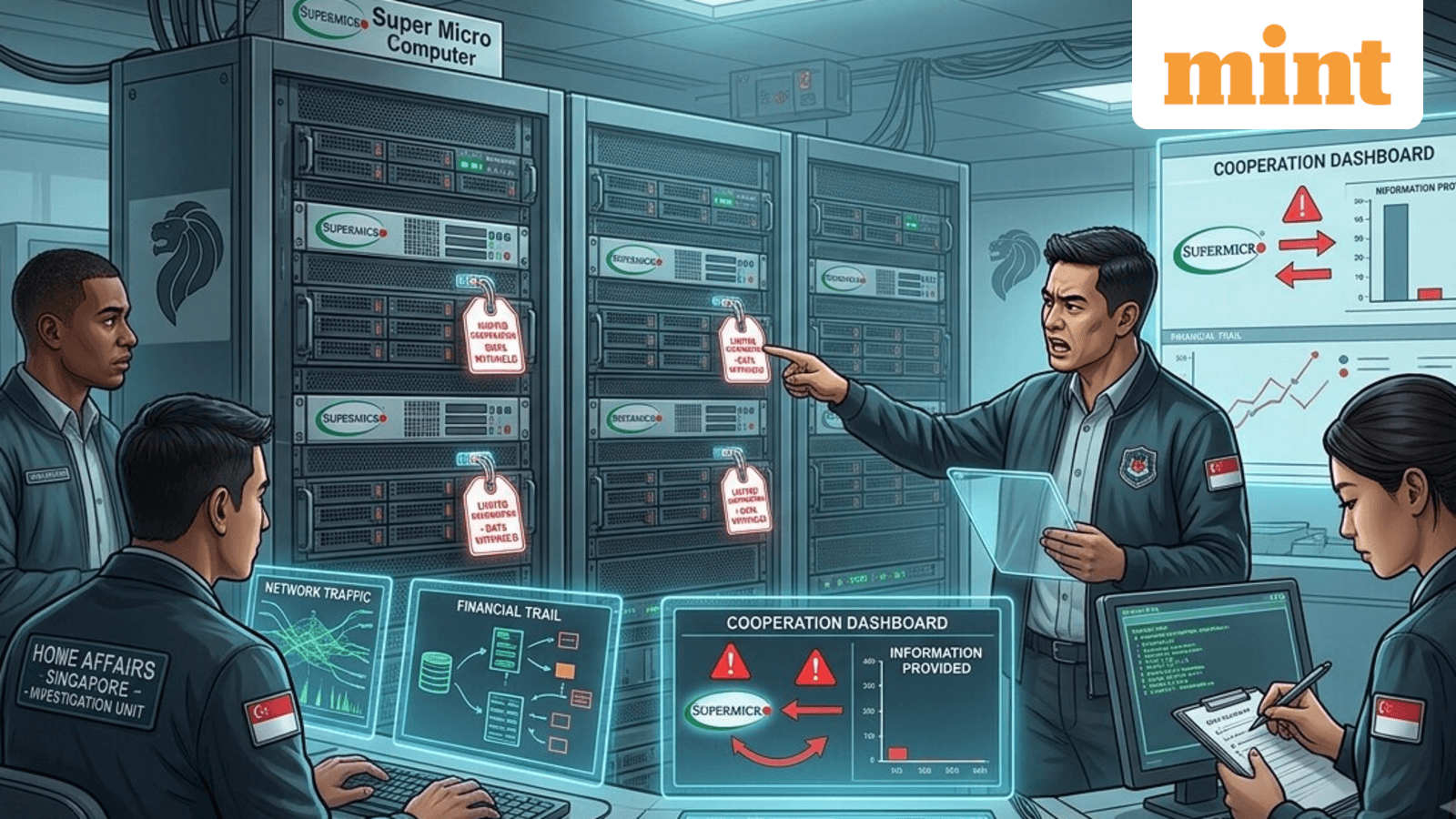
Singapore’s Home Affairs Ministry has been digging into Super Micro since February 2025. This month, it escalated its criticism, accusing the company of providing only "limited cooperation." Super Micro fired back, calling the claim "unfounded." It insisted it had responded to Singapore’s requests and fully cooperated with US and Taiwanese authorities.
The investigation doesn’t stop with Super Micro. Singapore is also examining Megaspeed, a local cloud computing firm, for possible false declarations tied to server purchases. Super Micro distanced itself quickly, stating Megaspeed was never its customer. Meanwhile, Alice Huang, a former Megaspeed executive, faced scrutiny for her suspected role in AI server transactions. Authorities found insufficient evidence to charge her, but the episode left questions unanswered.
Inside the $2.5B scheme to reroute AI servers
US prosecutors describe a brazen operation. Super Micro’s then senior vice-president of business development, Yih-Shyan Liaw, allegedly teamed up with two others to route servers through a Southeast Asian intermediary. The goal: hide their delivery to China.
The scheme unfolded in stages. Servers were assembled in the US, shipped to Super Micro’s Taiwan facilities, then sent to the intermediary. There, workers repackaged the hardware into unmarked boxes. Fake documents hid the true end users, and decoy servers fooled auditors. The operation diverted at least $2.5 billion in hardware to China.
Super Micro placed Liaw and employee Ruei-Tsang ‘Steven’ Chang on administrative leave after the charges. It also cut ties with Ting-Wei ‘Willy’ Sun, the broker accused of facilitating the transactions. None of the three have faced trial.
Why the Super Micro case rattles the AI supply chain
This isn’t just about Super Micro. It’s the latest battle in a wider war over how restricted Nvidia AI chips reach China despite US export controls. Lazyfounder reported in November 2026 that Nvidia CEO Jensen Huang resigned amid allegations involving his personal ties to Alice Huang, the former Megaspeed executive linked to this case. US authorities have also examined whether Megaspeed helped China obtain advanced Nvidia chips.
The Super Micro case zeroes in on the physical diversion of restricted hardware. It exposes how intermediaries in Southeast Asia create vulnerabilities. For AI hardware companies, the warning is stark: compliance failures can spark multi-country investigations, disrupt business, and inflict lasting damage.
How export controls keep failing—and what comes next
This investigation didn’t come out of nowhere. In March 2026, Lazyfounder covered bipartisan US efforts to tighten export controls on AI chips after reports of smuggling. The Super Micro case proves that even as rules tighten, determined players find ways around them—often by exploiting weak spots in logistics or supply chains.
Earlier coverage also connected the dots between Nvidia’s leadership turmoil and rising scrutiny of its compliance practices. The resignations, including Jensen Huang’s exit, coincided with allegations of banned chips reaching China. The Super Micro probe adds another layer. For AI infrastructure providers, the stakes are higher than ever. One misstep can trigger legal headaches and erode trust.
What this means
Lazyfounder analysis — our interpretation, not reported fact.
The Super Micro case shows how restricted AI servers can slip through export controls when companies or intermediaries cut corners. For businesses in the AI supply chain, this means stricter scrutiny of logistics partners and end users—or risk multi-country investigations and serious reputational damage.
Key takeaways
- Gaps in US export controls allowed $2.5 billion in restricted AI servers to reach China, revealing how intermediaries exploit weak oversight.
- Compliance failures now trigger simultaneous probes in multiple countries, disrupting operations and tarnishing brands.
- Companies must audit their supply chains—from manufacturing to delivery—to ensure they aren’t enabling diversion.
- Stricter enforcement may force firms to drop partners in high-risk markets where compliance can’t be guaranteed.
Related on Lazyfounder
Sources
- Mint (Technology) · 2026-11-16
What to know about Super Micro Computer as Singapore probes alleged diversion of Nvidia AI servers to China
This story is an original summary drafted with AI by Lazyfounder from the reporting listed above and checked by automated validation. Facts are attributed to their original publishers; sections marked as analysis are Lazyfounder's. Where a source is in another language, facts were machine-translated and quotations are reported, not reproduced. Read the original coverage via the links, and see our AI policy and corrections policy.

About the author
Editor, Lazyfounder
Tarun Mottlia edits LazyFounders, covering Indian startups, funding rounds, AI and product launches. Every story on the site is AI-assisted and checked against its cited sources before publication.
More stories by Tarun MottliaGet the LazyFounder Brief
Startup, funding and AI news in a five-minute read. Join the early-access list.
