

SpaceX lands Starship upper stage with Mechazilla arms after booster explodes
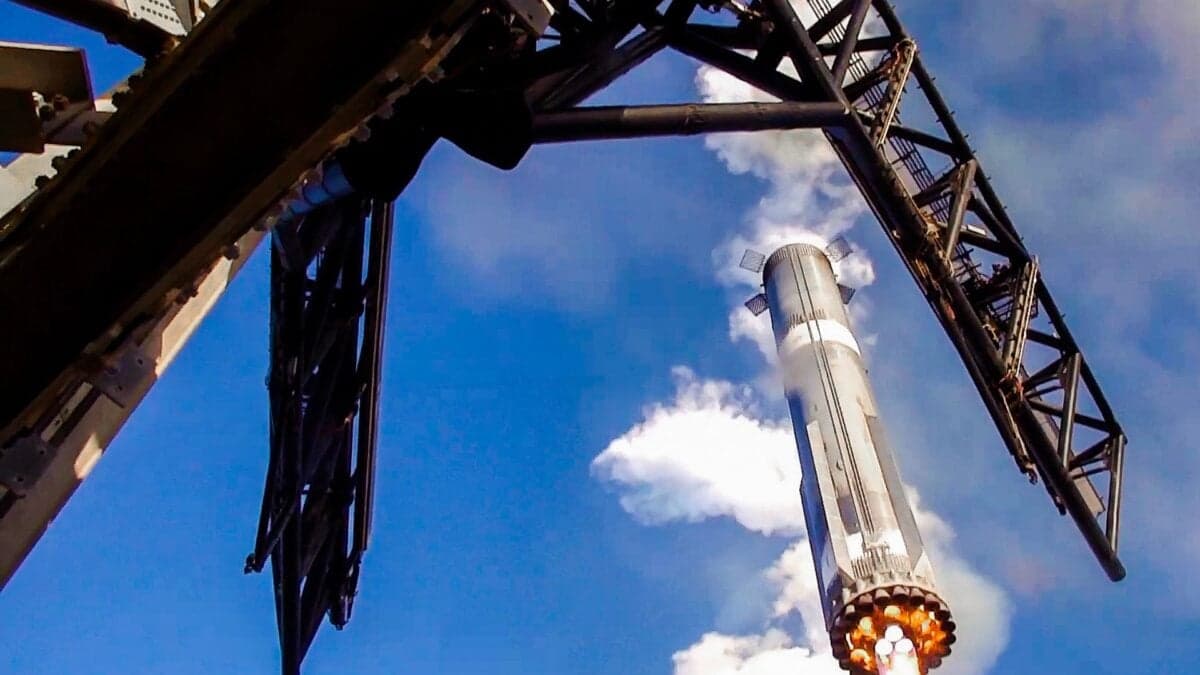
SpaceX pulled off a historic first on November 14, 2026, catching its Starship upper stage midair as it returned from orbit. The Super Heavy booster, however, aborted its landing and exploded over the Gulf of Mexico. Ship 42 completed 14 orbits and deployed 26 Starlink satellites before its successful catch at Starbase, Texas.

Editor, Lazyfounder
30 SEC SUMMARY
- SpaceX achieved its first midair catch of a Starship upper stage using its Mechazilla launch tower’s arms at Starbase, Texas, on November 14, 2026.
- The Super Heavy booster aborted its landing attempt due to a guidance issue and exploded before reaching the Gulf of Mexico.
- Starship’s upper stage, Ship 42, completed 14 orbits around Earth and deployed 26 Starlink V3 satellites during its 22-hour mission.
- This marked the first time an orbital-class spacecraft was recovered midair after a full orbital mission, a milestone for rocket reusability.
- SpaceX had previously caught Super Heavy boosters three times but never attempted a catch of the upper stage before this flight.
TABLE OF CONTENTS
Flight 15: A historic test
SpaceX launched its 15th Starship test flight on November 13, 2026. The goal was ambitious: catch both the Super Heavy booster and the Starship upper stage midair using the Mechazilla towers at its Starbase site in South Texas. This was Starship’s second trip to orbit. The first, in September, ended early when an engine failed.
Booster explodes after guidance failure
The Super Heavy booster, the rocket’s first stage, aborted its return to Starbase minutes after liftoff. A guidance and navigation control issue forced the V3 booster to change course. It exploded just before splashing down in the Gulf of Mexico. SpaceX had successfully caught and reflown older boosters three times before, but this was the first attempt with the larger, more powerful V3 model.
Upper stage completes full orbital mission
The Starship upper stage, Ship 42, performed as planned. It reached orbit, deployed 26 Starlink V3 satellites, and circled Earth 14 times over 22 hours. The stage’s heat shield held up during reentry, a critical test for future missions. Engineers confirmed the spacecraft’s systems were functioning normally before it began its descent toward Starbase.
Mechazilla arms make history with first catch
On November 14, Mechazilla’s mechanical arms caught Ship 42 as it descended over Starbase. The midair recovery marked a first for SpaceX—and for spaceflight. No other orbital-class spacecraft has ever been retrieved this way after completing a full mission. "This is a profound milestone," Elon Musk said. "It proves we can bring the most expensive part of the rocket back intact."
The catch was the culmination of years of testing. SpaceX had already landed and reused Super Heavy boosters three times. But the upper stage’s higher speed and altitude made this attempt far riskier. The success keeps SpaceX on track to achieve its goal: a fully reusable rocket system that flies as often as an airliner.
What the catch means for the future
The booster’s loss underscores the challenges ahead. SpaceX must still refine its guidance systems to ensure consistent recoveries. But the upper-stage catch is a major leap forward. It could cut launch costs dramatically and speed up turnaround times for future missions.
NASA’s Artemis program is counting on Starship to land astronauts on the moon by 2028. Meanwhile, China is racing to put its own crew on the lunar surface before 2030. The pressure is on for SpaceX to deliver a reliable, reusable system—fast.
What this means
Lazyfounder analysis — our interpretation, not reported fact.
Success in catching the upper stage proves SpaceX can retrieve the most valuable part of its rocket—cutting launch costs by potentially millions per flight and accelerating turnaround times for future missions.
Key takeaways
- The catch of Ship 42 demonstrates that SpaceX’s heat shield and reentry systems work as designed, removing a major technical hurdle for rapid reuse.
- Booster losses remain a weak link; SpaceX must address guidance and navigation issues to achieve full, reliable reusability.
- NASA’s Artemis program depends on Starship’s success, adding pressure to refine the system ahead of crewed lunar missions.
- Competitors like China’s space program are advancing quickly, making rapid progress in reusability critical for maintaining SpaceX’s edge.
Related on Lazyfounder
Sources
- Gizmodo · 2026-11-09
SpaceX Picked Friday the 13th to Attempt Its First Double Catch of Starship and Its Booster - Engadget · 2026-11-10
SpaceX's First Attempt To Catch Both Starship Stages Takes Place November 13 - Mashable · 2026-11-13
SpaceX aims to snatch both halves of Starship out of the air: watch it - Gizmodo · 2026-11-13
Watch Live as SpaceX Tries to Catch Both Starship Stages for the First Time - The Next Web · 2026-11-14
SpaceX aborts Starship booster catch, but the ship is still in orbit - Mashable · 2026-11-14
SpaceX Starship landing livestream: Watch the catch attempt live - Mashable · 2026-11-14
SpaceX debris causes West Coast flight delays - Gizmodo · 2026-11-14
Watch SpaceX Try to Salvage Its Attempt to Catch a Starship - Engadget · 2026-11-14
Watch SpaceX Attempt To Catch The Starship Upper Stage For The First Time - Mint (Technology) · 2026-11-15
‘Holy Grail of spaceflight’: SpaceX pulls off first-ever midair 'catch' of Starship returning from orbit
This story is an original summary drafted with AI by Lazyfounder from the reporting listed above and checked by automated validation. Facts are attributed to their original publishers; sections marked as analysis are Lazyfounder's. Where a source is in another language, facts were machine-translated and quotations are reported, not reproduced. Read the original coverage via the links, and see our AI policy and corrections policy.

About the author
Editor, Lazyfounder
Tarun Mottlia edits LazyFounders, covering Indian startups, funding rounds, AI and product launches. Every story on the site is AI-assisted and checked against its cited sources before publication.
More stories by Tarun MottliaGet the LazyFounder Brief
Startup, funding and AI news in a five-minute read. Join the early-access list.
