
NASA CHAPEA Mission 2 crew exits Mars simulation after 378 days
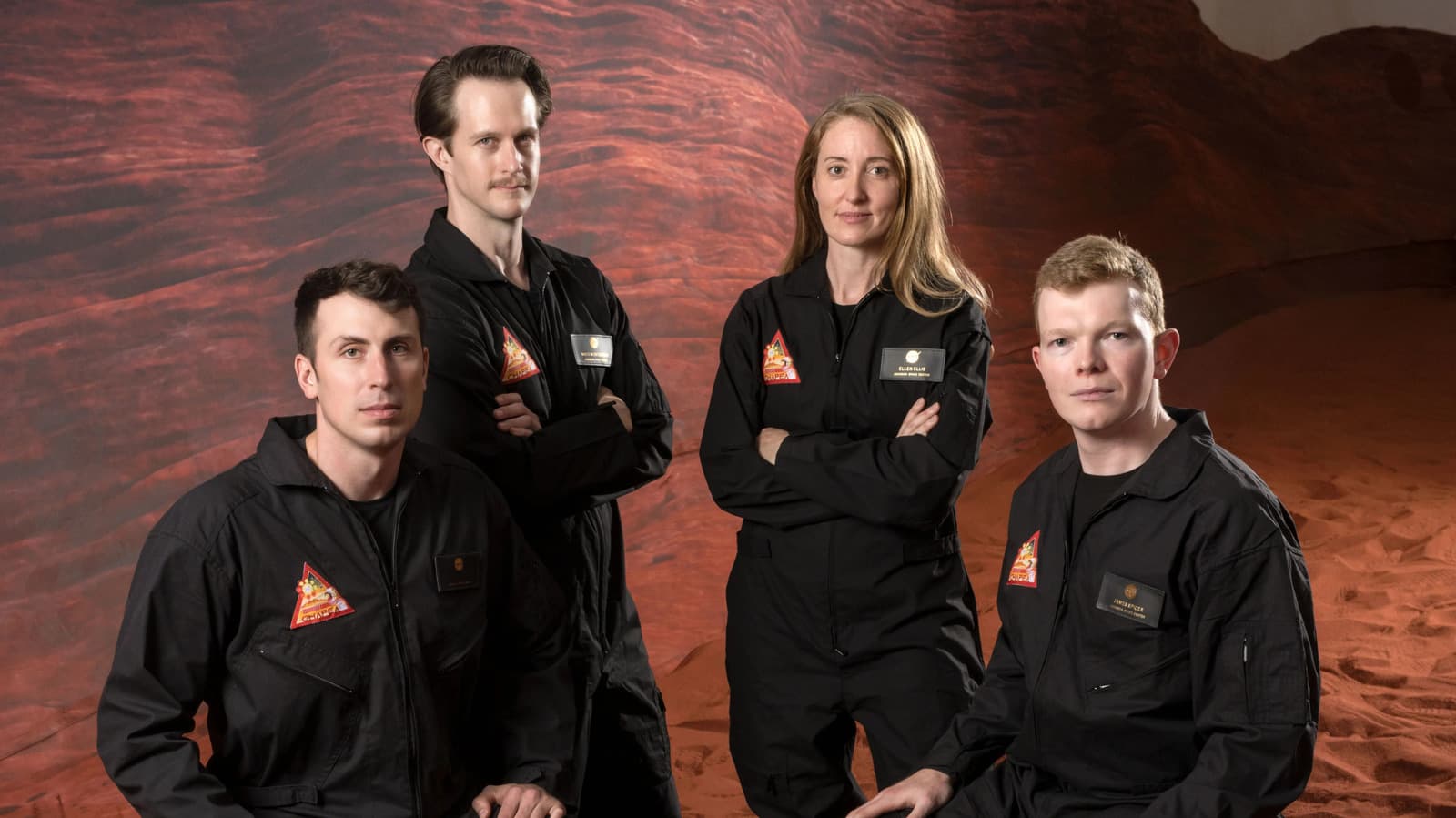
NASA’s second Crew Health and Performance Exploration Analog (CHAPEA) mission has ended after 378 days, with four volunteers exiting the 3D-printed Mars habitat in Houston, Texas. The mission simulated the challenges of a Mars expedition, including isolation, communication delays, and resource limitations, while testing technologies like 3D printing for habitat maintenance.

Editor, Lazyfounder
KEY HIGHLIGHTS
- NASA’s CHAPEA Mission 2 concluded today after 378 days, with four volunteers exiting the mock Mars habitat.
- The crew conducted simulated spacewalks, habitat maintenance, and plant growth under conditions designed to mimic a Mars mission.
- 3D printing played a key role in the habitat’s construction and was tested for tool and replacement part production.
- The mission included stressors like isolation, communication delays, and limited resources to study their effects on crew health and performance.
- NASA livestreamed the crew’s exit at 3PM Eastern time, marking the end of the simulation.
- Applications are open for a combined Moon and Mars Exploration Analog mission, set to begin no earlier than August 2027.
Mission overview and crew experience
Four volunteers—Ross Elder, Matthew Montgomery, Ellen Ellis, and James Spicer—entered NASA’s 3D-printed Mars habitat in Houston, Texas, on October 19, 2025, as part of the CHAPEA Mission 2. The mission lasted 378 days, during which the crew simulated the operations of a Mars expedition, including spacewalks, habitat maintenance, and plant cultivation.
The crew faced conditions designed to replicate the stressors of a real Mars mission, such as isolation, delayed communications, and constrained resources. Exiting the habitat required passing through an airlock, a protocol consistent with procedures for extraterrestrial environments.
NASA livestreamed the crew’s exit today at 3PM Eastern time, providing a public conclusion to the year-long simulation.
3D printing’s role in space and on Earth
The CHAPEA habitat was built using 3D printing, a technology NASA has increasingly adopted for its cost efficiency and flexibility. On the International Space Station, 3D printers are used to produce tools and spare parts on demand, reducing dependence on resupply missions from Earth.
This approach mirrors trends in consumer 3D printing, where entry-level machines like the Creality Ender-3 V3 SE—starting at $170—enable hobbyists and small businesses to create custom parts and accessories. Filament costs approximately $20 per kilogram, making it a practical option for applications ranging from drone components to gardening tools.
For instance, drone enthusiasts use 3D printing to produce camera mounts, antenna guards, and protective arm components, while gardeners create planters and soil tools. Libraries, maker spaces, and platforms like MyMiniFactory provide access to 3D printers and pre-designed models for users without their own equipment.
Next steps for NASA’s analog missions
The first CHAPEA mission began in June 2023, and NASA is already recruiting for a combined Moon and Mars Exploration Analog mission, slated to start no earlier than August 2027. This next phase reflects NASA’s ongoing efforts to prepare for human exploration of the Moon and Mars.
Data from these missions will help NASA refine systems for food production, habitat design, and crew health management during long-duration spaceflight. The findings could also offer insights for commercial applications, particularly for companies developing technologies for remote or extreme environments.
What this means
Lazyfounder analysis — our interpretation, not reported fact.
NASA’s CHAPEA missions demonstrate how simulated extraterrestrial environments can test technologies and strategies with direct relevance to both space exploration and terrestrial industries. The reliance on 3D printing for habitat maintenance and tool production underscores the growing role of additive manufacturing in addressing resource constraints—whether in a Mars habitat or a hobbyist’s workshop. For founders and operators, this mission highlights the value of self-sufficiency and customization, particularly in sectors like consumer electronics, drones, gardening, and home automation, where cost-effective, on-demand solutions are increasingly in demand.
Related on Lazyfounder
Sources
- Engadget · 2026-10-31
NASA's Second Year-Long Mars Simulation Mission Ends Today - Engadget · 2026-11-01
5 Expensive Hobbies Where Owning A 3D Printer Actually Saves You Money
This story is an original summary drafted with AI by Lazyfounder from the reporting listed above and checked by automated validation. Facts are attributed to their original publishers; sections marked as analysis are Lazyfounder's. Where a source is in another language, facts were machine-translated and quotations are reported, not reproduced. Read the original coverage via the links, and see our AI policy and corrections policy.

About the author
Editor, Lazyfounder
Tarun Mottlia edits LazyFounders, covering Indian startups, funding rounds, AI and product launches. Every story on the site is AI-assisted and checked against its cited sources before publication.
More stories by Tarun MottliaGet the LazyFounder Brief
Startup, funding and AI news in a five-minute read. Join the early-access list.
