

Jalandhar’s sports goods industry loses export dominance to Chinese automation
Jalandhar, a mid-sized city in Punjab, was once the backbone of India’s sports goods exports, supplying products to over 130 countries. That dominance has eroded as Chinese manufacturers, backed by automation and lower costs, have captured much of the market. The shift holds lessons for founders and operators in labour-intensive industries facing global competition.

Editor, Lazyfounder
How Jalandhar became a global manufacturing hub
According to YourStory, Jalandhar’s sports goods industry originated in Sialkot, now in Pakistan, where British colonial influence and demand for cricket and hockey equipment created an early market. After Partition in 1947, skilled workers and entrepreneurs relocated to Jalandhar, rebuilding the industry from the ground up. By the 1980s and 1990s, the city accounted for roughly 90% of India’s sports goods exports, supplying products to over 130 countries.
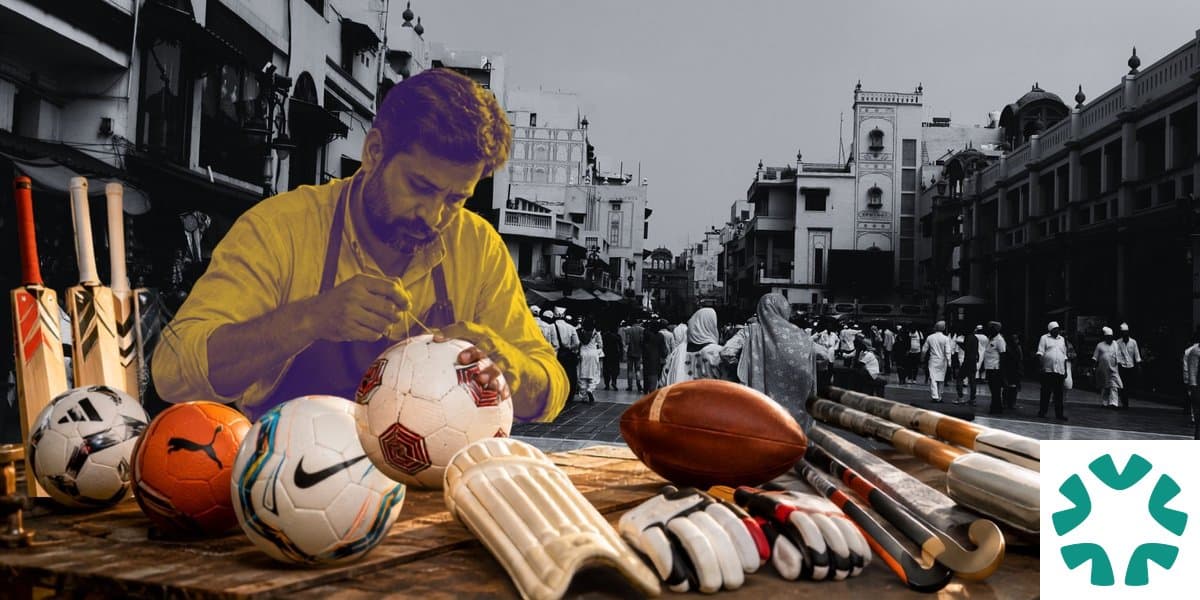
The industry thrived on specialised craftsmanship rather than low-cost assembly. Small and medium enterprises, along with home-based labour, produced hand-stitched footballs, cricket bats made from Kashmir willow, and hockey sticks, with inflatable balls making up about 60% of output. Global brands like Nike, Adidas, Puma, Mitre, and Umbro sourced from the cluster, establishing India as a leading destination for these products.
Why market share declined
YourStory reports that Jalandhar’s share of India’s sports goods exports has fallen to around 35%, while Meerut in Uttar Pradesh now holds approximately 45%, making it the country’s largest cluster. The shift is attributed to competition from Chinese manufacturers, who gained an edge through automation, lower production costs, and advanced technology.
Jalandhar’s traditional, small-scale units, which rely on craftsmanship, struggled to compete at scale. While India’s overall sporting goods exports, including toys and fitness items, reached $400.1 million in FY25, exports of sports equipment alone remain a fraction of China’s global market share.
What kept Jalandhar relevant
Despite the pressure, Jalandhar has retained a foothold in categories that are difficult to automate, such as hand-stitched balls and traditional protective gear. These products continue to be exported to Europe, North America, and other markets, with the UK, US, Germany, France, and Australia as key destinations.
Meerut, meanwhile, has leveraged its historical buyer relationships and adopted technology for quality testing and logistics. Together, the two clusters support over 500,000 livelihoods in India, many of them women working in labour-intensive roles.
What this means
Lazyfounder analysis — our interpretation, not reported fact.
Jalandhar’s trajectory is a clear example of how global manufacturing shifts can reshape local industries within a few decades. For founders and operators, it highlights the risks of relying on labour-intensive production in categories where automation and scale confer a decisive cost advantage. The story also shows that craftsmanship and niche expertise can still command value even after dominant market share is lost—provided the industry adapts to remain relevant in specialised segments. For Indian manufacturers, the lesson is not to abandon traditional strengths but to integrate them with tech-enabled quality and logistics to defend against lower-cost competitors.
Sources
This story is an original summary drafted with AI by Lazyfounder from the reporting listed above and checked by automated validation. Facts are attributed to their original publishers; sections marked as analysis are Lazyfounder's. Where a source is in another language, facts were machine-translated and quotations are reported, not reproduced. Read the original coverage via the links, and see our AI policy and corrections policy.

About the author
Editor, Lazyfounder
Tarun Mottlia edits LazyFounders, covering Indian startups, funding rounds, AI and product launches. Every story on the site is AI-assisted and checked against its cited sources before publication.
More stories by Tarun MottliaGet the LazyFounder Brief
Startup, funding and AI news in a five-minute read. Join the early-access list.
