
UK removes masts but leaves explosives on sunken WWII ship SS Richard Montgomery
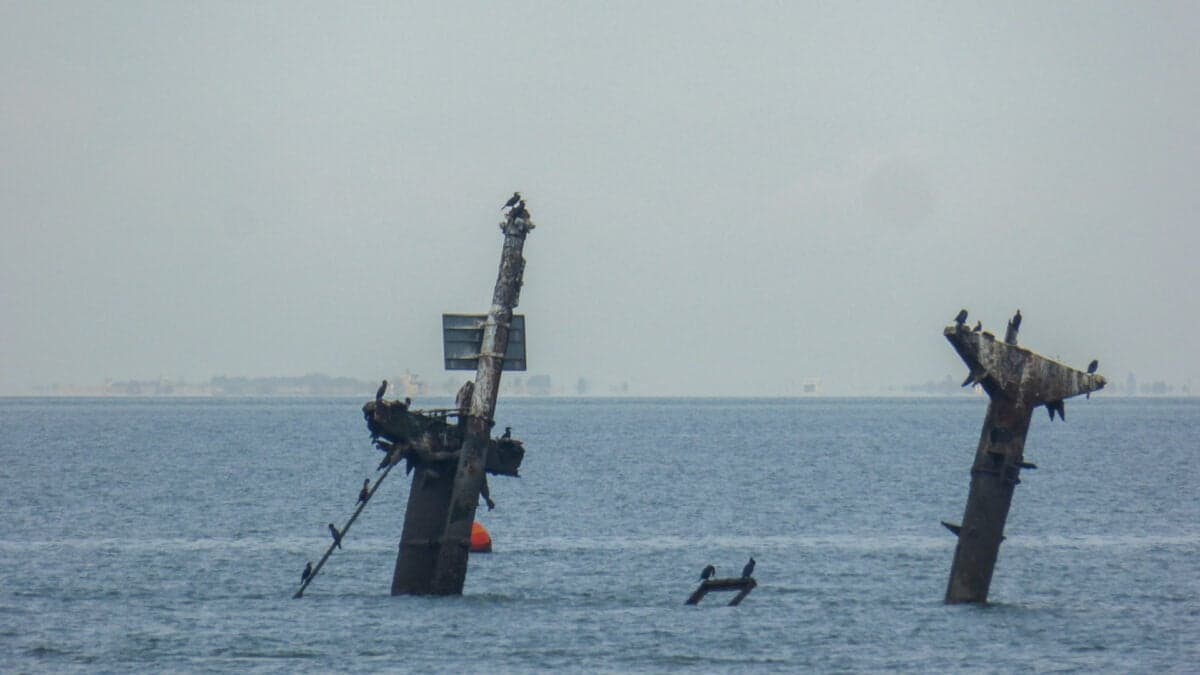
The UK government has removed the masts of the SS Richard Montgomery, a World War II-era shipwreck lying in the Thames Estuary with approximately 1,400 metric tons of explosives. The decision follows warnings that the masts could collapse the deteriorating hull and trigger a detonation. The explosives, however, remain on the seabed, with no further action announced.

Editor, Lazyfounder
30 SEC SUMMARY
- UK removes masts from sunken WWII ship SS Richard Montgomery to prevent collapse.
- Ship sank in 1944 with 1,400 metric tons of explosives; 13,700 devices still onboard.
- Experts warned masts’ weight could cause hull to collapse, risking explosion.
- Explosives remain underwater; no plan announced for their removal.
KEY HIGHLIGHTS
- The SS Richard Montgomery sank in 1944 in the Thames Estuary with 1,400 metric tons of explosives.
- The UK government removed the ship’s masts to reduce strain on its deteriorating structure.
- Approximately 13,700 explosive devices remain onboard, posing a risk of detonation.
- Experts have warned since 1967 that seawater reaching the fuses could trigger an explosion.
- The masts were transported to the Historic Dockyard Chatham in Kent.
Why the masts were removed
The SS Richard Montgomery, a Liberty ship built in 1943, sank in the Thames Estuary in 1944 after running aground on a sandbank. It was carrying roughly 1,400 metric tons of explosives, including bombs and munitions intended for the Allied war effort. The ship has remained submerged since, with its cargo largely intact but increasingly unstable.
In 2020, expert advisors warned that the weight of the ship’s masts was putting additional strain on its deteriorating hull. There were concerns that the masts could collapse onto the cargo, potentially triggering a detonation. According to Michael Fellows, a former Royal Navy expert in submerged explosives, the fear was that such a collapse could cause the explosives to ignite.
The UK government conducted the removal operation to mitigate this immediate risk. The masts were transported to the Historic Dockyard Chatham, a maritime museum in Kent, where they will be preserved.
Risks posed by the remaining explosives
While the masts have been removed, the explosives—approximately 13,700 devices—remain onboard the wreck. The bombs are encased in watertight casings, but the fuses are not, raising concerns that seawater could eventually reach them and trigger an explosion.
Experts, including David Alexander from University College London, have warned for decades about the risks. A 2020 report highlighted that seawater reaching the fuses could set off a chain reaction, leading to a catastrophic detonation. The UK government has acknowledged the risk since at least 1967 but has not announced a plan to remove the explosives.
Nolan Conway, an architect at Resolve Marine Group, emphasized the need for a thorough survey by specialists to assess the wreck’s condition. Earlier proposals, such as burying the wreck in sand or concrete or removing the cargo in fragments, have not been acted upon.
Potential consequences of an explosion
The potential detonation of the SS Richard Montgomery’s cargo has long been a subject of concern. A worst-case scenario, as described in expert analyses, could result in a blast powerful enough to shatter windows in the nearby town of Sheerness and send a column of water, mud, metal, and munitions nearly two miles into the air. The explosion could also cause significant environmental and economic disruption in the Thames Estuary.
Despite these risks, the UK government has not outlined further steps to neutralize the threat. Authorities have stated they will continue monitoring the wreck, but no timeline or strategy for addressing the explosives has been disclosed.
What this means
Lazyfounder analysis — our interpretation, not reported fact.
For founders and operators, this story underscores the complexities of managing legacy risks—particularly those involving critical infrastructure or hazardous materials. The UK government’s decision to address only the most immediate threat (the masts) while deferring action on the explosives highlights how long-term risks can become political and logistical dilemmas. It also serves as a case study in risk assessment: the trade-off between urgent mitigation and permanent solutions. Startups in sectors like marine salvage, defense, or environmental safety may find this a relevant example of how governments prioritize (or deprioritize) high-stakes problems with no easy answers.
Key takeaways
- The removal of the masts reduces an immediate structural risk but leaves the unresolved threat of 1,400 tons of explosives.
- Governments may prioritize short-term mitigation over long-term solutions for high-risk legacy problems, even when experts warn of catastrophic outcomes.
- The case highlights the challenges of coordinating technical expertise, regulatory frameworks, and political will to address dormant risks.
Related on Lazyfounder
Sources
- Gizmodo · 2026-11-03
UK Finally Removes Masts From Sunken WWII Bomb Ship—and Leaves the Explosives
This story is an original summary drafted with AI by Lazyfounder from the reporting listed above and checked by automated validation. Facts are attributed to their original publishers; sections marked as analysis are Lazyfounder's. Where a source is in another language, facts were machine-translated and quotations are reported, not reproduced. Read the original coverage via the links, and see our AI policy and corrections policy.

About the author
Editor, Lazyfounder
Tarun Mottlia edits LazyFounders, covering Indian startups, funding rounds, AI and product launches. Every story on the site is AI-assisted and checked against its cited sources before publication.
More stories by Tarun MottliaGet the LazyFounder Brief
Startup, funding and AI news in a five-minute read. Join the early-access list.
