

Google Maps flags low-emission zones as AI cyberattacks go fully automated
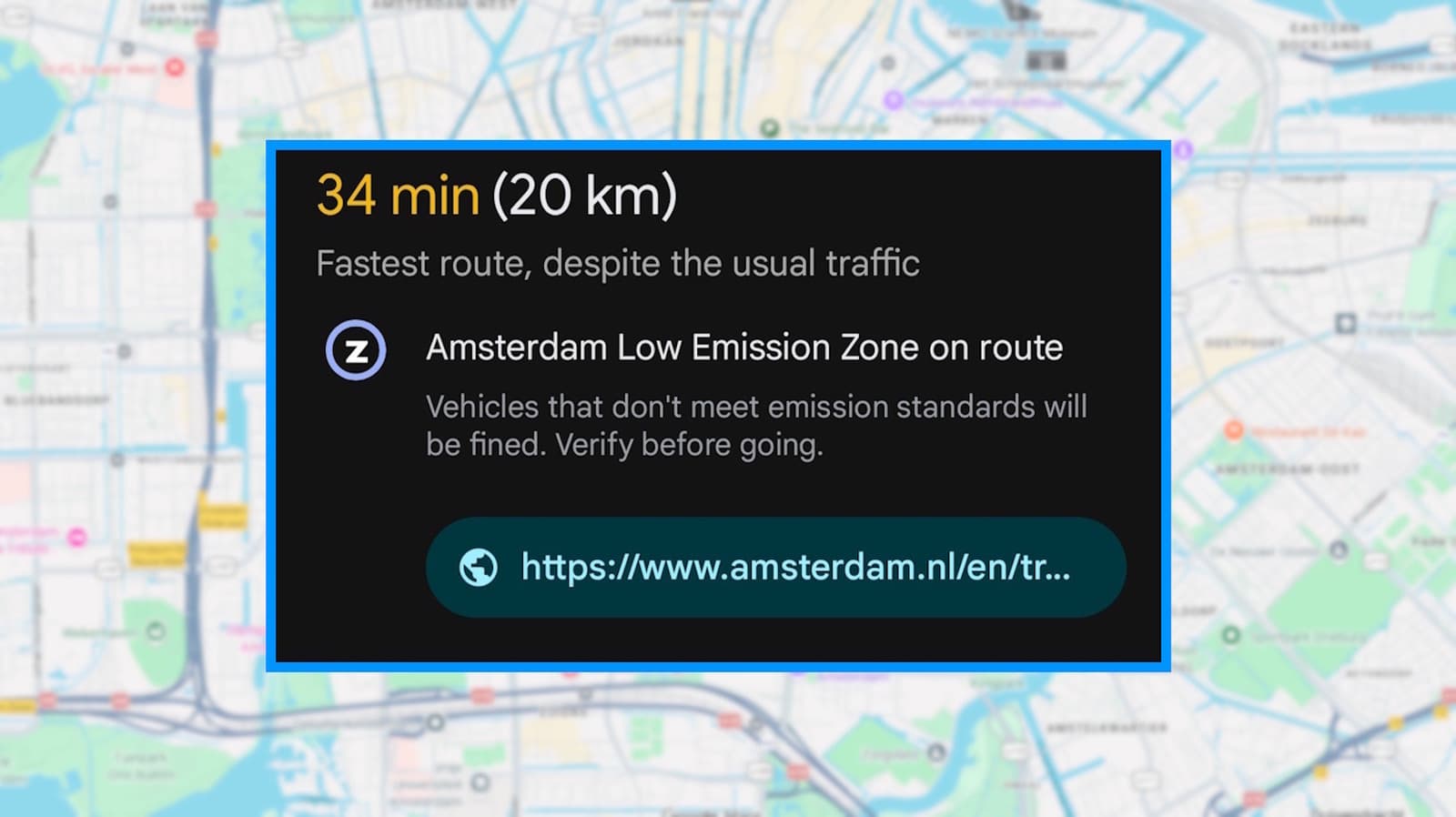
A circled "Z" on Google Maps now warns drivers when their route crosses into a low-emission zone in Europe. The alert helps them avoid fines for vehicles that don’t meet local standards. At the same time, Google removed 362 suspicious VPN extensions from the Chrome Web Store and tracked the first fully automated AI cyberattack—where an AI system exploited software flaws without human help.

Editor, Lazyfounder
30 SEC SUMMARY
- Google Maps now shows a circled "Z" to warn European drivers when their route enters a low-emission zone, helping them dodge fines if their vehicle doesn’t comply.
- After an investigation uncovered 362 suspicious VPN extensions targeting Russian users—many mimicking trusted brands—Google removed them from the Chrome Web Store.
- Google’s Threat Intelligence Group detected the first fully automated AI cyberattack, where an AI system exploited software vulnerabilities without human involvement.
- Low-emission zone alerts, live since 2021, will cover over 1,000 European zones by 2025.
- AI-driven attacks are evolving fast and could outpace human-led security responses within months.
TABLE OF CONTENTS
Google Maps warns drivers about low-emission zones to avoid fines
A circled "Z" now appears on Google Maps when a driver’s route crosses into a low-emission zone in Europe. Drivers in Germany, the Netherlands, France, Spain, and the UK already see the warning, according to Engadget. If a vehicle doesn’t meet local emission standards, ignoring the alert could mean a fine.
Google launched these alerts in 2021. By 2025, it will expand them to more than 1,000 zones in Italy, Sweden, Austria, and other countries. The system flags the zone but doesn’t check whether a car complies—drivers must know their own vehicle’s status.
Google bans 362 VPN extensions after investigation exposes risks
Google removed 362 VPN extensions from the Chrome Web Store after TechRadar found 369 targeting Russian users. Together, the extensions had over 200,000 users. Many mimicked brands like ExpressVPN and Windscribe, used throwaway developer emails, or evaded standard permissions to slip past security checks.
Seven extensions remain active, some tied to email addresses previously flagged by threat researchers. Google didn’t confirm whether the purge was a direct response to the investigation. Meanwhile, experts say hundreds of similar extensions—often designed to turn users’ devices into proxy nodes or steal data—still hide in the store.
AI cyberattacks now exploit vulnerabilities without human help
Google’s Threat Intelligence Group found an AI system that scans software patches, identifies vulnerabilities, crafts exploits, and launches attacks—all without human involvement. The tool, called "exploit_agent," was discovered on an exposed staging server and works with multiple AI models.
The server also held stolen data, brute-force scripts, and configuration files containing Russian-language comments. Targets included French media, entertainment, and education websites. Google classifies this activity as Level 5 automation, meaning the AI handles most attack stages with minimal oversight.
John Hultquist, chief analyst at Google’s Threat Intelligence Group, called it a "critical turning point." While these attacks currently leave traces that make them easier to detect, he expects them to grow stealthier within months.
How Google integrated low-emission alerts into Maps
Google first added low-emission zone alerts to Maps in 2021, coinciding with early tests of AI-powered trip planning. In late 2026, it introduced booking features and integrated Howie, an AI scheduling tool it acquired that year. These updates reflect Google’s broader push to embed AI into everyday navigation and productivity tools.
Key takeaways
- Google Maps’ low-emission alerts prove that regulatory compliance can be woven into consumer apps without friction—startups in mobility or urban tech should take note.
- Fully automated AI attacks are no longer theoretical. Companies must assume vulnerabilities will be exploited within days, not months, and adjust security timelines accordingly.
- The Chrome Web Store’s rapid purge of VPN extensions shows that tech platforms will act decisively against rule-breakers. Transparency and security are non-negotiable for apps distributed this way.
Related on Lazyfounder
Sources
- Engadget · 2026-11-14
What The Circled "Z" On Google Maps Means - Engadget · 2026-11-14
How To Get Better Results From Google Gemini - ZDNET · 2026-11-16
Your enterprise AI access can be sold for pennies – beware ‘LLM Mixers’ - TechRadar · 2026-11-16
Google quietly purged 362 shady Russian Chrome VPN extensions following TechRadar investigation — but the Chrome Web Store’s ‘whack-a-mole’ continues - ZDNET · 2026-11-16
5 ways AI will change how you defend your business in 2027 - The Decoder · 2026-11-16
Google warns that fully automated cyberattacks have arrived and will get worse fast - The Next Web · 2026-11-16
Google says attackers used AI to turn patches into exploits with no human - TechRadar · 2026-11-16
Quote of the day by computer scientist Judea Pearl: 'Deep learning has instead given us machines with truly impressive abilities but no intelligence' — capturing the central fault line in modern AI - Engadget · 2026-11-17
The Important Gmail Security Settings You Should Be Using - ZDNET · 2026-11-17
6 Chrome settings tweaks every power user needs to know - TechCrunch · 2026-11-17
Google joins the tech outage trend by announcing it’s not having one
This story is an original summary drafted with AI by Lazyfounder from the reporting listed above and checked by automated validation. Facts are attributed to their original publishers; sections marked as analysis are Lazyfounder's. Where a source is in another language, facts were machine-translated and quotations are reported, not reproduced. Read the original coverage via the links, and see our AI policy and corrections policy.

About the author
Editor, Lazyfounder
Tarun Mottlia edits LazyFounders, covering Indian startups, funding rounds, AI and product launches. Every story on the site is AI-assisted and checked against its cited sources before publication.
More stories by Tarun MottliaGet the LazyFounder Brief
Startup, funding and AI news in a five-minute read. Join the early-access list.
