
Climate change fuels new type of landslide in Canada’s permafrost regions
A study from the University of Alberta has identified a novel type of landslide, termed "permafrost detachment slides," in Canada’s Northwest Territories. The research links these events to climate change, highlighting risks to Arctic landscapes and waterways as temperatures rise and wildfires intensify.

Editor, Lazyfounder
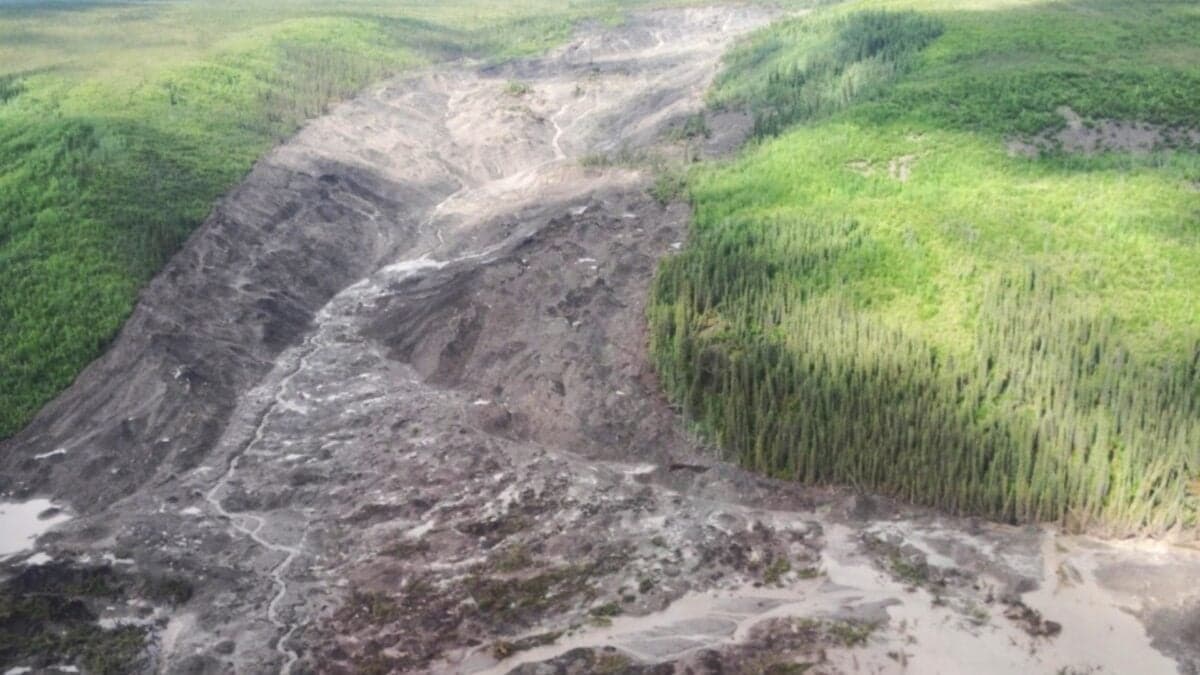
What happened in 2017 and 2018
In 2017, a massive landslide struck the Johnson River Valley in Canada’s Northwest Territories, displacing house-sized chunks of permafrost and carving a 2-mile scar into the landscape. The event was unprecedented for the region, according to researchers.
A year later, a similar slide occurred in the Redstone River Valley, moving approximately 160 million cubic feet of debris. Unlike typical permafrost thaw—where melting creates a muddy slurry—this slide involved entire slabs of frozen ground dislodging and sliding downslope in cohesive blocks.
A new geophysical hazard
Researchers have classified these events as "permafrost detachment slides," a distinct type of landslide. The slides occur in the discontinuous permafrost zone of the central Mackenzie Valley, where permafrost is thin (66 to 131 feet thick) and near its melting point of -1°C.
Between 1980 and 2020, permafrost in the region warmed by about 0.3°C per decade. Wildfires in 1995 further destabilized the ground by creating cracks, allowing water to penetrate deep into the permafrost and melt it from below—a process researchers describe as "bottom-up" thawing.
Why these landslides are increasing
The study, published in Geophysical Research Letters, identifies hundreds of similar landslides in the Mackenzie Valley. These slides are expected to become more frequent as climate change drives higher temperatures and more intense wildfires across Canada and Alaska.
The 2017 and 2018 landslides dammed rivers, forming new lakes. While no infrastructure was damaged, the events signal broader risks to Arctic ecosystems and waterways.
What this means
Lazyfounder analysis — our interpretation, not reported fact.
This research underscores the cascading effects of climate change on Arctic landscapes, where rising temperatures and wildfires are not just thawing permafrost but reshaping it in ways that create new geophysical hazards. For founders and operators in industries like infrastructure, resource extraction, or environmental monitoring, these findings highlight an emerging risk: permafrost detachment slides could disrupt land stability, waterways, and access routes in Arctic regions.
While the immediate impacts of these slides are currently limited to remote areas, their growing frequency may demand new approaches to risk assessment and adaptation. Companies operating in or adjacent to permafrost zones—particularly in Canada and Alaska—may need to account for these hazards in long-term planning, from pipeline construction to remote sensing technologies.
Sources
- Gizmodo · 2026-10-27
Climate Change Is Fueling an Entirely New Type of Landslide
This story is an original summary drafted with AI by Lazyfounder from the reporting listed above and checked by automated validation. Facts are attributed to their original publishers; sections marked as analysis are Lazyfounder's. Where a source is in another language, facts were machine-translated and quotations are reported, not reproduced. Read the original coverage via the links, and see our AI policy and corrections policy.

About the author
Editor, Lazyfounder
Tarun Mottlia edits LazyFounders, covering Indian startups, funding rounds, AI and product launches. Every story on the site is AI-assisted and checked against its cited sources before publication.
More stories by Tarun MottliaGet the LazyFounder Brief
Startup, funding and AI news in a five-minute read. Join the early-access list.
