
Archaeologists uncover 2,600-year-old religious complex beneath Buto using satellite imagery
A team of archaeologists has revealed a buried religious complex beneath the ancient Egyptian city of Buto using satellite radar and geophysical surveys. The structure, estimated to be over 2,600 years old, offers new insights into the city’s historical and religious significance.

Editor, Lazyfounder
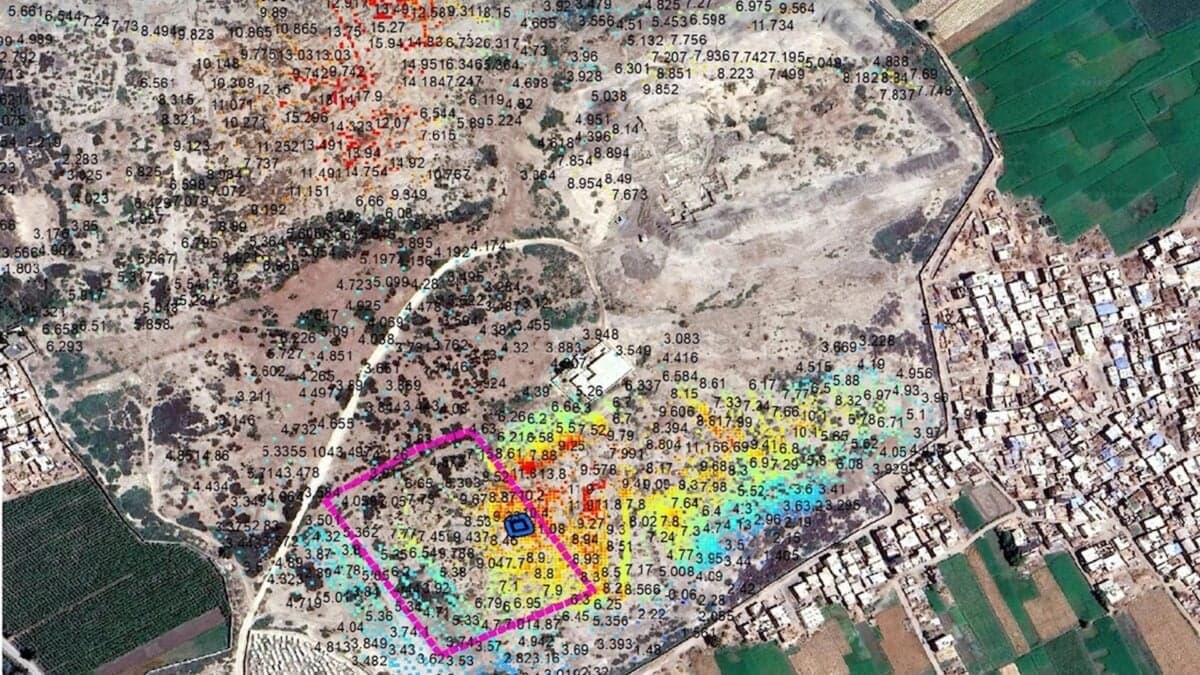
TABLE OF CONTENTS
Satellite and geophysical tools reveal buried structure
Archaeologists have identified the remains of a massive structure beneath the ancient city of Buto in Egypt’s Nile Delta, believed to be a religious complex dating back over 2,600 years. The discovery was made using satellite radar imagery from the European Space Agency’s Sentinel-1 satellite, combined with electrical resistivity tomography, a non-invasive geophysical technique.
The satellite imagery exposed a large, oval-shaped anomaly beneath a mound known as Kom C, measuring approximately 420 feet by 203 feet (128 by 62 meters). Further investigation using electrical resistivity tomography revealed a buried mudbrick wall located 10 to 20 feet (3 to 6 meters) below the surface.
Excavations link complex to religious activity
Excavations at the site uncovered mudbrick walls and artifacts tied to religious practices. Among the findings were amulets depicting Egyptian deities and a small offering basin, supporting the theory that the structure served a religious function.
Researchers suggest the complex may have been a secondary temple, a religious service center, a priestly residence, or a funerary structure. The estimated age of the site places it in either the late eighth century BCE or the Saite period (26th Dynasty).
Buto’s historical significance
Buto, known today as Tell al-Fara’in, was a major religious and political center in ancient Egypt, associated with the worship of Wadjet, the cobra goddess and protector of Lower Egypt and its rulers. The city was largely abandoned after the Old Kingdom and remained unoccupied for roughly 1,500 years before being resettled during the Third Intermediate Period.
The newly discovered structure indicates renewed activity at the site during the Saite period, suggesting that additional significant buildings may still lie beneath later archaeological layers.
How this discovery connects to space technology
This discovery builds on recent demonstrations of space-based tools in archaeology, including the European Space Agency’s involvement in similar projects. Earlier this year, the agency’s Euclid Space Telescope identified a comet during its dark matter mission, showcasing the versatility of satellite technology in both astronomy and historical research.
Another example is the Juice spacecraft, which recently used Earth’s gravity to accelerate its journey to Jupiter while testing its instruments during a flyby. These missions highlight how space agencies leverage advanced technology for diverse scientific goals.
What this means
Lazyfounder analysis — our interpretation, not reported fact.
For founders and operators in tech, geospatial analytics, and remote sensing, this discovery underscores the growing role of non-invasive technologies in fields beyond their traditional applications. Satellite imagery and geophysical surveys are not only reshaping archaeology but also offering scalable tools for industries like agriculture, urban planning, and environmental monitoring. The use of electrical resistivity tomography and radar imagery here demonstrates how legacy techniques can be enhanced with modern data analysis, creating opportunities for startups to explore hybrid approaches in their own domains.
Related on Lazyfounder
Sources
- Gizmodo · 2026-11-03
Satellite Imagery Reveals a 2,600 Year-Old Complex Buried Beneath an Ancient City in Egypt
This story is an original summary drafted with AI by Lazyfounder from the reporting listed above and checked by automated validation. Facts are attributed to their original publishers; sections marked as analysis are Lazyfounder's. Where a source is in another language, facts were machine-translated and quotations are reported, not reproduced. Read the original coverage via the links, and see our AI policy and corrections policy.

About the author
Editor, Lazyfounder
Tarun Mottlia edits LazyFounders, covering Indian startups, funding rounds, AI and product launches. Every story on the site is AI-assisted and checked against its cited sources before publication.
More stories by Tarun MottliaGet the LazyFounder Brief
Startup, funding and AI news in a five-minute read. Join the early-access list.
