
You Have Every Reason to Distrust Googlebooks—And to Be Optimistic, Too
Googlebooks will get more serialized feature updates that could make its nascent OS a truly unique ecosystem.
Curated by Tarun Mottlia
Via Gizmodo
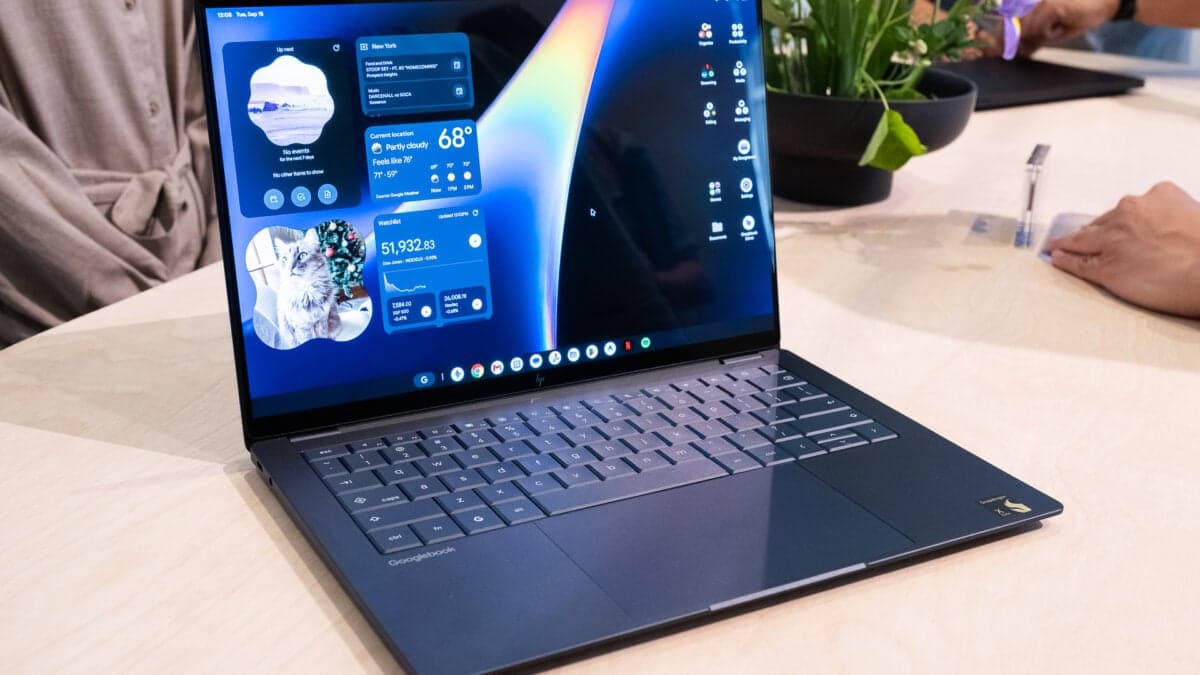
The first Googlebooks will have large, Chromebook-shaped shoes to fill when all five initial laptops launch Oct. 5. However, just know that the new AI-stuffed GooglebookOS may have to take some time before it’s actually good enough to actually become Android users’ own version of macOS.
At Snapdragon Summit, I chatted with Google’s director of product management Michael Wendling about what’s actually going on inside GooglebookOS. Here’s the thing: it’s more Android than it is ChromeOS. Google switched from using the company’s specialized Linux kernel (the core software that lets hardware talk to the OS) used for Chromebooks and switched over to the Android kernel.
In essence, Googlebooks are more Android than they are ChromeOS. © Kyle Barr / Gizmodo
“That kernel had things around it all from phones, but it did not have things around it that you need for desktops,” Wendling says. “Like the launcher, that is entirely new. We mostly borrowed ideas and concepts from ChromeOS but basically rewrote it.”
Google’s new OS was designed to be a companion to an Android phone. It has app casting, simultaneous wireless file sharing, and the promise of big-screen Android apps. There may be hundreds of apps that work with a larger display, but you’ll inevitably find yourself disappointed with some poor compatibility.
You may have noticed that Googlebooks are powered by either a modern Intel Core Ultra Series 3 chip or a near-two-year-old Snapdragon X Elite processor. Qualcomm’s head of PCs and gaming, Kedar Kondap, told me in a small group interview that the reason they didn’t use the more recent and more powerful Snapdragon X2 platform was because “the partnership with Google started a while back; [the original X Elite platform] was much more deeply rooted.”
Even though Google has been working on this new operating system for a while, it may not be a clean and serene experience at launch. In my short time flicking through the OS, I spotted a few issues, including the fact that I couldn’t click to drag on the desktop (at the time, Google told me that it was a bug, not a missing feature). PC users will likely be disappointed by an OS that may not have all the features they’re used to if they were mainstays on Windows 11 or macOS 27.
You’ll recognize a very Android-ish look to much of what’s happening on GooglebookOS. © Adriano Contreras / Gizmodo
There will be major concerns with compatibility as well. Wendling says Google took peripheral support from ChromeOS so mice and keyboards could work on GooglebookOS. Inevitably, there will be devices that fall through the cracks. If you remember the initial ARM on PC launch from 2024 (and the introduction of Copilot+ PCs, RIP), customers who bought the initial shiny and new Snapdragon devices found that many legacy drivers and apps weren’t compatible.
Once Google gets over the hump of an initial launch, the horizon could look bright. Being on the Android kernel means Google can develop for Android and GooglebookOS concurrently with annual releases alongside quarterly updates. And here’s something you probably didn’t expect: Googlebooks will grant access to the Linux terminal, which allows users to run agents like Claude Code or Google’s own Antigravity. However, that terminal exists as a virtual machine—essentially a software-based computer running the separate OS. It exists within a “secure environment,” and it may only be useful for developers, at least at launch.
Moreover, what I wanted to know is how far you could take that Linux machine. An end user can’t get an app like Steam running inside the virtual machine, but Google could work with Valve and the people behind the Windows-to-Linux compatibility layer Proton to get it running on Googlebooks. “It’s certainly something we’re talking about,” Wendling says. What may start as a limited experience could grow into something that’s not just usable but actually unique in the all-too humdrum world of PCs.
Courtesy
This story was originally published by Gizmodo. All rights belong to the original publisher.
Read the original on gizmodo.com ↗