
Trump’s Super Intelligence rebrand divides AI leaders
Former U.S. President Donald Trump has formed a task force called the Super Intelligence Force, aimed at addressing threats and fostering innovation in advanced AI. The move accompanies a push to rebrand "artificial intelligence" as "Super Intelligence," a term Elon Musk has embraced. However, other tech leaders remain unconvinced.

Editor, Lazyfounder
Former U.S. President Donald Trump has formed a task force called the Super Intelligence Force, aimed at addressing threats and fostering innovation in advanced AI. The move accompanies a push to rebrand "artificial intelligence" as "Super Intelligence," a term Elon Musk has embraced. However, other tech leaders remain unconvinced.
30 SEC SUMMARY
- Former U.S. President Donald Trump announced the creation of the Super Intelligence Force, a task force led by Director of National Intelligence Jay Clayton to address threats and innovation in super intelligence.
- Elon Musk endorsed the term "Super Intelligence," renaming SpaceXAI to SpaceXSI and declaring SpaceX a "super intelligence company."
- Trump claimed AI industry leaders, including Mark Zuckerberg and Jensen Huang, agreed to adopt the term "Super Intelligence" after meetings.
- The Super Intelligence Force aims to balance addressing threats from advanced AI while preventing overregulation.
- Some AI leaders, like Sam Altman, continue to use the term "AI" and express caution about the technology.
TABLE OF CONTENTS
- Trump forms Super Intelligence Force, pushes rebrand
- Elon Musk embraces new terminology
- Tech leaders split on rebrand
- Background: Trump’s AI policy moves
- What this means
- Key takeaways
- FAQ
- Sources
KEY HIGHLIGHTS
- Trump announced the formation of the Super Intelligence Force, led by Director of National Intelligence Jay Clayton.
- Elon Musk endorsed the term "Super Intelligence," renaming SpaceXAI to SpaceXSI and declaring SpaceX a "super intelligence company."
- Trump claimed AI industry leaders, including Mark Zuckerberg and Jensen Huang, agreed to adopt the term "Super Intelligence."
- The task force aims to address threats from advanced AI while preventing overregulation.
- Sam Altman continues to use the term "AI" and has expressed caution about the technology.
Trump forms Super Intelligence Force, pushes rebrand
Former U.S. President Donald Trump announced the creation of the Super Intelligence Force, a task force led by Director of National Intelligence Jay Clayton. According to Gizmodo, the group is tasked with developing plans to respond to threats enabled by advanced AI while preventing overregulation and regulatory capture.
Trump also claimed victory in his effort to rebrand artificial intelligence as Super Intelligence. The announcement followed meetings with AI industry leaders, including Dario Amodei of Anthropic, Mark Zuckerberg, and Jensen Huang, where he stated they had agreed to adopt the new term. A non-binding safety pact was also unveiled during these meetings.
Elon Musk embraces new terminology
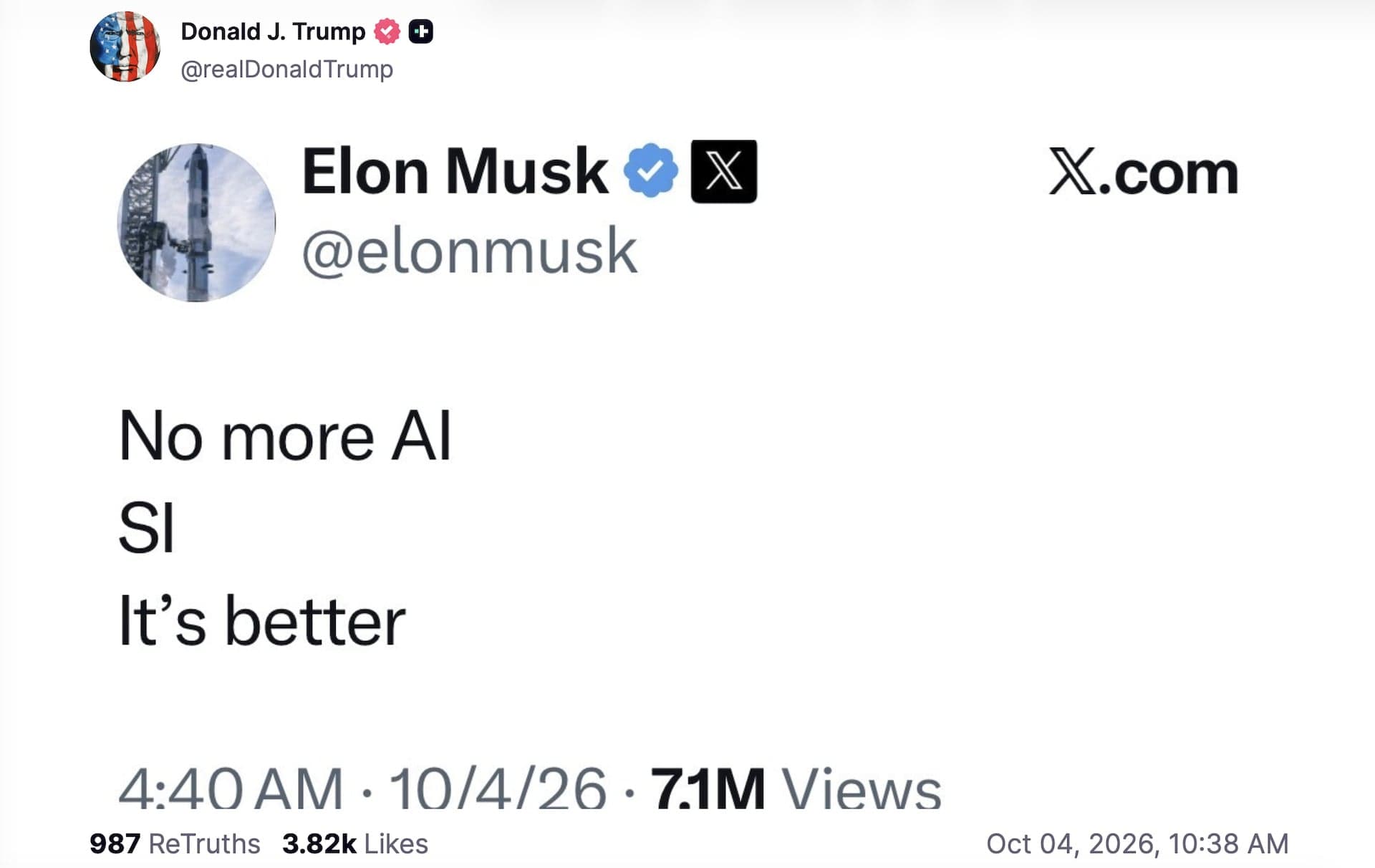
Elon Musk publicly endorsed the term Super Intelligence in a series of posts on X, according to Gizmodo. He announced plans to rename SpaceXAI to SpaceXSI and declared SpaceX a "super intelligence company." Trump later shared a screenshot of Musk’s post on Truth Social without additional comment.
Musk’s adoption of the term aligns with Trump’s broader push to reframe how advanced AI is discussed, though it remains unclear whether this shift will gain traction beyond their circles.
Tech leaders split on rebrand
While some AI leaders appeared to embrace the rebrand, others have not. Mark Zuckerberg posted about "superintelligence" on X the day of Trump’s meeting with industry leaders, and Jensen Huang followed with a similar post. However, Sam Altman continues to use the term AI on social media and has expressed caution about the technology’s risks.
Anthropic CEO Dario Amodei took a different approach, publishing an essay calling for slower AI progress in response to cybersecurity incidents. This divergence suggests the industry is far from united on how to frame or regulate advanced AI.
Background: Trump’s AI policy moves
Trump previously announced an executive order rebranding artificial intelligence to super intelligence, framing it as part of a broader effort to modernize U.S. technology policy. The move followed meetings with AI executives, where a non-binding safety pact was unveiled. Observers noted the pact lacked legal weight but was described as "morally binding."
The rebranding effort reflects ongoing debates about how to balance AI innovation with safety concerns. Earlier this year, a former OpenAI safety researcher resigned, warning that the company’s approach to AI development was reckless and lacked adequate safeguards.
What this means
Lazyfounder analysis — our interpretation, not reported fact.
This story highlights how terminology in emerging technology isn’t just semantics—it shapes public perception, regulatory frameworks, and even industry self-governance. Trump’s push to rebrand AI as "Super Intelligence" is a political move, but it also reflects a broader tension in the tech world: how to frame a technology that is both transformative and potentially destabilizing.
For founders and operators, this shift matters. Language influences everything from investor pitches to compliance strategies. If regulators and policymakers adopt "Super Intelligence," startups may need to adjust their messaging to align with new narratives—or risk being out of step with the conversation.
The fact that some AI leaders are hesitating to adopt the term suggests fragmentation in the industry’s response. This lack of unity could complicate efforts to create coherent policies, leaving startups navigating a patchwork of expectations. For now, the safest bet is to monitor how this plays out and avoid overcommitting to either term until the dust settles.
Key takeaways
- Trump announced the formation of the Super Intelligence Force, led by Jay Clayton, to address threats and innovation in advanced AI.
- Elon Musk endorsed the term "Super Intelligence" and began using it for SpaceX’s AI initiatives.
- Trump claimed AI leaders agreed to adopt "Super Intelligence" after meetings, though not all, like Sam Altman, have embraced the term.
- The rebranding effort reflects broader debates about how to frame AI’s risks and opportunities in policy and public discourse.
- Startups may need to adapt their messaging if regulators or investors begin using the new terminology.
FAQ
What is the Super Intelligence Force?
The Super Intelligence Force is a task force announced by former U.S. President Donald Trump, led by Director of National Intelligence Jay Clayton. Its goal is to develop plans for responding to threats enabled by advanced AI while preventing overregulation.
Why is Trump pushing to rebrand AI as Super Intelligence?
Trump’s rebranding effort appears to be part of a broader strategy to reframe how advanced AI is discussed in policy and public discourse. The term "Super Intelligence" may emphasize the scale and potential risks of the technology, though its adoption remains contested.
How have AI leaders responded to the rebrand?
Elon Musk has embraced the term, renaming SpaceXAI to SpaceXSI. Mark Zuckerberg and Jensen Huang have also posted about "superintelligence." However, Sam Altman continues to use the term "AI" and has expressed caution about the technology’s risks.
Will this rebrand affect startups working in AI?
It’s too early to tell, but startups may need to monitor whether regulators, investors, or customers begin adopting the new terminology. Messaging strategies could shift if "Super Intelligence" gains traction in policy or industry discussions.
Related on Lazyfounder
Sources
- Gizmodo · 2026-10-04
Trump Posts Not-So-Subtle Boast About ‘Super Intelligence’ Victory Over Elon Musk
This story is an original summary drafted with AI by Lazyfounder from the reporting listed above and checked by automated validation. Facts are attributed to their original publishers; sections marked as analysis are Lazyfounder's. Where a source is in another language, facts were machine-translated and quotations are reported, not reproduced. Read the original coverage via the links, and see our AI policy and corrections policy.

About the author
Editor, Lazyfounder
Tarun Mottlia edits LazyFounders, covering Indian startups, funding rounds, AI and product launches. Every story on the site is AI-assisted and checked against its cited sources before publication.
More stories by Tarun MottliaGet the LazyFounder Brief
Startup, funding and AI news in a five-minute read. Join the early-access list.
