
Solar roofs deliver just 4 miles of range for EVs under ideal conditions
Research into solar-powered electric vehicles (EVs) reveals significant limitations, with a 400W solar roof capable of generating enough energy for only about 4 miles of driving under ideal conditions. While ultra-efficient designs like Aptera’s show promise, the technology remains impractical as a primary power source for most passenger EVs.

Editor, Lazyfounder
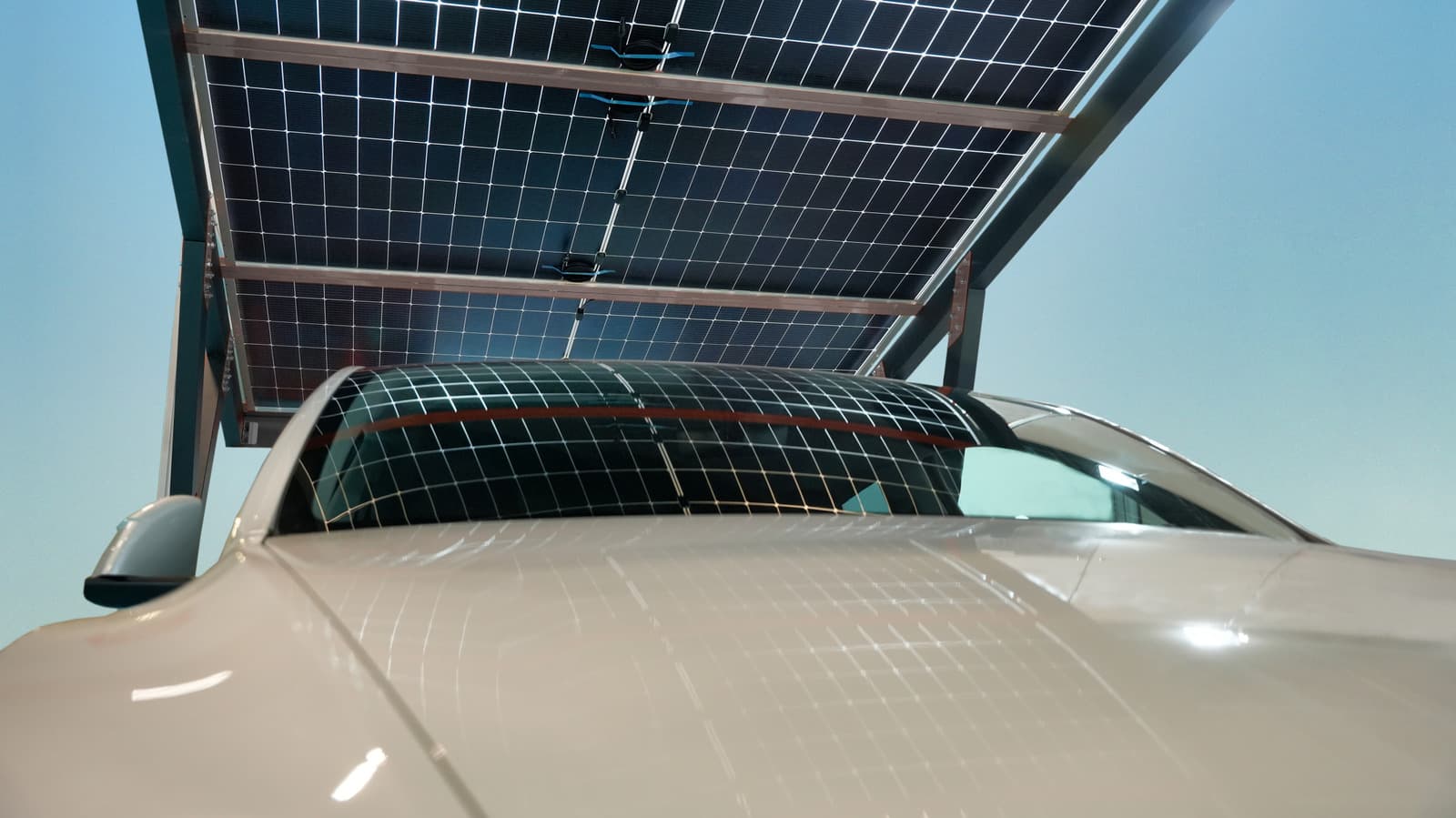
TABLE OF CONTENTS
Why solar roofs struggle to power EVs
Electric vehicles (EVs) with solar roofs face a fundamental limitation: energy density. The median 2025 EV consumes 39kWh per 100 miles, or 390Wh per mile. A 400W solar array on a car’s roof can generate about 1.6kWh in four hours under ideal conditions—enough for roughly 4 miles of driving. This gap between energy demand and solar supply makes it difficult for solar roofs to serve as a primary power source for most passenger vehicles.
How efficiency changes the equation
The viability of solar-powered EVs improves with ultra-efficient designs. Aptera’s solar EV targets 100Wh per mile, less than a third of the median EV’s consumption. During July testing in Southern California, Aptera’s solar panels delivered 4.23kWh to a prototype’s battery, enough for about 42 miles of range. This suggests that solar roofs can contribute meaningfully to range in vehicles designed from the ground up for efficiency, though they remain insufficient for typical daily driving needs.
Innovations and setbacks in the solar EV space
Companies are exploring creative solutions to overcome solar power limitations. Nissan’s Ao-Solar Extender prototype uses retractable panels to increase output from 300W to 500W when expanded, though even this falls short of daily driving requirements. Meanwhile, Lightyear, a solar EV startup, suspended production in January 2023, and its operating company, Atlas Technologies, later entered bankruptcy. These setbacks highlight the technical and financial challenges of scaling solar EV technology.
Where solar roofs make sense today
While solar roofs have limited utility for passenger EVs, they are better suited for applications like RVs, where energy demands are lower and vehicles are often parked for extended periods. Winnebago’s 210W system, for example, is used to power lights, fans, and refrigerators rather than propulsion. Similarly, Squad Mobility, a European micro-mobility startup, integrates solar roofs into small urban vehicles designed for short trips and frequent parking.
What this means
Lazyfounder analysis — our interpretation, not reported fact.
Solar roofs on electric vehicles (EVs) are a compelling idea but face practical limits that founders and operators in the automotive and energy sectors must weigh. The core constraint is physics: a 400W solar roof can only deliver about 4 miles of range under ideal conditions, while the median EV consumes 39kWh per 100 miles. For most passenger vehicles, this makes solar roofs more of a supplementary feature than a primary power source.
However, the story is different for ultra-efficient or niche vehicles. Aptera’s target of 100Wh per mile—less than a third of the median EV’s consumption—shows that solar power can be viable if the entire vehicle is designed around efficiency. This aligns with a broader trend in automotive innovation: marginal gains in aerodynamics, weight, and energy use add up to meaningful improvements. For startups, this underscores the value of systems-level thinking. A solar roof alone won’t solve range anxiety, but paired with lightweight materials, low-drag designs, and smart energy management, it can extend range or reduce reliance on grid charging.
The setbacks faced by Lightyear and the cautious approach of incumbents like Nissan also serve as a reality check. Nissan’s Ao-Solar Extender prototype generates just 500W even with expandable panels—a fraction of what’s needed for daily driving. This suggests that solar roofs are better suited for specific use cases, such as RVs or urban micro-mobility, where energy demands are lower or parking times are longer. Founders exploring solar EVs must ask: Is the solar roof a differentiator, a cost-saving feature, or a distraction from core engineering challenges?
Key takeaways
- Solar roofs on EVs provide limited range—about 4 miles under ideal conditions—making them impractical as a primary power source for most passenger vehicles.
- Ultra-efficient vehicles like Aptera’s, designed for 100Wh per mile, can extract meaningful range from solar roofs, but only if the entire vehicle is optimized for energy efficiency.
- Nissan’s prototype and Lightyear’s bankruptcy highlight the technical and financial hurdles of scaling solar EV technology, suggesting a slower adoption timeline than initially hyped.
- Solar roofs may be better suited for niche applications like RVs or urban micro-mobility, where energy demands are lower or vehicles are parked for longer periods.
Related on Lazyfounder
Sources
- Engadget · 2026-11-01
The Biggest Problem With Trying To Directly Power EVs With Solar Roofs
This story is an original summary drafted with AI by Lazyfounder from the reporting listed above and checked by automated validation. Facts are attributed to their original publishers; sections marked as analysis are Lazyfounder's. Where a source is in another language, facts were machine-translated and quotations are reported, not reproduced. Read the original coverage via the links, and see our AI policy and corrections policy.

About the author
Editor, Lazyfounder
Tarun Mottlia edits LazyFounders, covering Indian startups, funding rounds, AI and product launches. Every story on the site is AI-assisted and checked against its cited sources before publication.
More stories by Tarun MottliaGet the LazyFounder Brief
Startup, funding and AI news in a five-minute read. Join the early-access list.
