
Roman soldier’s death in Netherlands linked to personal violence, not revolt
Archaeologists from Leiden University have revisited the remains of a Roman soldier discovered in 1977, long believed to have been killed during the Frisian revolt in 28 CE. New evidence indicates his death was likely the result of unusually cruel interpersonal violence, rather than a military or political conflict.

Editor, Lazyfounder
Discovery and initial assumptions
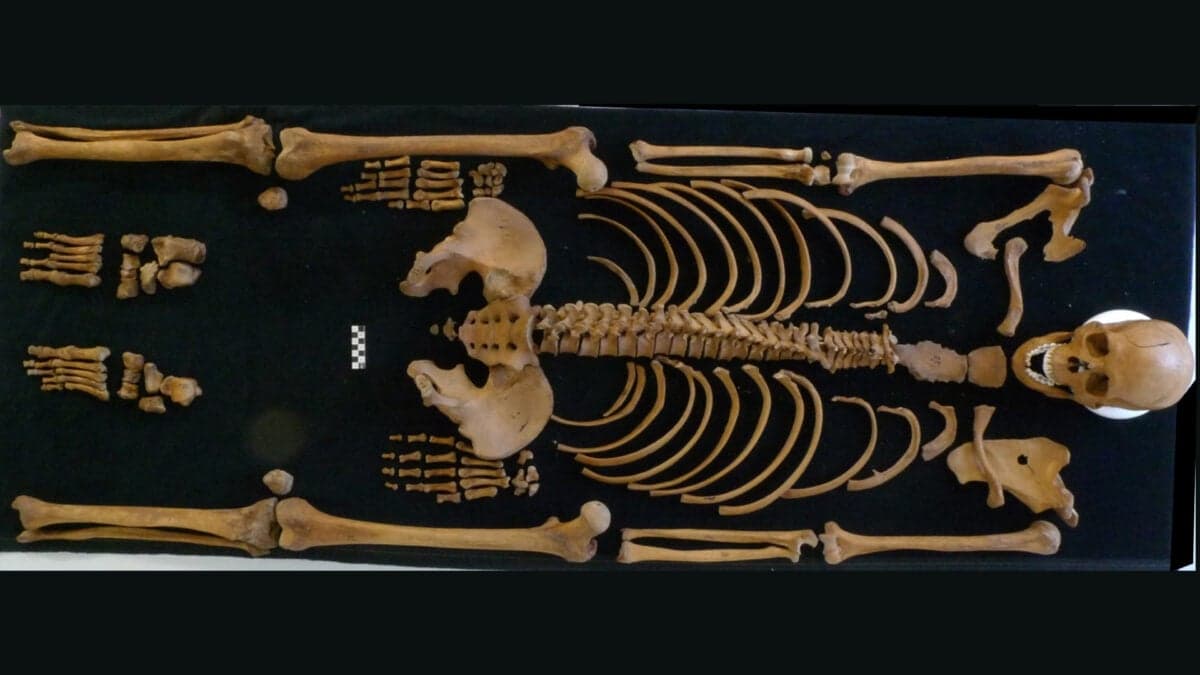
In 1977, the remains of a Roman soldier were unearthed in Velsen, Netherlands, alongside broken weapons, 165 pounds of millstones, and a stick. Initial research linked his death to the Frisian revolt of 28 CE, a violent uprising against Roman tax policies. The soldier’s unusual height—approximately 6 feet 3 inches—led archaeologists in the 1980s to speculate he might have been a member of the Frisii, an ancient local tribe.
Archaeologists Mark Driessen and Carol van Driel-Murray, both from Leiden University, have now reconsidered this theory. Their findings challenge the narrative of death in battle, suggesting instead a more personal and brutal encounter.
Forensic and isotopic evidence
The soldier, estimated to be in his mid-twenties at the time of death, was found wearing Roman off-duty attire, including a patched belt set, dagger, sheath, cloak pin, sandal, and signet ring. Chemical isotope analysis of his remains indicates he likely spent his youth in the Mediterranean region, reinforcing his identity as a Roman soldier rather than a local combatant.
Forensic pathologists who examined the remains noted that the wounds on his bones were atypical for a combat scenario. The nature of the injuries—described as unusually severe—suggested "profound personal anger against the victim." The pathologists, who regularly work with the Dutch national forensics service, stated they had not encountered such stabbing wounds before.
Additional evidence, such as fly pupae found near the body, suggests the soldier’s remains were left exposed during warmer months before being disposed of in a well.
Possible scenarios and unanswered questions
Driessen and Van Driel-Murray have proposed six potential scenarios for the soldier’s death in their edited book, though they do not endorse a single theory. One hypothesis they personally favor is that the soldier was killed by fellow Roman soldiers as retaliation for misconduct. The unusual brutality of the attack and the disposal of his body with damaged weapons and millstones support the idea of a targeted, personal act of violence.
Despite the new evidence, the exact circumstances of his death remain unresolved. The lack of definitive proof means the soldier’s fate continues to be a subject of scholarly debate.
What this means
Lazyfounder analysis — our interpretation, not reported fact.
This re-examination of ancient remains highlights how modern forensic techniques can challenge long-held historical narratives. For researchers and academics, it underscores the importance of revisiting old evidence with new methods, particularly in fields like archaeology and anthropology where interpretations can evolve significantly over time. The findings also serve as a reminder that historical events are often more complex—and more human—than initial accounts suggest.
Related on Lazyfounder
Sources
- Gizmodo · 2026-10-27
Archaeologists Thought This Roman Soldier Was Killed in a Tax Revolt. The Truth May Be Much Worse
This story is an original summary drafted with AI by Lazyfounder from the reporting listed above and checked by automated validation. Facts are attributed to their original publishers; sections marked as analysis are Lazyfounder's. Where a source is in another language, facts were machine-translated and quotations are reported, not reproduced. Read the original coverage via the links, and see our AI policy and corrections policy.

About the author
Editor, Lazyfounder
Tarun Mottlia edits LazyFounders, covering Indian startups, funding rounds, AI and product launches. Every story on the site is AI-assisted and checked against its cited sources before publication.
More stories by Tarun MottliaGet the LazyFounder Brief
Startup, funding and AI news in a five-minute read. Join the early-access list.
