

P3C Technology develops perovskite solar modules for glass and flexible substrates
P3C Technology, a Gurugram-based startup, is developing perovskite solar modules for applications ranging from glass panels to flexible substrates. The company aims to address reliability challenges that have limited the adoption of perovskite as an alternative to silicon in solar energy.

Editor, Lazyfounder
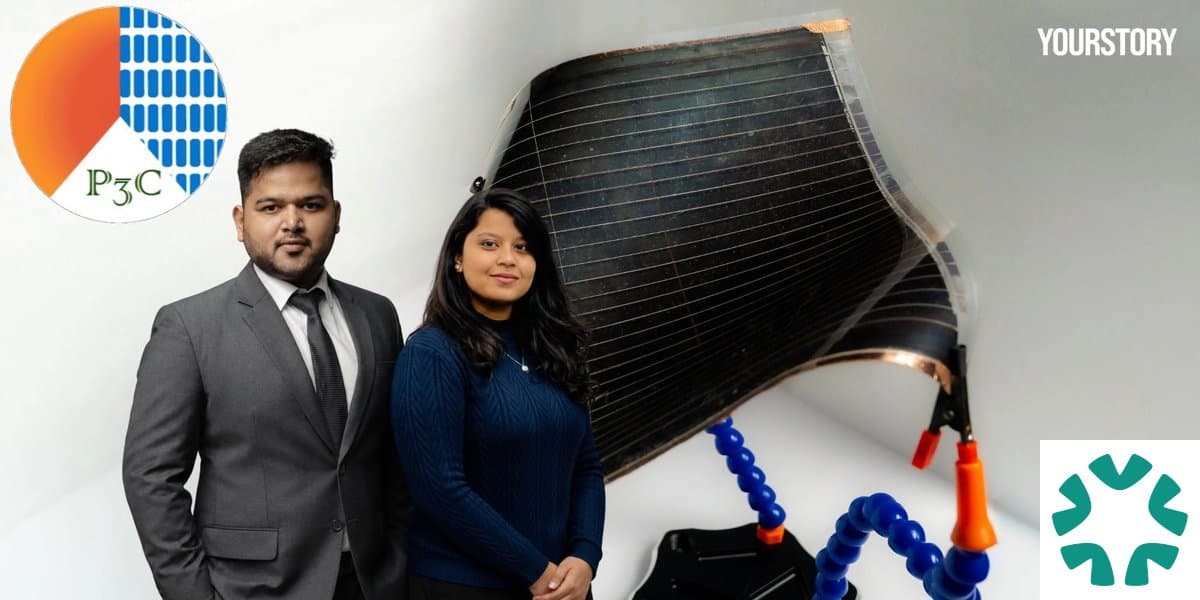
TABLE OF CONTENTS
KEY HIGHLIGHTS
- P3C Technology develops perovskite solar modules for glass and flexible substrates, targeting industries like commercial installations, automobiles, defense, and agriculture.
- The company reports 19.3% cell efficiency certified by India’s National Institute of Solar Energy, with module efficiency around 15%.
- P3C Technology operates a self-developed assembly line with a capacity of 100 kilowatts, aiming to scale to one megawatt and eventually gigawatt-scale production by 2027.
- Launched P3SKY, a platform for manufacturers to validate perovskite modules under real-world conditions before production commitments.
- Funding includes a $250,000 seed round from Oberoi Thermit, with an additional $3 million committed pending successful trials.
Products and efficiency
P3C Technology has developed two perovskite solar products: MySUN Glass, which integrates modules onto glass substrates, and MySUN Flex, which uses flexible materials. The company reports a certified cell efficiency of 19.3% from the National Institute of Solar Energy, an autonomous body under India’s Ministry of New and Renewable Energy. Module efficiency, which is typically lower than cell efficiency, stands at around 15%. Semi-transparent research cells achieve approximately 20% efficiency, according to the company.
Manufacturing and scalability
The company operates a self-developed assembly line with a capacity of 100 kilowatts for small-format modules. It plans to expand this to one megawatt and has publicly targeted gigawatt-scale production by 2027. P3C Technology has sent modules for durability testing at the National Institute of Solar Energy and intends to seek validation from the U.S. National Renewable Energy Laboratory.
P3SKY validation platform
In March 2026, P3C Technology launched P3SKY, a platform designed to let manufacturers test and validate perovskite modules under real-world conditions. The company positions this as a solution to the industry’s lack of reliability data, framing it as a prerequisite for production commitments.
Target markets and partnerships
P3C Technology identifies multiple sectors for its products, including commercial installations, rooftops, automobiles, space, defense, railways, and agriculture. It is also collaborating with an unnamed major silicon manufacturer on perovskite-silicon tandem modules and developing anti-soiling and anti-reflective coatings.
Funding and backing
The startup’s funding began with a grant from FITT, the technology transfer arm of IIT Delhi, where it is incubated. In June 2023, Oberoi Thermit, an industrial machinery company based in Uttar Pradesh, led a $250,000 seed round, with an additional $3 million committed contingent on successful trials. Unlike venture capital, this backing comes from an industrial player, aligning with P3C Technology’s focus on scaling production rather than user acquisition.
What this means
Lazyfounder analysis — our interpretation, not reported fact.
P3C Technology’s work highlights perovskite’s potential as a next-generation solar material, but its emphasis on reliability over efficiency records suggests the technology is still maturing. For founders and operators, this is both an opportunity and a warning: perovskite could redefine solar applications, particularly in sectors like automotive or defense where flexibility and weight matter, but the path to commercial viability remains uncertain. The lack of disclosed customers or revenue underscores the risk for early adopters. Meanwhile, Oberoi Thermit’s investment signals that non-traditional funding sources—such as industrial players—may become more relevant for hardware startups tackling capital-intensive, long-term R&D challenges.
Key takeaways
- Perovskite solar technology is positioned as a potential replacement for silicon, offering higher efficiency and flexibility, but reliability remains a critical challenge.
- P3C’s progress signals growing maturity in perovskite manufacturing, which could accelerate adoption in industries requiring lightweight or flexible solar solutions.
- The lack of published customers or revenue underscores the early-stage risks for founders considering perovskite as a market opportunity.
- Oberoi Thermit’s investment reflects industrial backing, which may appeal to hardware startups seeking non-traditional funding for capital-intensive R&D.
Sources
This story is an original summary drafted with AI by Lazyfounder from the reporting listed above and checked by automated validation. Facts are attributed to their original publishers; sections marked as analysis are Lazyfounder's. Where a source is in another language, facts were machine-translated and quotations are reported, not reproduced. Read the original coverage via the links, and see our AI policy and corrections policy.

About the author
Editor, Lazyfounder
Tarun Mottlia edits LazyFounders, covering Indian startups, funding rounds, AI and product launches. Every story on the site is AI-assisted and checked against its cited sources before publication.
More stories by Tarun MottliaGet the LazyFounder Brief
Startup, funding and AI news in a five-minute read. Join the early-access list.
