
Jensen Huang says U.S. chip bans hurt national security amid spy probe
Nvidia CEO Jensen Huang has a blunt message for Washington: U.S. export bans on AI chips to China are backfiring. The rules, he told BBC News, push Beijing to develop its own technology—and that, he argues, weakens American security. His comments arrive as he faces an investigation into allegations of an affair with a Chinese intelligence operative. Huang met with both Donald Trump and Xi Jinping in September 2025 to make his case. But national security experts call his view dangerous, warning the AI race is zero-sum.

Editor, Lazyfounder
30 SEC SUMMARY
- Jensen Huang, Nvidia’s CEO, is under investigation for an alleged affair with a Chinese intelligence operative.
- Huang told BBC News that U.S. export bans on AI chips to China push Beijing to develop its own technology, weakening American security.
- In September 2025, he met with Donald Trump and Xi Jinping to argue for lifting restrictions on high-performance chips like the H200.
- National security experts reject Huang’s view, calling the AI race a zero-sum battle for military and economic dominance.
- Nvidia’s $4 trillion valuation and $400 billion in annual revenue face new risks as dual investigations unfold.
TABLE OF CONTENTS
Huang argues chip bans hurt U.S. security
Nvidia CEO Jensen Huang told BBC News that U.S. export bans on advanced AI chips to China do more harm than good. The restrictions, he argued, push China to build its own technology and ultimately weaken American security. His comments come as he faces an investigation into allegations of an affair with a Chinese intelligence operative.
During Donald Trump’s state visit to the UK in September 2025, Huang met with the U.S. president and Chinese leader Xi Jinping. He used the opportunity to argue for lifting bans on high-performance chips like the H200, insisting the AI race is not zero-sum. Both countries, he claimed, can advance without one dominating the other.
Jobs-like persona vs. zero-sum security risks
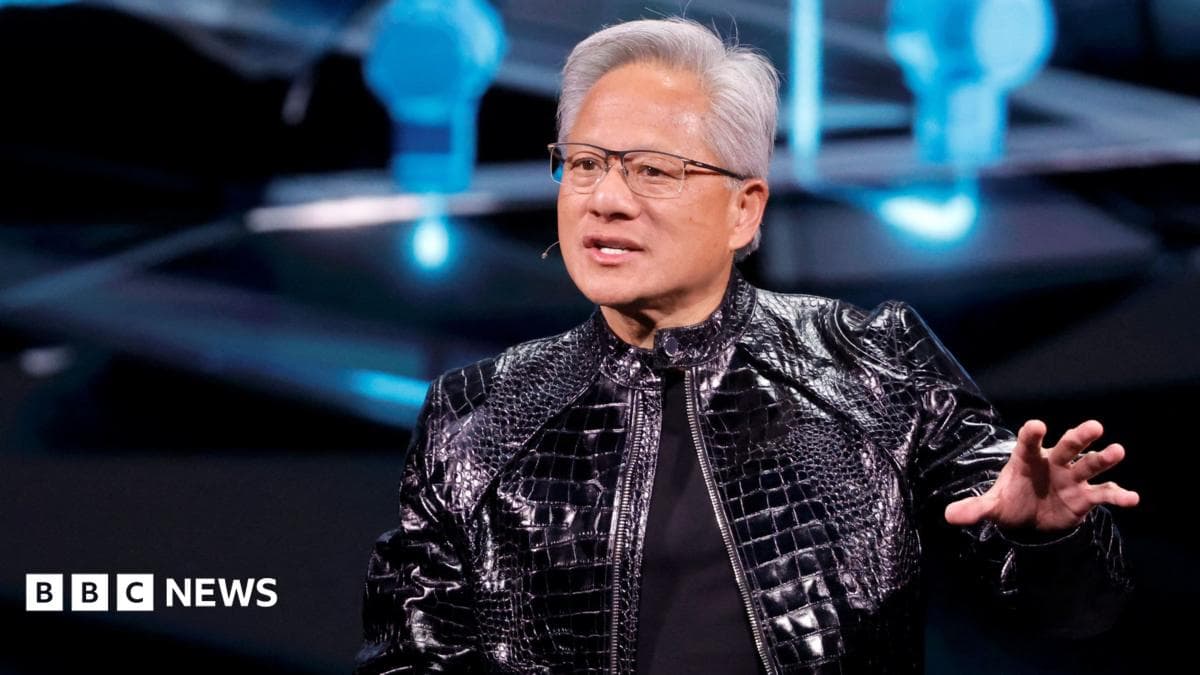
Huang has cultivated a public image reminiscent of Steve Jobs—charismatic, relentless, and rarely seen without his signature black leather jacket. His argument hinges on a provocative claim: global dependence on the "American tech stack," with Nvidia’s chips at its core, actually makes the U.S. safer. If China relies on American technology, he reasons, it has less incentive to weaponize it.
National security experts flatly reject this logic. They see AI leadership as a zero-sum contest, where dominance in encryption, cyber warfare, and economic power is at stake. Huang’s push for interdependence puts him at odds with U.S. policy, which has steadily tightened restrictions on China’s access to advanced semiconductors.
A $4 trillion company caught in a geopolitical storm
Nvidia’s financial muscle remains undeniable—$400 billion in revenue this year and a market value still hovering above $4 trillion, even after a 4% drop following the espionage allegations. The investigation into Huang’s personal conduct follows an earlier probe into whether Nvidia chips were illegally diverted to China. That allegation, denied by Nvidia’s partner Megaspeed International, remains unresolved.
As Washington and Beijing clash over tech supremacy, Nvidia finds itself in the crossfire. Existing export controls already force the company to tailor chips for the Chinese market. U.S. regulators, meanwhile, are weighing even tighter restrictions.
Earlier chip diversion probe still open
In March, Lazyfounder reported that Nvidia’s board launched an independent probe into allegations Huang was linked to a woman suspected of ties to foreign intelligence. That investigation focused on whether advanced AI chips sold to a major customer were diverted to China in violation of U.S. export controls.
The board’s inquiry remains open. Now, new allegations about Huang’s personal conduct have added another layer of legal and reputational risk.
What this means
Lazyfounder analysis — our interpretation, not reported fact.
Nvidia’s legal and reputational exposure could force U.S. regulators to tighten export licenses—even for chips already approved for China. If Huang is sidelined or shipments are curtailed, competitors like AMD and Intel may seize market share, while AI startups face stricter compliance demands.
Key takeaways
- If U.S. regulators link Huang’s conduct or Nvidia’s chip sales to national security risks, export licenses could be revoked or new restrictions imposed.
- Huang’s push to lift chip bans clashes with Washington’s view of AI as a zero-sum race, increasing regulatory scrutiny.
- Nvidia’s $4 trillion valuation and $400 billion revenue stream could face volatility if Huang is forced out or licenses are revoked.
- Competitors may gain ground in China if Nvidia’s shipments slow due to legal or licensing setbacks.
Related on Lazyfounder
Sources
- BBC News (Tech & Business) · 2026-11-10
Faisal Islam: What Jensen Huang told me about China, national security and persuading Trump - BBC News (Tech & Business) · 2026-11-10
Faisal Islam: What Jensen Huang told me about China, national security and persuading Trump
This story is an original summary drafted with AI by Lazyfounder from the reporting listed above and checked by automated validation. Facts are attributed to their original publishers; sections marked as analysis are Lazyfounder's. Where a source is in another language, facts were machine-translated and quotations are reported, not reproduced. Read the original coverage via the links, and see our AI policy and corrections policy.

About the author
Editor, Lazyfounder
Tarun Mottlia edits LazyFounders, covering Indian startups, funding rounds, AI and product launches. Every story on the site is AI-assisted and checked against its cited sources before publication.
More stories by Tarun MottliaGet the LazyFounder Brief
Startup, funding and AI news in a five-minute read. Join the early-access list.
