
New Study Proposes 'Cosmic Lockdown' to Prevent Universe Collapse
A new study explores the theoretical risk of the universe collapsing into a true vacuum—a scenario that could rewrite physics and end reality as we know it. Researchers propose a 'cosmic lockdown' mechanism that may reduce the likelihood of this catastrophic event by leveraging quantum effects to stabilize the universe’s current state.

Editor, Lazyfounder
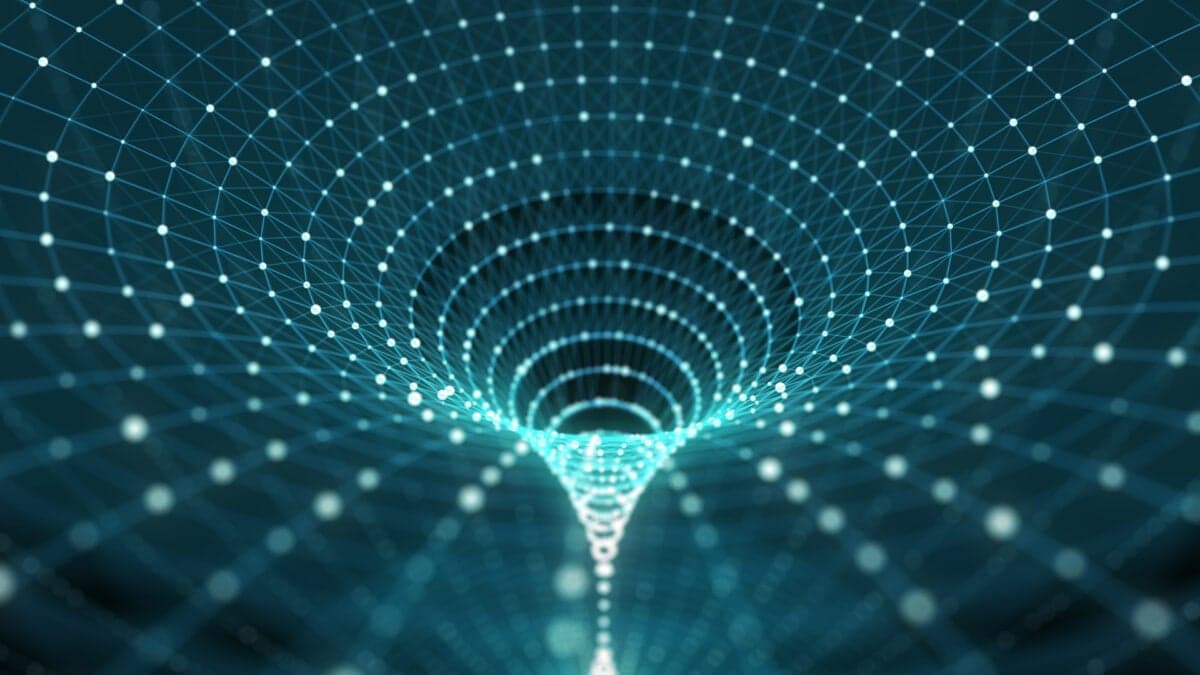
A new study explores the theoretical risk of the universe collapsing into a true vacuum—a scenario that could rewrite physics and end reality as we know it. Researchers propose a 'cosmic lockdown' mechanism that may reduce the likelihood of this catastrophic event by leveraging quantum effects to stabilize the universe’s current state.
30 SEC SUMMARY
- The universe may exist in a false vacuum state, a metastable condition that could collapse into a true vacuum, rewriting physics.
- A new study proposes a 'cosmic lockdown' mechanism that could reduce the risk of false vacuum decay.
- False vacuum decay could create a quantum bubble expanding at light speed, wiping out reality as we know it.
- The Higgs field, which gives particles mass, is central to this theoretical scenario.
- The study suggests quantum decoherence and the quantum Zeno effect may 'lock' the universe into its current state.
TABLE OF CONTENTS
- Theoretical Risk of False Vacuum Decay
- The 'Cosmic Lockdown' Mechanism
- How False Vacuum Decay Could Unfold
- Limitations and Unanswered Questions
- What this means
- Key takeaways
- FAQ
- Sources
KEY HIGHLIGHTS
- Physicists have theorized that the universe may exist in a false vacuum state, which could transition to a true vacuum and rewrite the laws of physics.
- A study in the Journal of Cosmology and Astroparticle Physics proposes a 'cosmic lockdown' mechanism to reduce the risk of false vacuum decay.
- False vacuum decay could create a quantum bubble expanding at nearly the speed of light, wiping out reality as we know it.
- The Higgs field, which gives particles mass, plays a central role in this theoretical scenario.
- Quantum decoherence and the quantum Zeno effect may 'lock' the universe into its current state, preventing collapse.
Theoretical Risk of False Vacuum Decay
Physicists have long explored the possibility that the universe exists in a metastable state known as a false vacuum. According to a recent study published in the Journal of Cosmology and Astroparticle Physics, this state could theoretically collapse into a true vacuum, a process that would rewrite the laws of physics and eliminate reality as we understand it. The scenario, while purely theoretical, has been a subject of debate in cosmology and quantum mechanics.
The 'Cosmic Lockdown' Mechanism
The new study introduces a concept called 'cosmic lockdown,' which suggests that quantum effects could prevent the universe from transitioning into a true vacuum. Researchers Gregory Kaplanek of Syracuse University and Robson Christie of the University of Portsmouth propose that quantum decoherence—the breakdown of quantum systems after interacting with their environment—and the quantum Zeno effect could 'lock' the universe into its current state, reducing the likelihood of catastrophic false vacuum decay.
How False Vacuum Decay Could Unfold
False vacuum decay, if it were to occur, would begin with the formation of a quantum bubble. This bubble, expanding at nearly the speed of light, would rewrite the fundamental laws of physics in its path. The Higgs field, which gives particles mass, is central to this scenario. A shift in the field’s state could trigger the decay, leading to an irreversible transformation of the universe.
The study notes that while this scenario is alarming, it remains highly speculative. The mechanisms described are based on simplified models that do not account for all factors, such as variations in cosmic expansion or gravitational effects.
Limitations and Unanswered Questions
While the 'cosmic lockdown' theory offers a potential stabilizing mechanism, the study’s authors emphasize that it does not prove the universe’s stability. The model used is a simplified iteration and does not incorporate all relevant cosmic variables, including changes in the universe’s expansion rate or the Higgs field’s influence on gravity.
According to Gizmodo, the researchers acknowledge that their framework does not completely rule out the possibility of false vacuum decay. It merely proposes a mechanism that could mitigate the risk under specific conditions.
What this means
Lazyfounder analysis — our interpretation, not reported fact.
This research underscores how little we still understand about the fundamental stability of the universe. For founders and operators, the study is a reminder of the limits of theoretical models—even in physics, simplified assumptions can lead to vastly different conclusions. While the 'cosmic lockdown' idea is intriguing, it’s not a proof of safety, just a possible mechanism. The takeaway isn’t panic, but perspective: the universe’s rules are still being decoded, and even the most catastrophic theories are works in progress.
Key takeaways
- The universe could theoretically transition from a false vacuum to a true vacuum, ending reality as we know it.
- A new study explores a 'cosmic lockdown' mechanism that might reduce the likelihood of this collapse.
- False vacuum decay would create a quantum bubble expanding at nearly the speed of light, rewriting physics.
- The Higgs field’s role in assigning mass to particles is key to this scenario.
- Quantum decoherence and the quantum Zeno effect may help stabilize the universe’s current state.
- The study’s model is simplified and does not account for all cosmic variables.
FAQ
What is false vacuum decay?
False vacuum decay is a theoretical process where the universe transitions from a metastable state (false vacuum) to a true vacuum. This transition would create a quantum bubble expanding at nearly the speed of light, rewriting the laws of physics and eliminating reality as we know it.
What is the 'cosmic lockdown' mechanism?
The 'cosmic lockdown' mechanism is a theoretical idea suggesting that quantum effects, such as decoherence and the quantum Zeno effect, could 'lock' the universe into its current state, reducing the likelihood of false vacuum decay.
Could false vacuum decay actually happen?
The possibility of false vacuum decay is purely theoretical and remains unproven. The new study does not confirm its likelihood but proposes a mechanism that could prevent it under certain conditions.
What role does the Higgs field play in this scenario?
The Higgs field gives fundamental particles their mass. In the context of false vacuum decay, a shift in the Higgs field’s state could trigger the transition to a true vacuum.
Related on Lazyfounder
Sources
- Gizmodo · 2026-10-06
A Quantum Bubble Could End Reality as We Know It. Here’s Why It (Probably) Won’t
This story is an original summary drafted with AI by Lazyfounder from the reporting listed above and checked by automated validation. Facts are attributed to their original publishers; sections marked as analysis are Lazyfounder's. Where a source is in another language, facts were machine-translated and quotations are reported, not reproduced. Read the original coverage via the links, and see our AI policy and corrections policy.

About the author
Editor, Lazyfounder
Tarun Mottlia edits LazyFounders, covering Indian startups, funding rounds, AI and product launches. Every story on the site is AI-assisted and checked against its cited sources before publication.
More stories by Tarun MottliaGet the LazyFounder Brief
Startup, funding and AI news in a five-minute read. Join the early-access list.