
NetApp and Nvidia rethink AI storage with Novus architecture
NetApp Inc. and Nvidia Corp. are partnering to rethink storage architecture for AI workloads, introducing the Novus architecture. The collaboration aims to address inefficiencies in AI infrastructure, such as underutilized GPUs and the concurrency demands of agentic workloads, by separating data and metadata functions for independent scaling.

Editor, Lazyfounder
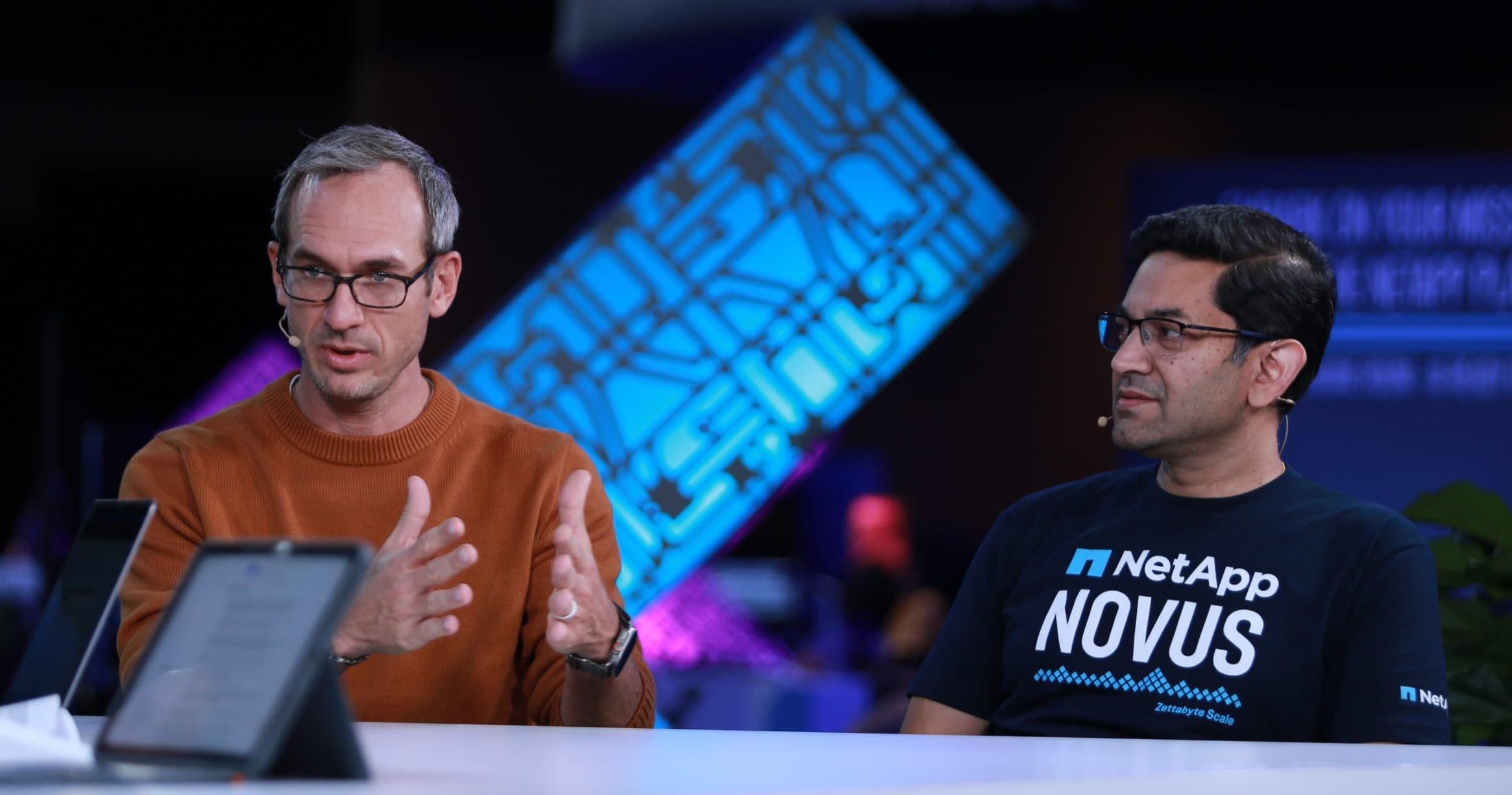
NetApp Inc. and Nvidia Corp. are partnering to rethink storage architecture for AI workloads, introducing the Novus architecture. The collaboration aims to address inefficiencies in AI infrastructure, such as underutilized GPUs and the concurrency demands of agentic workloads, by separating data and metadata functions for independent scaling.
30 SEC SUMMARY
- NetApp and Nvidia are collaboratively redesigning storage architecture for AI workloads with the Novus architecture.
- The Novus architecture separates data and metadata functions to enable independent scaling.
- AI workloads demand simultaneous handling of data and metadata, straining traditional storage systems.
- Storage inefficiencies can lead to underutilized GPUs and higher power consumption.
- Agentic workloads introduce new concurrency and throughput challenges for AI infrastructure.
- API-driven and flexible storage consumption is critical for AI teams.
TABLE OF CONTENTS
- A new approach to AI storage
- Addressing AI workload challenges
- Background: NetApp’s AI-focused evolution
- What this means
- Key takeaways
- FAQ
- Sources
KEY HIGHLIGHTS
- NetApp and Nvidia are collaborating to redesign storage architecture for AI workloads.
- The Novus architecture separates data and metadata functions for independent scaling.
- AI workloads require simultaneous handling of data and metadata, challenging traditional storage systems.
- Storage inefficiencies can lead to underutilized GPUs and higher power costs.
- Agentic workloads introduce new concurrency demands, pushing infrastructure limits.
A new approach to AI storage
NetApp Inc. and Nvidia Corp. are collaborating to redesign storage architecture for AI workloads, introducing the Novus architecture. According to SiliconANGLE, the partnership aims to address inefficiencies in AI infrastructure, particularly the demands of modern AI workloads that combine heavy data movement with transactional metadata activity.
The Novus architecture separates data and metadata functions, allowing each to scale independently based on workload demands. This departure from traditional enterprise storage—designed for predictable workloads—targets the unique challenges posed by AI, where metadata operations can compete with large data transfers for the same resources.
Addressing AI workload challenges
Storage delays in AI workloads can lead to underutilized GPUs, even as they continue consuming power. According to SiliconANGLE, this inefficiency is exacerbated by agentic workloads, where thousands of AI agents may need simultaneous access to data, creating new concurrency and throughput challenges.
The partnership emphasizes the need for AI infrastructure to scale flexibly without requiring redesigns for every new use case. The goal is to provide greater flexibility across fine-tuning, inference, and AI-ready data as production workloads evolve.
For AI teams, the ability to provision and consume storage without deep specialization is critical. The Novus architecture is positioned to enable API-driven storage consumption, simplifying infrastructure management for non-storage experts.
Background: NetApp’s AI-focused evolution
NetApp has been repositioning its data infrastructure offerings for the AI era, as seen in the recent launch of NetApp Novus, a storage architecture designed for AI workloads and large GPU environments. This shift reflects broader industry trends, where AI is reshaping enterprise priorities like data sovereignty and cyber resilience.
Earlier this year, NetApp’s Novus strategy began targeting chief data officers and other non-traditional buyers, signaling a move away from legacy storage models toward solutions tailored for AI-driven use cases.
What this means
Lazyfounder analysis — our interpretation, not reported fact.
This partnership reflects a broader trend: AI is forcing infrastructure providers to rethink foundational systems. Traditional storage architectures were not designed for the concurrency and scale demands of AI workloads, where metadata operations can bottleneck performance just as severely as data transfers.
For startups and enterprises building AI-driven products, this collaboration signals a shift toward more modular and adaptable infrastructure. The ability to scale metadata and data independently—and to consume storage via APIs—could reduce operational friction for teams that lack deep storage expertise. However, the real test will be whether Novus can deliver this flexibility without adding complexity or cost, especially for smaller players competing with cloud giants.
Key takeaways
- NetApp and Nvidia are introducing the Novus architecture to address inefficiencies in AI storage.
- Novus separates data and metadata functions to enable independent scaling for AI workloads.
- AI workloads combine heavy data movement with transactional metadata activity, straining traditional storage systems.
- Storage delays can lead to underutilized GPUs and increased power consumption.
- Agentic workloads introduce new concurrency demands, requiring scalable and flexible infrastructure.
- API-driven storage consumption is becoming essential for AI teams.
FAQ
What is the Novus architecture?
Novus is a storage architecture developed by NetApp in collaboration with Nvidia. It separates data and metadata functions to enable independent scaling, addressing the unique demands of AI workloads.
Why is traditional storage inefficient for AI workloads?
Traditional storage systems were designed for predictable workloads and struggle with the simultaneous demands of heavy data movement and transactional metadata activity in AI applications. This can lead to bottlenecks, underutilized GPUs, and higher power consumption.
How does the NetApp-Nvidia partnership benefit AI teams?
The partnership aims to simplify storage consumption for AI teams by enabling API-driven provisioning and scaling. This reduces the need for deep storage expertise and allows teams to focus on AI development rather than infrastructure management.
Related on Lazyfounder
Sources
- SiliconANGLE · 2026-10-01
NetApp and Nvidia rethink storage for AI factories
This story is an original summary drafted with AI by Lazyfounder from the reporting listed above and checked by automated validation. Facts are attributed to their original publishers; sections marked as analysis are Lazyfounder's. Where a source is in another language, facts were machine-translated and quotations are reported, not reproduced. Read the original coverage via the links, and see our AI policy and corrections policy.

About the author
Editor, Lazyfounder
Tarun Mottlia edits LazyFounders, covering Indian startups, funding rounds, AI and product launches. Every story on the site is AI-assisted and checked against its cited sources before publication.
More stories by Tarun MottliaGet the LazyFounder Brief
Startup, funding and AI news in a five-minute read. Join the early-access list.
