
National Museums Scotland unveils facial reconstruction of man from Roman Scotland
National Museums Scotland has revealed a facial reconstruction of a man who lived in Roman Scotland around 2,000 years ago. The reconstruction, based on skeletal analysis, ancient DNA, and isotopic studies, provides insights into his life, injuries, and burial in a grave containing decapitated individuals. The findings will be displayed in an upcoming exhibition starting November 14.

Editor, Lazyfounder
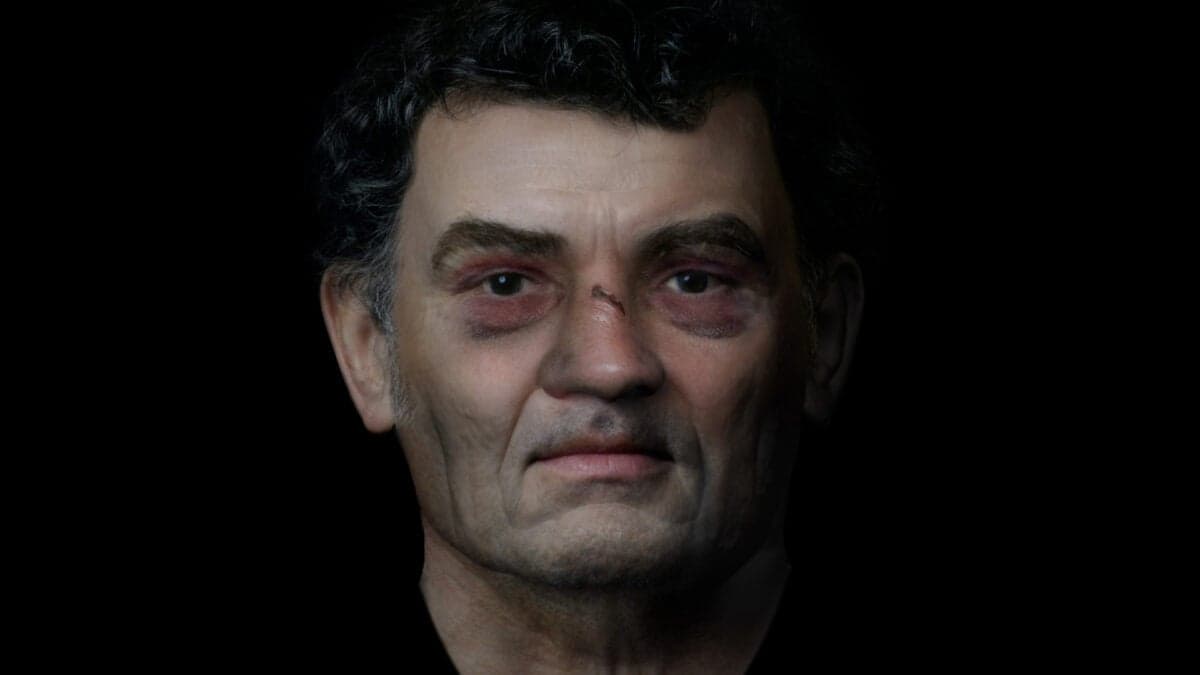
Reconstruction details and life story
Researchers at National Museums Scotland have reconstructed the face of a man who lived in Roman Scotland around 2,000 years ago. The man, estimated to be in his early 50s at the time of his death, was buried in a grave near Inveresk, eastern Scotland, alongside six individuals, four of whom were decapitated post-mortem. His skeleton showed signs of a physically active life, including a healed broken nose and injuries to his right arm that may have resulted from septic arthritis.
The reconstruction was led by osteoarchaeologist Jess Thompson and forensic artist Chris Rynn, using osteoarchaeological assessment, isotopic analyses, and ancient DNA. The man’s injuries, particularly to his right arm, likely limited his ability to perform tasks requiring strength, leading researchers to conclude he was not a soldier at the time of his death. His front teeth also showed pronounced wear, suggesting he may have used them to compensate for reduced mobility in his arm.
Burial rituals and origins
The grave, located near a Roman fort at Inveresk, marks the first known example of such burial rituals in Scotland. Decapitation was found in about 2-3% of Roman burials in Britain, though its purpose remains debated. Researchers suggest it may have been part of a ritual, a form of punishment, or linked to supernatural beliefs.
Isotopic studies indicate the man likely traveled from southern Britain to the Firth of Forth in Scotland. He died between 140 and 165 CE, a period when Roman influence in the region was expanding. Scotland’s acidic soil rarely preserves human remains, making this discovery particularly significant for understanding Roman-era life and customs.
Exhibition plans
National Museums Scotland will display the facial reconstruction and the original skeletons in an exhibition beginning November 14. The display aims to provide visitors with a glimpse into the life and death of individuals from Roman Scotland, highlighting advancements in archaeological and forensic techniques.
What this means
Lazyfounder analysis — our interpretation, not reported fact.
This reconstruction is a rare and valuable case study for archaeologists, forensic scientists, and historians. For researchers, it demonstrates how modern techniques—such as ancient DNA analysis and isotopic studies—can uncover detailed life histories from skeletal remains, even in regions where preservation is rare. The findings also underscore the complexity of Roman burial practices in Britain, particularly the use of decapitation, which remains a subject of debate. For museums and cultural institutions, this work offers a tangible way to engage audiences with history, bridging scientific research and public education.
Related on Lazyfounder
Sources
- Gizmodo · 2026-10-30
A Broken Nose, a Damaged Arm, and a Gruesome Grave. This Man From Roman Scotland Now Has a Face
This story is an original summary drafted with AI by Lazyfounder from the reporting listed above and checked by automated validation. Facts are attributed to their original publishers; sections marked as analysis are Lazyfounder's. Where a source is in another language, facts were machine-translated and quotations are reported, not reproduced. Read the original coverage via the links, and see our AI policy and corrections policy.

About the author
Editor, Lazyfounder
Tarun Mottlia edits LazyFounders, covering Indian startups, funding rounds, AI and product launches. Every story on the site is AI-assisted and checked against its cited sources before publication.
More stories by Tarun MottliaGet the LazyFounder Brief
Startup, funding and AI news in a five-minute read. Join the early-access list.
