
MuRay raises €7.1M to advance muon-based imaging for industrial inspections
Hamburg-based deeptech startup MuRay has raised €7.1 million to develop its Active Muon Imaging technology, which enables high-resolution inspections of dense materials. The funding will support applications in aerospace, defence, energy, and security, with a pilot service slated for 2027.

Editor, Lazyfounder
30 SEC SUMMARY
- Hamburg-based deeptech startup MuRay raises €7.1 million to advance Active Muon Imaging technology for inspecting dense materials.
- Funding includes €3.5 million in private investment led by First Momentum Ventures and Caelora, plus €3.6 million in public grants.
- Technology targets aerospace, defence, energy, and security industries, with first imaging service planned for 2027.
- Muon-based imaging enables faster, lower-radiation inspections compared to conventional X-ray methods.
TABLE OF CONTENTS
KEY HIGHLIGHTS
- MuRay secures €7.1 million in funding, comprising €3.5 million in private investment and €3.6 million in public grants.
- Investors include First Momentum Ventures, Caelora, Superangel, Mätch VC, Arcas VC, Tiny VC, and Nordic Science Investments.
- The company’s Active Muon Imaging technology enables high-resolution 3D imaging of dense materials like metals, ceramics, and composites.
- Applications span aerospace, defence, energy, and security, with potential for on-production-line defect detection.
- MuRay plans its first real-world imaging service in 2027 and a full-scale system by 2029.
Funding breakdown and investors
MuRay’s €7.1 million funding round consists of €3.5 million in private investment and €3.6 million in public grants, including support from the EU’s Horizon Europe programme. The private round was led by venture capital firms First Momentum Ventures and Caelora, a subsidiary of clean-energy startup Marvel Fusion.
Other investors in the round include Superangel, Mätch VC, Arcas VC, Tiny VC, and Nordic Science Investments, reflecting a mix of generalist and deeptech-focused funds.
How the technology works
MuRay’s Active Muon Imaging technology uses controlled muon beams—subatomic particles—to penetrate and create high-resolution 3D images of dense materials such as metals, ceramics, and composites. Unlike X-rays, muon-based imaging can inspect large, thick components in minutes, with significantly lower radiation exposure.
The system detects variations in material composition and density, allowing manufacturers to identify defects directly on production lines. MuRay claims this method could reduce inspection times and safety risks compared to conventional X-ray techniques.
Target industries and timeline
MuRay is targeting industries where quality assurance of dense components is critical, including aerospace, defence, energy, and security. The technology’s ability to detect nuclear materials like uranium in cargo could also have applications in border security.
The company plans its first real-world imaging service in 2027, followed by a full-scale system incorporating a laser-driven accelerator in 2029. Partnerships with the German Space Agency at DLR and DESY are expected to support development.
What the founders say
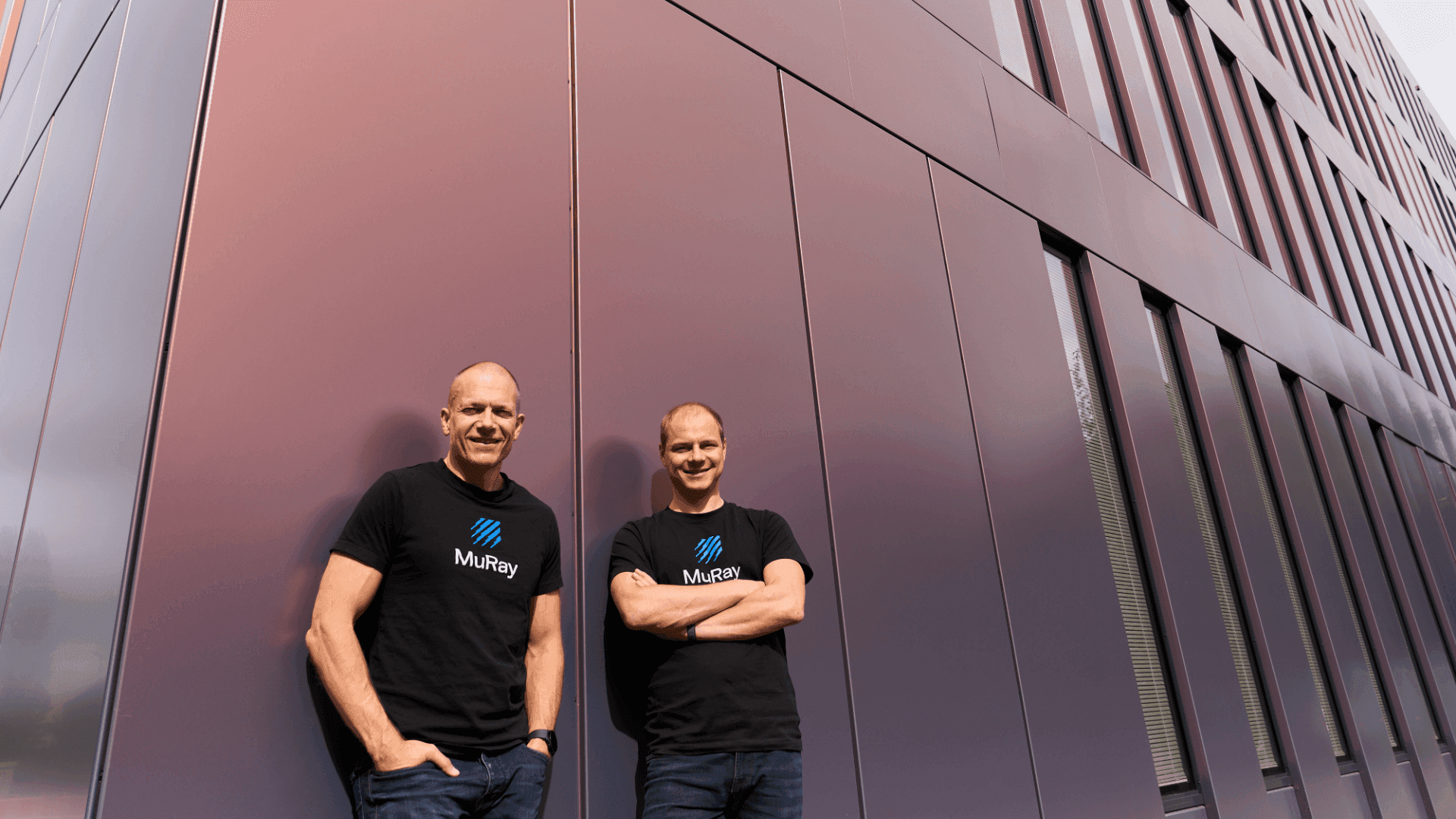
Dr Andi Hektor and Dr Kristjan Põder, MuRay’s co-founders and co-CEOs, emphasize the limitations of current inspection methods. Hektor stated that active muon imaging allows manufacturers to "see inside those large, dense components" where traditional methods fall short.
Põder added that defects invisible to conventional tools often lead to prolonged out-of-service periods for critical parts, highlighting the potential efficiency gains of MuRay’s approach.
What this means
Lazyfounder analysis — our interpretation, not reported fact.
MuRay’s funding and technology signal growing investor confidence in deeptech solutions for industrial quality assurance. For founders and operators in aerospace, defence, and energy, this development highlights an emerging alternative to X-ray-based inspection methods—one that promises faster, safer, and more precise imaging of dense components.
The mix of private investment and public grants also underscores the strategic importance of this technology, particularly in Europe, where regulatory and economic incentives favor non-dilutive funding for high-risk R&D. Startups in adjacent fields—such as advanced manufacturing, materials science, or nuclear security—may find value in tracking MuRay’s progress, especially as it moves toward commercialization in 2027.
For venture capitalists, MuRay’s round reflects a broader trend: early-stage bets on deeptech hardware are gaining traction, even in sectors traditionally dominated by software. The involvement of specialized investors like First Momentum Ventures and Caelora suggests that niche funds are increasingly willing to back complex, capital-intensive technologies with long development horizons.
Key takeaways
- MuRay’s technology could disrupt industrial quality assurance by reducing inspection times and radiation exposure compared to X-ray methods.
- The funding round, split between private and public sources, shows a viable path for capital-intensive deeptech startups in Europe.
- Founders in aerospace, defence, and energy should monitor MuRay’s 2027 pilot, as it may set a benchmark for next-generation inspection tools.
- The round’s investor mix—including sector-specific VCs—highlights opportunities for hardware startups with long-term R&D cycles.
Related on Lazyfounder
Sources
- Tech.eu · 2026-10-29
MuRay raises €7.1M to inspect rocket engines and turbines beyond X-ray limits
This story is an original summary drafted with AI by Lazyfounder from the reporting listed above and checked by automated validation. Facts are attributed to their original publishers; sections marked as analysis are Lazyfounder's. Where a source is in another language, facts were machine-translated and quotations are reported, not reproduced. Read the original coverage via the links, and see our AI policy and corrections policy.

About the author
Editor, Lazyfounder
Tarun Mottlia edits LazyFounders, covering Indian startups, funding rounds, AI and product launches. Every story on the site is AI-assisted and checked against its cited sources before publication.
More stories by Tarun MottliaGet the LazyFounder Brief
Startup, funding and AI news in a five-minute read. Join the early-access list.
