
MIT student launches open-source modular keyboard Keybytes
MIT student Nathan Alspaugh has introduced Keybytes, an open-source modular keyboard system that allows users to build custom layouts using magnetically connected keys. The project, still in its early stages, relies on RISC-V microcontrollers and Cherry MX switches but comes with a high assembly cost and limited functionality for now.

Editor, Lazyfounder
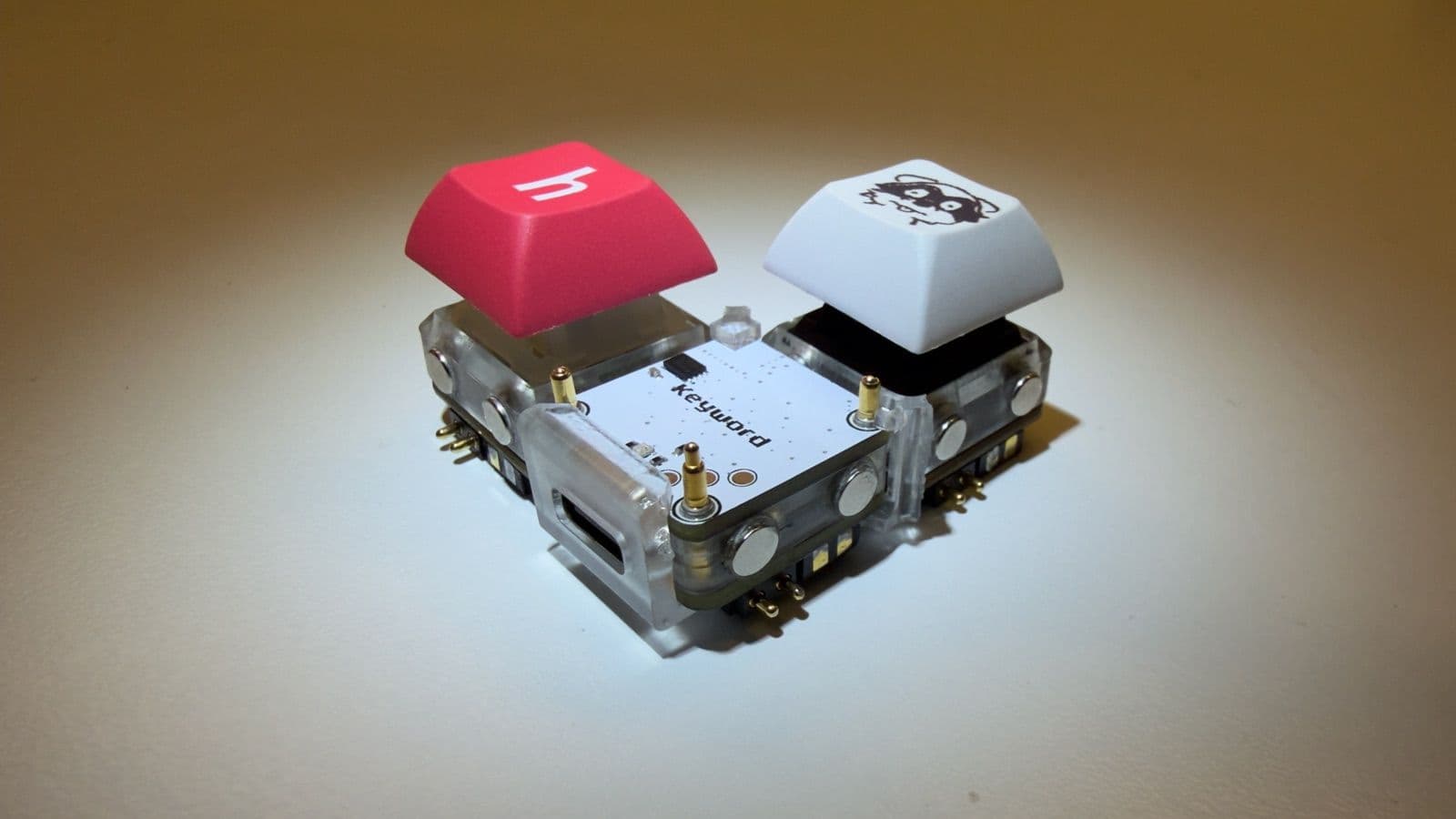
TABLE OF CONTENTS
A modular keyboard built from individual keys
Nathan Alspaugh, an MIT student, has developed Keybytes, an open-source modular keyboard that allows users to assemble custom layouts using magnetically connected keys called Keybits. Unlike traditional keyboards with fixed layouts, Keybytes enables users to arrange keys around a central controller or alongside other modules, removing restrictions on form and function.
How Keybytes works
The system consists of two core components: the Keyword controller and the Keybit modules. Each Keybit is a 19.05 x 19.05mm square (equivalent to a standard 1U keyboard unit) and contains its own RISC-V microcontroller. This allows each key to operate independently and connect magnetically to the Keyword controller or adjacent Keybits.
The Keyword controller features an Arm Cortex-M4 microcontroller and is built on two stacked circuit boards. The upper board houses a Bluetooth antenna and flash memory, while the lower board provides USB-C connectivity, charging functions, and power management via a buck-boost converter. Each Keybit accommodates a Cherry MX mechanical switch, a popular choice in custom keyboard builds.
Cost and current limitations
Keybytes remains in an early stage of development. Alspaugh has demonstrated only a limited range of module combinations so far, and the system’s high cost could be a barrier for most users. Assembling a full-size keyboard—requiring around 110 Keybits and 2 Keyword controllers—would cost approximately $900, excluding additional expenses like printed circuit board production, soldering, and custom 3D-printed enclosures.
The current design also lacks dedicated illumination for individual keys, limiting lighting customization options. However, Alspaugh has suggested potential future enhancements, including RGB lighting, rotary controls, fingerprint recognition modules, or a compatible touchpad.
Open-source and DIY-friendly
Alspaugh has released the Keybytes project files, design assets, and construction details on GitHub under the MIT licence. This permissive open-source approach allows builders, hobbyists, and developers to modify, adapt, or contribute to the project without legal restrictions.
What this means
Lazyfounder analysis — our interpretation, not reported fact.
Keybytes is a creative proof-of-concept that challenges the traditional keyboard design paradigm. For founders and operators in the consumer electronics or open-source hardware space, it signals growing interest in modular, user-configurable devices—even if the current $900 price tag makes it a niche product. The use of RISC-V microcontrollers in each key also highlights how decentralized computing can enable new form factors, though power consumption and latency could become challenges as the system scales.
The project’s open-source nature could accelerate community-driven iterations, much like how frameworks like QMK have standardized custom keyboard firmware. If future versions address cost and functionality gaps—such as adding RGB lighting or reducing the controller footprint—Keybytes might appeal to enthusiasts or even specialized industries like assistive tech or ergonomic workstations. For now, it remains a fascinating experiment rather than a market-ready product.
Related on Lazyfounder
Sources
- TechRadar · 2026-11-01
This 'truly modular' keyboard can be built like a Lego set — meaning you can add as many keys as you like
This story is an original summary drafted with AI by Lazyfounder from the reporting listed above and checked by automated validation. Facts are attributed to their original publishers; sections marked as analysis are Lazyfounder's. Where a source is in another language, facts were machine-translated and quotations are reported, not reproduced. Read the original coverage via the links, and see our AI policy and corrections policy.

About the author
Editor, Lazyfounder
Tarun Mottlia edits LazyFounders, covering Indian startups, funding rounds, AI and product launches. Every story on the site is AI-assisted and checked against its cited sources before publication.
More stories by Tarun MottliaGet the LazyFounder Brief
Startup, funding and AI news in a five-minute read. Join the early-access list.
