
James Webb Telescope Reveals Violent Collisions Shaping Young Planets
The James Webb Space Telescope, in collaboration with data from the Spitzer Space Telescope, has detected signs of violent collisions in young star systems by analyzing extreme debris disks. These findings provide new insights into the processes that shape terrestrial planets, including potential parallels to the collision that formed Earth’s moon.

Editor, Lazyfounder
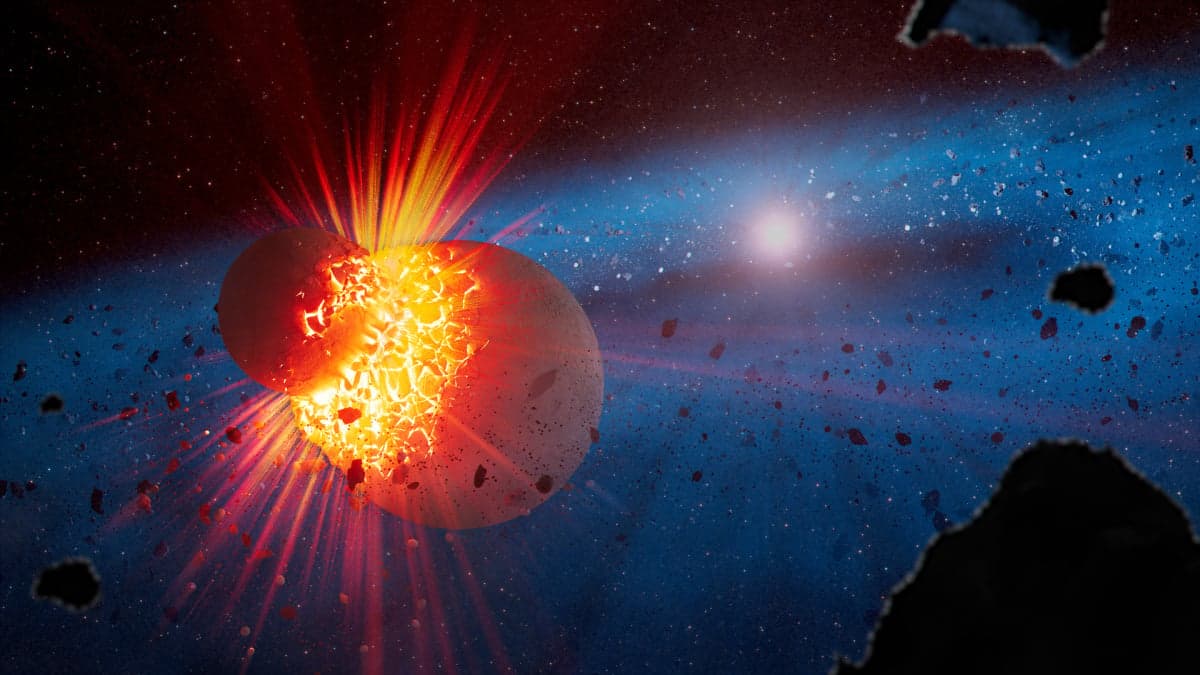
The James Webb Space Telescope, in collaboration with data from the Spitzer Space Telescope, has detected signs of violent collisions in young star systems by analyzing extreme debris disks. These findings provide new insights into the processes that shape terrestrial planets, including potential parallels to the collision that formed Earth’s moon.
30 SEC SUMMARY
- The James Webb Space Telescope, alongside data from the Spitzer Space Telescope, has identified extreme debris disks in 21 young star systems, revealing violent collisions between rocky planets.
- These collisions produce distinct debris, such as silica (volcanic glass) and forsterite (olivine), depending on the intensity of the impact.
- About one-third of the systems showed silica-rich debris from high-energy collisions between Mars-sized objects, while two-thirds contained forsterite from less violent collisions.
- Debris disks are rare, appearing around only 1% of young stars, and are found exclusively around stars younger than 300 million years.
- Ongoing collisions or orbital shifts caused by hidden planets may explain the flickering dust clouds observed in these systems.
TABLE OF CONTENTS
- Findings from the Study
- Implications for Planetary Formation
- Background: The Role of Space Telescopes
- What this means
- Key takeaways
- FAQ
- Sources
KEY HIGHLIGHTS
- James Webb and Spitzer Space Telescopes identified extreme debris disks in 21 young star systems, indicating violent collisions between rocky planets.
- Silica-rich debris, like volcanic glass, suggests high-energy collisions between Mars-sized objects.
- Forsterite, a form of olivine, was found in two-thirds of the systems, likely from less violent collisions.
- Debris disks are rare, appearing around only 1% of young stars, and are exclusive to stars younger than 300 million years.
- Flickering dust clouds in these systems may be caused by ongoing collisions or orbital shifts from hidden planets.
Findings from the Study
According to Mashable, researchers using the James Webb Space Telescope, alongside data from the retired Spitzer Space Telescope, have identified extreme debris disks in 21 young star systems. These disks are remnants of violent collisions between rocky planets, offering insights into the formation of terrestrial planets like Earth.
The study found that these collisions produce distinct types of debris depending on the intensity of the impact. About one-third of the systems contained silica, the primary component of volcanic glass, which forms during high-energy collisions between Mars-sized objects. The remaining two-thirds showed signs of forsterite, a green mineral similar to olivine, likely resulting from less violent, glancing collisions.
The debris disks are rare, appearing around only about 1% of young stars—far fewer than theoretical predictions. Additionally, the glassy debris was observed exclusively around stars younger than 300 million years, aligning with simulations of terrestrial planet formation.
Implications for Planetary Formation
The researchers suggest that these findings provide a window into the final stages of terrestrial planet formation, when collisions between large rocky bodies are frequent. Such violent events may resemble the collision believed to have formed Earth’s moon, where a Mars-sized object called Theia slammed into early Earth.
The study also noted that dust clouds in these systems flicker over time, which could indicate ongoing collisions or orbital shifts caused by hidden planets. This phenomenon suggests that the systems are dynamic and evolving, with gravitational interactions potentially driving further collisions.
Background: The Role of Space Telescopes
The James Webb Space Telescope, operated by NASA in collaboration with the European and Canadian space agencies, builds on the legacy of the Spitzer Space Telescope. Webb’s advanced capabilities allow researchers to analyze mid-infrared emissions and light patterns from debris disks, revealing their composition and origins.
This study marks the first time scientists have been able to analyze a sample of 21 extreme debris disks as a group, providing broader insights into the processes shaping young star systems. The larger sample size enabled researchers to identify patterns in the types of debris produced by different collision intensities.
What this means
Lazyfounder analysis — our interpretation, not reported fact.
This study matters to founders and operators in the space and technology sectors because it underscores the rapid advancements in observational capabilities enabled by tools like the James Webb Space Telescope. For startups in space exploration, asteroid mining, or planetary science, these findings highlight the importance of investing in next-generation sensors and AI-driven data analysis. The rarity of these debris disks also suggests that identifying and targeting high-value systems could be a competitive advantage for companies focused on resource extraction or deep-space research. Finally, the study reinforces the idea that violent collisions are a natural part of planetary formation—a consideration for any long-term space infrastructure or colonization efforts.
Key takeaways
- The James Webb and Spitzer Space Telescopes detected extreme debris disks in 21 young star systems, pointing to violent collisions between rocky planets.
- Debris from these collisions includes silica (volcanic glass) and forsterite (olivine), indicating varying levels of impact intensity.
- Silica-rich debris suggests high-energy collisions between Mars-sized objects, while forsterite points to less violent, glancing blows.
- Debris disks are rare, appearing around only 1% of young stars, and are limited to stars younger than 300 million years.
- Flickering dust clouds in these systems may result from ongoing collisions or orbital shifts caused by hidden planets.
FAQ
What are extreme debris disks?
Extreme debris disks are remnants of violent collisions between rocky planets in young star systems. They contain dust and debris, such as silica and forsterite, which provide clues about the intensity and nature of the collisions.
Why are these findings significant?
These findings are significant because they offer a glimpse into the final stages of terrestrial planet formation, when collisions between large rocky bodies are common. They also help scientists understand the rarity of these events and the conditions under which they occur.
How rare are these debris disks?
Debris disks appear around only about 1% of young stars, which is fewer than theoretical predictions. They are also exclusively observed around stars younger than 300 million years.
What role did the James Webb Space Telescope play in this study?
The James Webb Space Telescope enabled researchers to analyze mid-infrared emissions and light patterns from the debris disks, revealing their composition. Its advanced capabilities allowed scientists to study a larger sample of systems than previously possible.
Related on Lazyfounder
Sources
- Mashable · 2026-10-02
Webb telescope spots signs of collisions like the one that made our moon
This story is an original summary drafted with AI by Lazyfounder from the reporting listed above and checked by automated validation. Facts are attributed to their original publishers; sections marked as analysis are Lazyfounder's. Where a source is in another language, facts were machine-translated and quotations are reported, not reproduced. Read the original coverage via the links, and see our AI policy and corrections policy.

About the author
Editor, Lazyfounder
Tarun Mottlia edits LazyFounders, covering Indian startups, funding rounds, AI and product launches. Every story on the site is AI-assisted and checked against its cited sources before publication.
More stories by Tarun MottliaGet the LazyFounder Brief
Startup, funding and AI news in a five-minute read. Join the early-access list.
