

PM Surya Ghar scheme connects 50 lakh homes to rooftop solar in two years
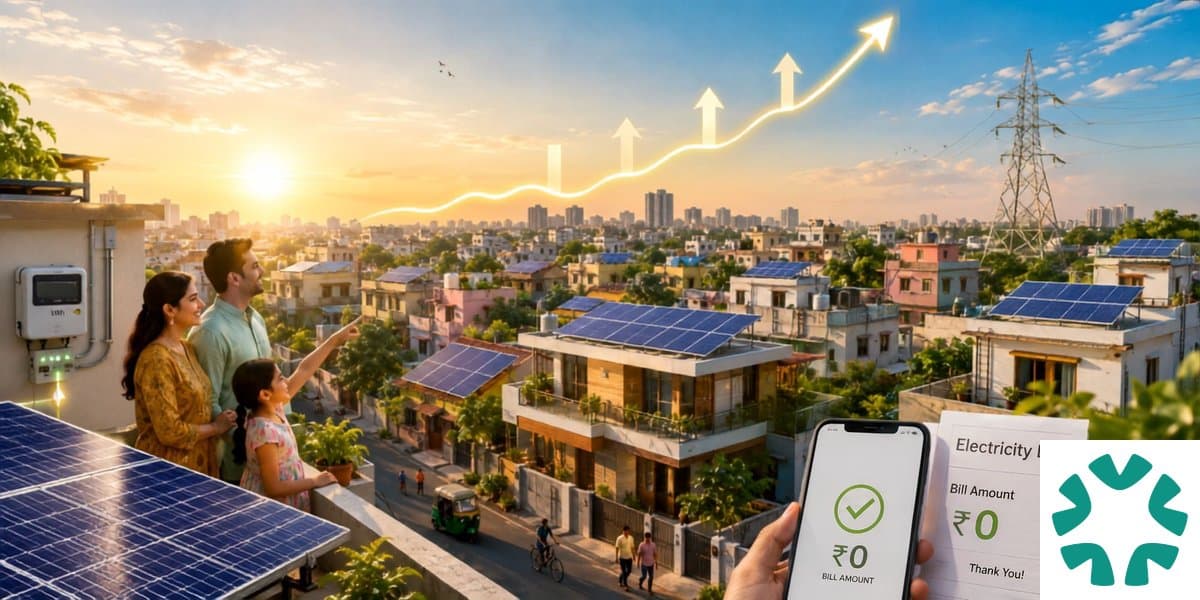
India’s rooftop solar programme, PM Surya Ghar: Muft Bijli Yojana, has connected 50.06 lakh households to solar power in just over two years—a milestone that took the previous decade to reach only 7.94 lakh installations. The scheme’s rapid scaling, driven by subsidies, concessional loans, and digital integration, is reshaping the market for clean energy adoption.

Editor, Lazyfounder
30 SEC SUMMARY
- PM Surya Ghar: Muft Bijli Yojana has enabled over 50 lakh Indian households to adopt rooftop solar in just over two years.
- The scheme has accelerated installations to 16,328 households daily, up from 5,038 in October 2025.
- Rs 28,024 crore in subsidies has been disbursed via Direct Benefit Transfer, supporting 14.8 GW of rooftop solar capacity.
- Concessional loans at 5.75% have been sanctioned for 21.87 lakh applicants, with 17.5 lakh installations completed using loan financing.
TABLE OF CONTENTS
KEY HIGHLIGHTS
- PM Surya Ghar: Muft Bijli Yojana has connected 50.06 lakh households to rooftop solar in just over two years, compared to 7.94 lakh installations in the previous decade.
- Daily installations have tripled from 5,038 in October 2025 to 16,328 in July 2026, with 5.06 lakh households added in July alone.
- Rs 28,024 crore in subsidies has been released to beneficiaries, enabling 14.8 GW of rooftop solar capacity.
- Concessional loans at 5.75% have been sanctioned for 21.87 lakh applicants, with 17.5 lakh installations completed using loan financing.
- The scheme aims to reach 1 crore households, with a Rs 75,021 crore outlay and direct subsidy transfers.
- Over 12 lakh households earned Rs 421 crore from surplus power exports in FY 2024-25.
Scheme surpasses decade-long installation record
According to YourStory, India’s Ministry of New and Renewable Energy reported on 4 August 2026 that PM Surya Ghar: Muft Bijli Yojana has enabled rooftop solar installations in over 50.06 lakh households. The programme, launched with a Rs 75,021 crore outlay, aims to reach 1 crore homes. In contrast, the previous decade saw only 7.94 lakh installations across the country.
The scheme’s design includes direct subsidy transfers to beneficiary bank accounts, reducing delays and improving accessibility. Union Minister for New and Renewable Energy Pralhad Joshi stated that 50 lakh Indian homes are now powered by solar energy.
Installation pace triples in nine months
The scheme has accelerated rooftop solar adoption significantly. According to YourStory, daily installations rose from 5,038 in October 2025 to 16,328 in July 2026, marking a 3.2-fold increase. July 2026 alone saw 5.06 lakh households connected, with the current run rate suggesting 1 lakh households are added every six days.
This pace has been supported by Rs 28,024 crore in subsidies released via Direct Benefit Transfer, enabling 14.8 GW of rooftop solar capacity.
Financing and digital integration drive adoption
Financing has played a key role in the scheme’s growth. The government has sanctioned concessional loans at 5.75%, tied to the repo rate plus 50 basis points, for 21.87 lakh applicants. Of these, 17.5 lakh installations have been completed using loan financing, facilitated by Jan Samarth integration for paperless processing.
The scheme’s digital infrastructure has reduced operational barriers. The process is fully online, from application to subsidy release, with PFMS integration ensuring subsidies are cleared within 15 days. Application programming interfaces (APIs) connect the national portal with over 80 DISCOMs, while net metering agreements are signed digitally. Consumers can also access star ratings for vendors, addressing concerns about installation quality.
The vendor ecosystem has expanded to 34,219 registered firms, of which 29,469 are active. Additionally, over 2.32 lakh people have been trained under capacity-building programmes, and around 23,000 third-party quality inspections have been conducted.
Surplus power generates income for households
Households with rooftop solar systems often generate more electricity than they consume. According to YourStory, net metering allows surplus power to be exported to the grid, with nearly 19 lakh households now receiving zero electricity bills.
For some, the surplus has become a source of income. Over 12 lakh households collectively earned Rs 421 crore from surplus power exports in FY 2024-25, averaging roughly Rs 3,500 per household annually.
Scheme expands beyond residential segment
The programme is broadening its reach beyond individual households. According to YourStory, 1.6 lakh installations have been completed under the Utility-Led Aggregation model for PMAY, BPL, and SC/ST households across four states, with plans to extend the model to 12 states. Rooftop systems up to 10 kW now receive deemed approval and a feasibility waiver, simplifying adoption.
The scheme has also solarised 1.06 lakh government buildings and launched a City Accelerator Programme across 46 cities. A payment security mechanism has been introduced to reduce risks for RESCO bidders in state solarisation projects, potentially attracting more private participation.
What this means
Lazyfounder analysis — our interpretation, not reported fact.
The pace of rooftop solar adoption under PM Surya Ghar signals a structural shift in India’s energy market. For founders and operators, this isn’t just about government targets—it’s a demand signal for ancillary services. The growth in vendor registrations (34,219 firms, 29,469 active) and trained workforce (2.32 lakh people) suggests a maturing ecosystem for installation, maintenance, and financing. The push for digital integration (paperless loans via Jan Samarth, API-linked DISCOM portals, and net metering agreements) also lowers operational friction for startups in this space.
The scheme’s expansion beyond households—into government buildings, PMAY/BPL/SC/ST communities, and urban accelerators—creates opportunities for businesses that can scale solutions for non-residential or low-income segments. The introduction of payment security mechanisms for RESCO bidders could also reduce risk for private players entering state-level solarisation projects.
For investors, the concessional loan uptake (17.5 lakh installations financed) and surplus power earnings (Rs 421 crore paid out) show a market moving from subsidy dependence to economic viability. Founders building tools for energy monitoring, vendor rating, or financing may find tailwinds here.
Key takeaways
- The scheme’s acceleration creates opportunities for startups in installation, financing, and maintenance services, particularly as vendor registrations and trained workforce grow.
- Digital integration (paperless loans, API-linked DISCOM portals) reduces operational barriers for businesses operating in the rooftop solar ecosystem.
- Expansion into government buildings and low-income households signals demand for scalable solutions beyond urban residential markets.
- Surplus power earnings and concessional loan uptake indicate a shift toward economic viability, offering potential for startups in energy monitoring and financing.
Sources
This story is an original summary drafted with AI by Lazyfounder from the reporting listed above and checked by automated validation. Facts are attributed to their original publishers; sections marked as analysis are Lazyfounder's. Where a source is in another language, facts were machine-translated and quotations are reported, not reproduced. Read the original coverage via the links, and see our AI policy and corrections policy.

About the author
Editor, Lazyfounder
Tarun Mottlia edits LazyFounders, covering Indian startups, funding rounds, AI and product launches. Every story on the site is AI-assisted and checked against its cited sources before publication.
More stories by Tarun MottliaGet the LazyFounder Brief
Startup, funding and AI news in a five-minute read. Join the early-access list.
