
ICFO researchers push solar cell efficiency beyond 33% limit with silver-based electrode
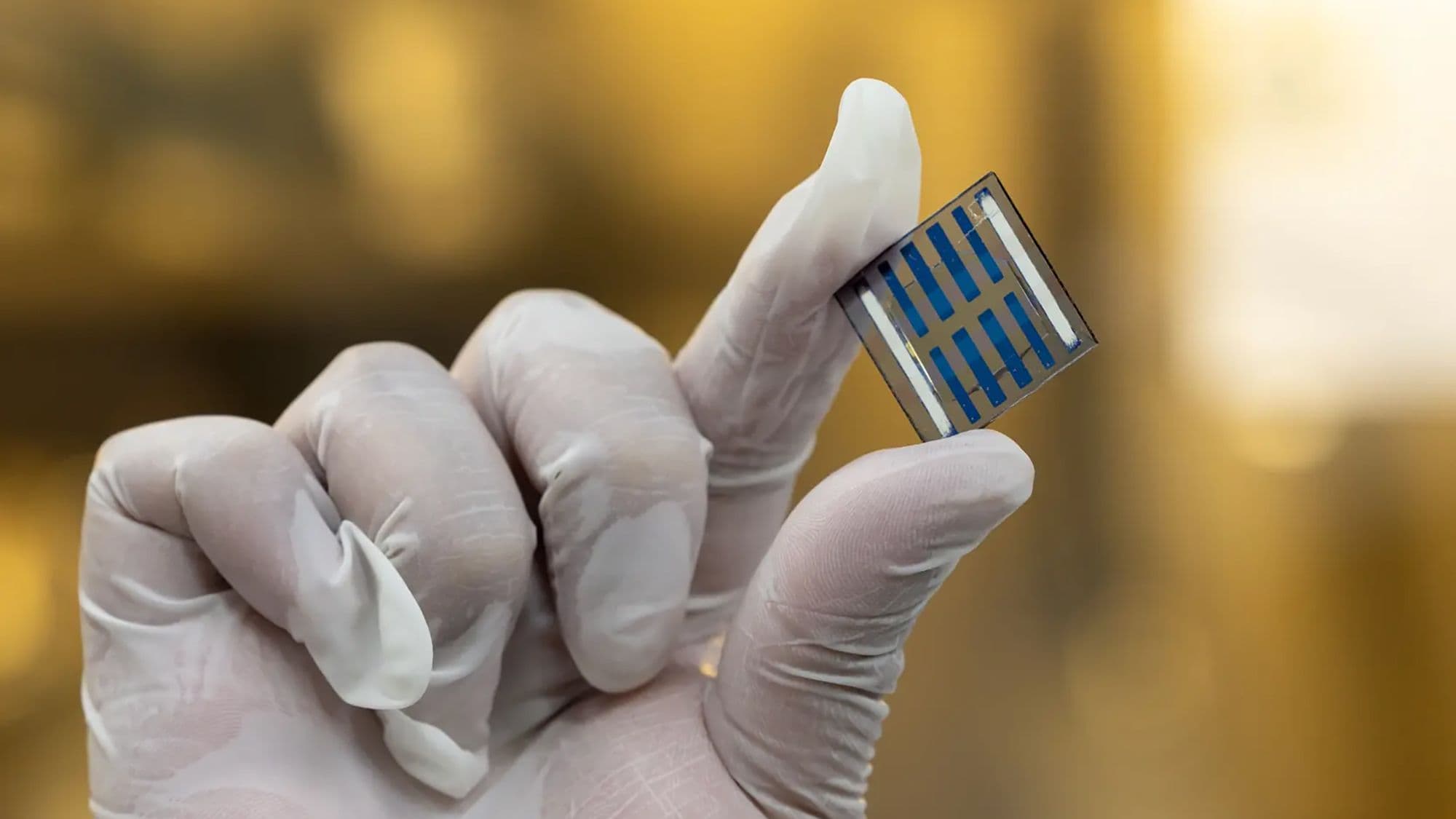
Researchers at the Institut de Ciències Fotòniques (ICFO) in Barcelona have developed a solar cell technology that could exceed the long-standing 33% Shockley-Queisser efficiency limit. The team used a silver-based electrode to reduce energy loss, achieving small gains in tests and projecting a theoretical potential of 43% efficiency.

Editor, Lazyfounder
30 SEC SUMMARY
- Researchers at ICFO in Barcelona announced a breakthrough in solar cell technology aimed at exceeding the 33% Shockley-Queisser efficiency limit.
- The team used a silver-based electrode to reduce energy loss from infrared glow, known as Boltzmann loss.
- Tests showed small efficiency gains, with a theoretical potential of reaching 43% efficiency.
- This approach, called the 'mirrored box,' was successfully implemented in a lab for the first time.
- Other advances, like Longi’s 35.5% efficiency record and a 130% quantum yield via singlet fission, highlight rapid progress in photovoltaics.
TABLE OF CONTENTS
KEY HIGHLIGHTS
- ICFO researchers in Barcelona developed a solar cell technology using a silver-based electrode to reduce Boltzmann loss, a form of energy loss from infrared glow.
- The breakthrough aims to surpass the 33% Shockley-Queisser limit, a long-standing efficiency ceiling for single-layer solar cells.
- Lab tests demonstrated small efficiency gains, with a theoretical potential of achieving 43% efficiency.
- The 'mirrored box' approach, previously explored theoretically, was implemented in a lab for the first time by the ICFO team.
- Longi, a solar technology company, set a record with 35.5% efficiency by stacking perovskite on silicon.
- Researchers from Kyushu University and Johannes Gutenberg University Mainz reported a 130% quantum yield using singlet fission.
Breakthrough aims to surpass Shockley-Queisser limit
Researchers at the Institut de Ciències Fotòniques (ICFO) in Barcelona, Spain, have announced a breakthrough in solar cell technology that could push efficiency rates beyond the traditional 33% Shockley-Queisser limit. According to TechRadar, this limit has long been considered a ceiling for standard single-layer solar cells.
The ICFO team focused on reducing energy loss from infrared glow, known as Boltzmann loss. To address this, they used a silver-based electrode in their solar cell design. While the gains observed in tests were modest, the approach has a theoretical potential to achieve up to 43% efficiency.
First lab implementation of the 'mirrored box' approach
The team’s method, described as a 'mirrored box' approach, has been explored in theoretical research but was successfully implemented in a laboratory setting for the first time. This technique aims to minimize energy loss by optimizing how light and heat are managed within the solar cell structure.
Recent advances in solar cell efficiency
The ICFO breakthrough is part of a broader wave of innovations in solar cell efficiency. According to TechRadar, Longi, a leading solar technology company, recently set a new record by achieving 35.5% efficiency. This was accomplished by stacking a perovskite layer on top of a conventional silicon cell, a method that has gained traction in the industry.
In another development, researchers from Kyushu University and Johannes Gutenberg University Mainz reported a 130% quantum yield using singlet fission. This process involves splitting high-energy photons into multiple lower-energy photons, effectively boosting the number of electrons generated per photon absorbed.
What this means
Lazyfounder analysis — our interpretation, not reported fact.
For founders and operators in the clean energy and semiconductor sectors, this breakthrough underscores the pace of innovation in photovoltaics. While the ICFO team’s results are still theoretical at higher efficiencies, even incremental gains in solar cell performance can have outsized impacts on commercial viability. The emergence of new techniques—like the 'mirrored box' approach or perovskite stacking—suggests that the industry is far from hitting its physical limits. However, translating lab successes into scalable, cost-effective solutions remains the critical challenge. Startups in this space should watch how these technologies evolve, particularly in reducing production costs and improving durability under real-world conditions.
Key takeaways
- The ICFO breakthrough highlights the potential to surpass long-standing efficiency limits in solar cells, which could reshape the economics of solar energy.
- While theoretical potential is promising, practical implementation and scalability will determine its commercial impact.
- Founders in renewable energy should monitor advances like perovskite stacking and singlet fission, as these could complement or compete with ICFO’s approach.
- Reducing energy loss in solar cells remains a key focus area, with multiple research teams exploring different methods to improve efficiency.
- Lab breakthroughs must be validated in real-world conditions, particularly in terms of durability and cost, before widespread adoption becomes feasible.
FAQ
What is the Shockley-Queisser limit?
The Shockley-Queisser limit is a theoretical efficiency ceiling for single-layer solar cells, predicting that only 33% of sunlight can be converted into electricity under standard conditions.
How does the ICFO team’s approach differ from existing methods?
The ICFO team used a silver-based electrode to reduce energy loss from infrared glow, or Boltzmann loss. Their 'mirrored box' approach aims to optimize how light and heat are managed within the solar cell, a technique not previously implemented in a lab.
What are the challenges in scaling this technology?
While the theoretical potential is high, scaling this technology will require addressing practical challenges like production costs, durability, and performance under real-world conditions.
Related on Lazyfounder
Sources
- TechRadar · 2026-10-11
Scientists announce solar panel breakthrough that could take the tech past a significant threshold — silver-based electrode pushes efficiency towards 43%
This story is an original summary drafted with AI by Lazyfounder from the reporting listed above and checked by automated validation. Facts are attributed to their original publishers; sections marked as analysis are Lazyfounder's. Where a source is in another language, facts were machine-translated and quotations are reported, not reproduced. Read the original coverage via the links, and see our AI policy and corrections policy.

About the author
Editor, Lazyfounder
Tarun Mottlia edits LazyFounders, covering Indian startups, funding rounds, AI and product launches. Every story on the site is AI-assisted and checked against its cited sources before publication.
More stories by Tarun MottliaGet the LazyFounder Brief
Startup, funding and AI news in a five-minute read. Join the early-access list.