
Heatbit Launches Bitwater, a Bitcoin-Mining Water Heater Element for Homes
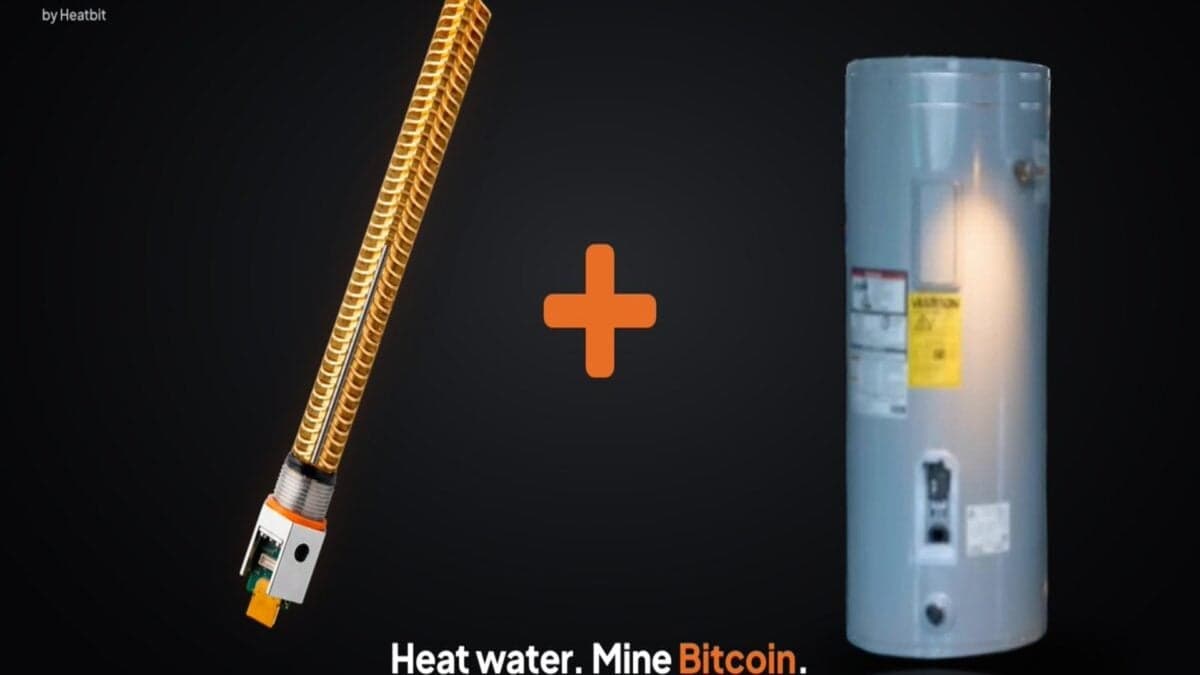
Heatbit, a U.S.-based hardware startup, has unveiled Bitwater, a water heater element that doubles as a Bitcoin-mining device. The product replaces traditional resistance wires with Bitmain mining chips and is compatible with most electric water heaters in the U.S. and Canada. Preorders are available for $899, with shipments slated for early 2027.

Editor, Lazyfounder
30 SEC SUMMARY
- Heatbit introduces Bitwater, a $899 water heater element that mines Bitcoin while heating water.
- Bitwater uses Bitmain BM1370 chips, offering up to 34 terahashes per second (TH/s).
- Compatible with 30- to 80-gallon electric water heaters from brands like A. O. Smith and Rheem.
- Preorders open for 2027 shipments; annual gross mining revenue estimated at $292 to $365.
- Debates continue over Bitcoin mining’s economic viability and environmental impact.
TABLE OF CONTENTS
KEY HIGHLIGHTS
- Bitwater replaces traditional water heater elements with Bitmain BM1370 mining chips, delivering up to 34 TH/s.
- Priced at $899, with refundable preorders available for early 2027 delivery.
- Compatible with most 30- to 80-gallon electric water heaters in the U.S. and Canada, including models from A. O. Smith, Rheem, and GE.
- Estimated annual gross mining revenue: $292 to $365, based on 80% uptime and current Bitcoin mining conditions.
- Heatbit claims Bitwater maintains the same water heating costs as conventional elements, though test results are not publicly detailed.
What Bitwater Does
Bitwater is a water heater element that replaces standard resistance wires with twenty Bitmain BM1370 Bitcoin-mining chips. According to Heatbit, the device offers up to 34 terahashes per second (TH/s) and a power draw of up to 600 watts, with mining efficiency starting at 12 joules per terahash. It is designed to fit most 30- to 80-gallon electric tank water heaters sold in the U.S. and Canada, including models from A. O. Smith, Rheem, Bradford White, Whirlpool, and GE.
Pricing and Availability
Heatbit has opened refundable preorders for Bitwater at $899, with shipments targeted for the first quarter of 2027. For comparison, conventional water heater elements typically cost under $30 and last six to ten years.
Economic and Practical Questions
Heatbit claims Bitwater maintains the same water heating costs as conventional elements, though it has not released detailed test results. The company tested the product in households of four and five people in New York and Florida during winter, but broader real-world data is lacking.
Using xAI’s Grok tool, Heatbit estimates Bitcoin earnings of roughly $1 to $1.25 per day for Bitwater, translating to $292 to $365 in annual gross revenue at 80% uptime. However, profitability depends on electricity tariffs, hardware lifespan, and Bitcoin mining conditions, all of which vary by region and market.
Broader Context for Bitcoin-Mining Heat Solutions
Bitcoin-mining heat solutions have been explored at both industrial and residential scales. For example, MARA Holdings, the U.S.-based mining firm behind Marathon Digital Holdings, has deployed projects in Finland that recycle mining heat for district-heating networks serving nearly 80,000 residents. These initiatives aim to offset Bitcoin’s environmental impact by repurposing waste heat.
Heatbit argues that Bitwater could help decentralize Bitcoin mining by distributing hashrate across households, reducing reliance on large-scale industrial miners. However, Bitcoin’s network hashrate growth has slowed as major miners shift infrastructure toward AI applications, potentially limiting the impact of small-scale solutions like Bitwater.
The environmental debate around Bitcoin mining persists. A 2025 study found that 34 large U.S. Bitcoin mines increased electricity consumption, prompting additional generation from power plants reliant on fossil fuels. While Heatbit’s solution repurposes existing energy use, its net environmental benefit remains unclear without rigorous, independent verification.
What this means
Lazyfounder analysis — our interpretation, not reported fact.
For hardware startups and Bitcoin operators, Bitwater represents an attempt to merge everyday household utilities with cryptocurrency mining. The product’s success hinges on whether it can deliver on its dual promise: maintaining water heating efficiency while generating meaningful Bitcoin returns. Founders in the hardware or crypto space may see this as a signal to explore synergies between energy-consuming appliances and decentralized technologies.
However, the economic viability of Bitwater is far from guaranteed. At $899, the upfront cost is nearly 30 times that of a conventional water heater element, and the estimated annual revenue of $292 to $365 assumes optimal mining conditions. Operators will need to weigh these numbers against their local electricity costs, hardware durability, and Bitcoin’s volatile market dynamics.
The broader trend of repurposing Bitcoin-mining heat—for district heating or household use—also raises questions about scalability and environmental impact. While projects like MARA Holdings’ district-heating initiatives show promise, Bitwater’s residential focus introduces new variables, such as household energy patterns and the willingness of consumers to engage with mining hardware. For founders considering similar products, the lesson is clear: the intersection of crypto and everyday utilities demands not just technical innovation, but also a compelling economic case and transparent data.
Key takeaways
- Bitwater’s $899 price tag and estimated annual revenue of $292–$365 highlight the economic challenges of residential Bitcoin-mining appliances.
- Compatibility with major water heater brands lowers technical barriers but does not guarantee adoption.
- The product’s environmental impact—and its marketing as a ‘green’ solution—requires independent validation to move beyond claims.
- For hardware startups, Bitwater signals growing interest in merging energy-consuming devices with decentralized technologies, but profitability remains a critical hurdle.
Related on Lazyfounder
Sources
- Gizmodo · 2026-10-25
Heatbit Says Your Water Heater Should Be Mining Bitcoin, and Now It Can
This story is an original summary drafted with AI by Lazyfounder from the reporting listed above and checked by automated validation. Facts are attributed to their original publishers; sections marked as analysis are Lazyfounder's. Where a source is in another language, facts were machine-translated and quotations are reported, not reproduced. Read the original coverage via the links, and see our AI policy and corrections policy.

About the author
Editor, Lazyfounder
Tarun Mottlia edits LazyFounders, covering Indian startups, funding rounds, AI and product launches. Every story on the site is AI-assisted and checked against its cited sources before publication.
More stories by Tarun MottliaGet the LazyFounder Brief
Startup, funding and AI news in a five-minute read. Join the early-access list.
