
Hayabusa2’s Engine Failure Puts Asteroid Mission in Jeopardy
Japan’s Hayabusa2 asteroid probe, which made history by delivering samples from asteroid Ryugu in 2020, is at risk of missing its next target after its last operational ion engine failed. Engineers at JAXA are now attempting a creative workaround to restore propulsion and salvage the mission.

Editor, Lazyfounder
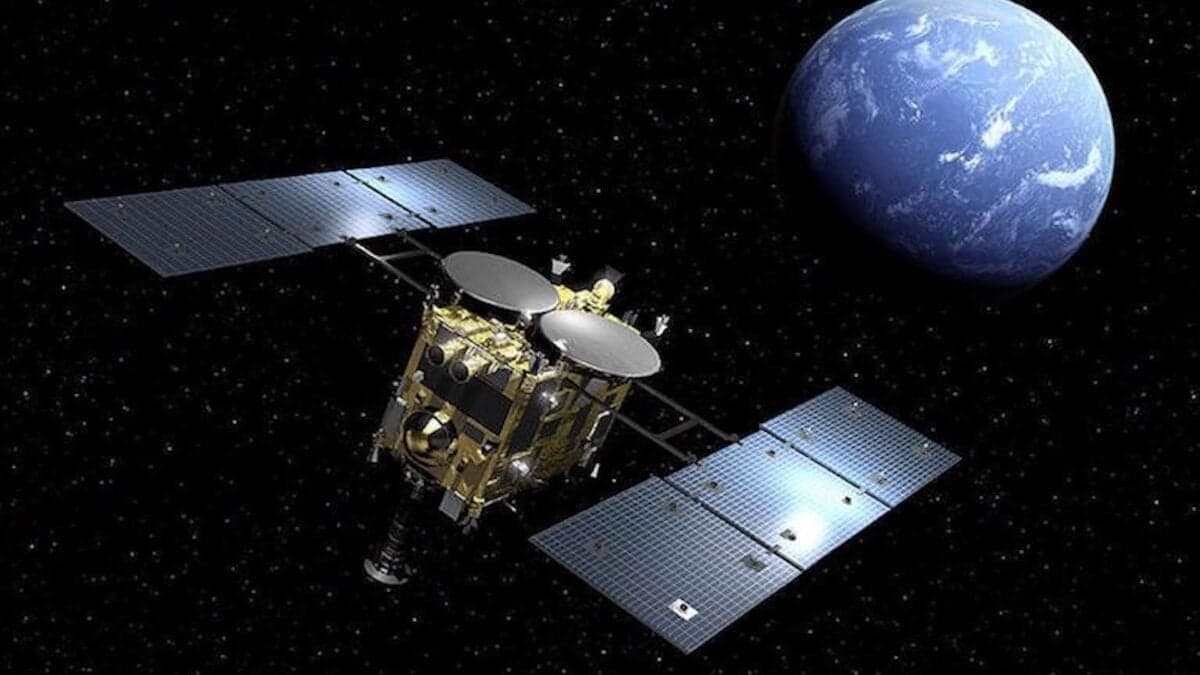
Japan’s Hayabusa2 asteroid probe, which made history by delivering samples from asteroid Ryugu in 2020, is at risk of missing its next target after its last operational ion engine failed. Engineers at JAXA are now attempting a creative workaround to restore propulsion and salvage the mission.
30 SEC SUMMARY
- Japan’s Hayabusa2 probe, which delivered samples from asteroid Ryugu in 2020, is facing a critical challenge after its last operational ion engine failed.
- JAXA engineers plan to create a hybrid engine using parts from two failed engines to restore functionality.
- The fix is scheduled for late October, but success is uncertain due to the spacecraft’s deterioration.
- The extended mission targets asteroid 1998 KY26, a small, water-rich near-Earth object with a rapid rotation.
- This marks another creative engineering effort to extend the lifespan of deep-space missions.
TABLE OF CONTENTS
- Engine Failure Threatens Extended Mission
- A Creative Fix in the Works
- Race Against Time to Reach 1998 KY26
- What this means
- Key takeaways
- FAQ
- Sources
KEY HIGHLIGHTS
- Hayabusa2 delivered samples from asteroid Ryugu to Earth in December 2020.
- The spacecraft’s last operational ion engine failed in mid-August, endangering its extended mission.
- JAXA engineers will attempt to create a hybrid engine using parts from two failed engines.
- The fix is planned for late October, with no guarantee of success due to the probe’s deterioration.
- Asteroid 1998 KY26 is a small, water-rich near-Earth object with a rapid rotation period.
Engine Failure Threatens Extended Mission
Japan’s Hayabusa2 probe, which successfully delivered samples from asteroid Ryugu to Earth in December 2020, is facing a major setback. According to Gizmodo, the spacecraft’s last operational ion engine failed in mid-August, threatening its extended mission to asteroid 1998 KY26. The probe had already completed its primary mission, but JAXA, Japan’s space agency, had planned to send it to a second target for further study.
A Creative Fix in the Works
Hayabusa2 relies on four microwave discharge xenon ion engines, labeled A, B, C, and D. Gizmodo reports that three of these engines had already failed prior to the latest breakdown. Engineers at JAXA now plan to create a hybrid engine by combining parts from the remaining failed engines. Specifically, they intend to pair the neutralizer from Engine B, which is still functional, with the ion source from Engine D, which also remains operational.
This approach mirrors a technique used during the first Hayabusa mission, which returned samples from asteroid Itokawa in 2010. However, the success of the fix is not guaranteed, particularly given the spacecraft’s age and deterioration over time.
Race Against Time to Reach 1998 KY26
The hybrid engine fix is scheduled to be attempted as early as late October. If successful, it could allow Hayabusa2 to continue its journey toward asteroid 1998 KY26, a small near-Earth object believed to contain significant amounts of water. The asteroid is also notable for its unusually rapid rotation, with a day lasting just over 10 minutes.
Hayabusa2’s original mission included collecting samples from Ryugu’s surface and subsurface, the latter achieved by deploying an impactor to create an artificial crater. The samples were delivered to the Australian outback in 2020, marking a major milestone in space exploration.
What this means
Lazyfounder analysis — our interpretation, not reported fact.
Hayabusa2’s current struggle highlights the challenges of extending deep-space missions beyond their original objectives. Spacecraft, especially those operating far from Earth, are exposed to extreme conditions that accelerate wear and tear. JAXA’s proposed hybrid engine fix is a testament to the ingenuity of engineers working with limited resources—but it also underscores the fragility of aging hardware.
For startup founders in the space or deep-tech sectors, this story is a reminder of the importance of redundancy, modular design, and adaptability in long-term projects. The ability to improvise with existing components could be a valuable lesson for hardware-focused startups, where supply chain constraints or unexpected failures can derail timelines. However, the uncertainty of success also raises questions about how to balance ambition with pragmatism when pushing the limits of technology.
Key takeaways
- Hayabusa2’s last operational ion engine failed in mid-August, jeopardizing its extended mission to asteroid 1998 KY26.
- JAXA engineers plan to combine parts from two failed engines to create a functional hybrid engine.
- The fix is set for late October, but the spacecraft’s deterioration adds risk to the mission.
- Asteroid 1998 KY26 is a small, water-rich near-Earth object with an unusually fast rotation period.
- This mission extension follows Hayabusa2’s successful delivery of samples from asteroid Ryugu in 2020.
FAQ
What is the current status of Hayabusa2?
Hayabusa2 successfully delivered samples from asteroid Ryugu to Earth in December 2020. However, its last operational ion engine failed in mid-August, threatening its extended mission to asteroid 1998 KY26.
What caused the engine failure on Hayabusa2?
The probe’s four ion engines have experienced gradual failures over time. The most recent failure left it without any fully operational engines, prompting engineers to devise a hybrid solution using parts from failed engines.
What is the goal of Hayabusa2’s extended mission?
The extended mission aims to reach asteroid 1998 KY26, a small near-Earth object believed to contain water. The asteroid is also notable for its extremely short rotation period.
How do ion engines work on Hayabusa2?
Hayabusa2 uses microwave discharge xenon ion engines, which generate thrust by ionizing xenon gas and accelerating it through an electric field. These engines are highly efficient but can degrade over time.
What are the chances of success for the hybrid engine fix?
JAXA engineers have not provided a specific probability of success, but they acknowledge that the spacecraft’s deterioration adds significant risk to the attempt.
Related on Lazyfounder
Sources
- Gizmodo · 2026-10-06
Japan’s Asteroid Probe Lost Its Last Working Engine. Engineers Have a Clever Fix
This story is an original summary drafted with AI by Lazyfounder from the reporting listed above and checked by automated validation. Facts are attributed to their original publishers; sections marked as analysis are Lazyfounder's. Where a source is in another language, facts were machine-translated and quotations are reported, not reproduced. Read the original coverage via the links, and see our AI policy and corrections policy.

About the author
Editor, Lazyfounder
Tarun Mottlia edits LazyFounders, covering Indian startups, funding rounds, AI and product launches. Every story on the site is AI-assisted and checked against its cited sources before publication.
More stories by Tarun MottliaGet the LazyFounder Brief
Startup, funding and AI news in a five-minute read. Join the early-access list.
