

Gudlyf Mobility develops Type IV hydrogen cylinders for vehicles and industrial use
Gudlyf Mobility, a Madurai-based startup, is developing Type IV hydrogen cylinders for mobility, industrial, and energy applications. These cylinders, rated for 700 bar working pressure, are designed to address the challenges of hydrogen storage and transportation, which are critical for the viability of hydrogen as a fuel.

Editor, Lazyfounder
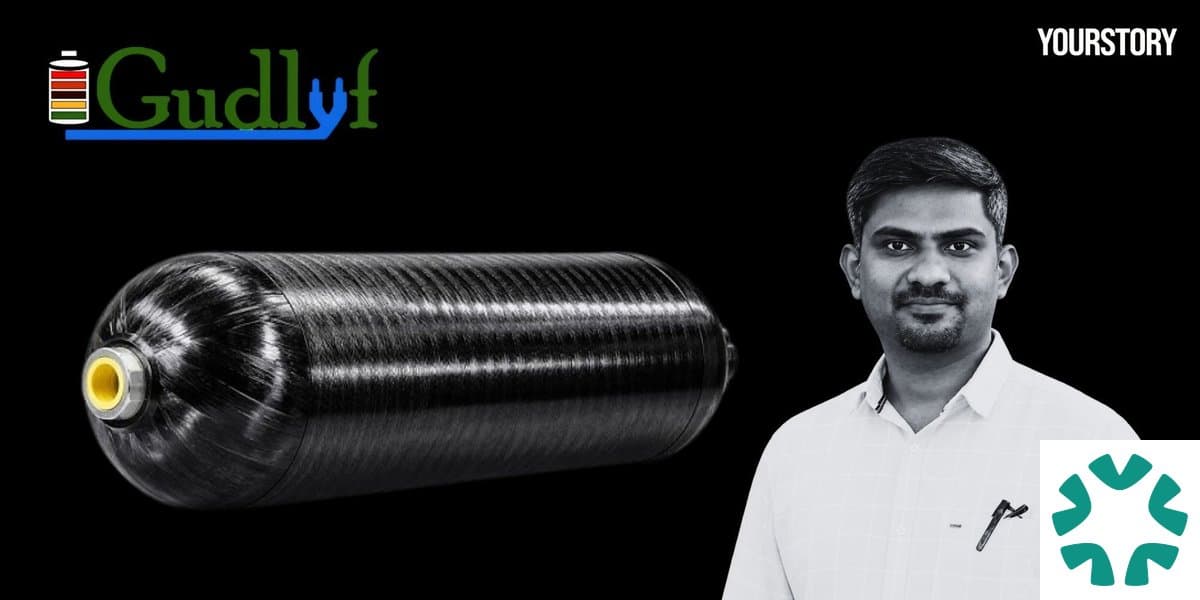
TABLE OF CONTENTS
KEY HIGHLIGHTS
- Gudlyf Mobility develops Type IV hydrogen cylinders for mobility, industrial, and energy applications.
- Cylinders are rated for 700 bar working pressure, using proprietary materials and manufacturing processes.
- Company founded in Madurai in October 2022 by four founders with a combined 120 years of experience in hydrogen storage and advanced materials.
- Revenue of ₹9.75 lakh reported for the year ended March 2024, with paid-up capital of ₹1 lakh.
- Funding raised across three undisclosed rounds; Startup India participated in April 2025.
Why Type IV cylinders matter for hydrogen mobility
Hydrogen’s low energy density per litre requires compression to hundreds of atmospheres for practical use in vehicles. Steel cylinders capable of holding 700 bar pressure are too heavy, negating the fuel’s efficiency gains. Type IV cylinders solve this by combining a plastic liner with a carbon fibre composite wrap, significantly reducing weight while maintaining strength.
Gudlyf Mobility focuses on this cylinder type, which is considered the most viable for hydrogen-powered vehicles. The company’s cylinders are engineered for 700 bar working pressure, the standard for fuel cell passenger vehicles, and are tested through destructive methods like burst and impact testing to ensure safety.
Gudlyf’s approach and target markets
The company describes its cylinders as suitable for mobility, industrial storage, and energy applications. Target sectors include fuel cell vehicles, trucks, buses, locomotives, oil and gas refineries, petrochemical plants, city gas distribution networks, and aviation. Weight reduction is central to its value proposition, as lighter cylinders improve fuel efficiency and vehicle range.
Gudlyf Mobility claims to use proprietary materials and manufacturing processes, positioning itself as a local player in India’s hydrogen ecosystem. Its team includes specialists with a combined 120 years of experience in hydrogen storage and advanced materials.
Recognition and financials
Gudlyf Mobility has gained recognition from institutions rather than commercial customers. It was among the top six teams at the Carbon Zero Challenge organized by IIT Madras and participated in the JSW MG Motor India startup programme. The company also collaborates with Kalasalingam University in Tamil Nadu and has enabled an SAE hydrogen student engineering event.
Financial filings show revenue of ₹9.75 lakh for the fiscal year ending March 2024, with paid-up capital of ₹1 lakh. The company has raised funding across three undisclosed rounds, with Startup India participating in one of them in April 2025. Its current operations are small, with about four employees.
Earlier business and unanswered questions
A separate website, last updated in 2024, describes an earlier incarnation of Gudlyf as a software business selling lithium-ion cell models. This earlier version appears unrelated to the current hydrogen cylinder focus, and there is no public explanation for the shift.
The company’s claims about locally developed and validated cylinders have not been independently certified. No customer orders or commercial deployment are mentioned in public sources, leaving its market readiness unclear.
What this means
Lazyfounder analysis — our interpretation, not reported fact.
Gudlyf Mobility’s work highlights a critical gap in India’s hydrogen economy: storage and transportation. While the National Green Hydrogen Mission focuses on production, the viability of hydrogen as a fuel depends on solving the engineering challenges of storing and moving it. Founders in the mobility and energy sectors should watch how companies like Gudlyf address these problems, as their solutions could determine the timeline for hydrogen adoption in India.
For operators, the lack of independent certification or commercial orders raises questions about scalability. However, the company’s institutional recognition and R&D approach may signal long-term potential, particularly if it secures partnerships with automakers or industrial players.
Key takeaways
- Type IV cylinders are critical for hydrogen mobility due to their lightweight and high-pressure capacity, making Gudlyf Mobility’s work relevant to automakers and energy sectors.
- India’s National Green Hydrogen Mission prioritizes hydrogen production, but storage solutions like Gudlyf’s are essential for practical adoption.
- The company’s focus on local R&D and validation signals potential for domestic deep-tech innovation in hydrogen infrastructure.
Sources
- yourstory.com
Gudlyf Mobility builds the lightweight cylinders that hydrogen vehicles need to carry fuel
This story is an original summary drafted with AI by Lazyfounder from the reporting listed above and checked by automated validation. Facts are attributed to their original publishers; sections marked as analysis are Lazyfounder's. Where a source is in another language, facts were machine-translated and quotations are reported, not reproduced. Read the original coverage via the links, and see our AI policy and corrections policy.

About the author
Editor, Lazyfounder
Tarun Mottlia edits LazyFounders, covering Indian startups, funding rounds, AI and product launches. Every story on the site is AI-assisted and checked against its cited sources before publication.
More stories by Tarun MottliaGet the LazyFounder Brief
Startup, funding and AI news in a five-minute read. Join the early-access list.
