
Google Cloud updates Agentic Data Cloud with borderless Lakehouse and autonomous AI tools
Google Cloud has introduced major updates to its Agentic Data Cloud platform, focusing on autonomous AI workers and multicloud data accessibility. The updates include a borderless Lakehouse for seamless querying across AWS and Microsoft Azure, a Knowledge Catalog to improve AI accuracy, and autonomous machine learning capabilities in Gemini.

Editor, Lazyfounder
30 SEC SUMMARY
- Google Cloud has updated its Agentic Data Cloud platform to support autonomous AI workers at scale.
- New features include borderless Lakehouse for multicloud data access without egress fees, built on Apache Iceberg.
- Knowledge Catalog improves AI agent accuracy by up to four times and reduces token consumption by 75%.
- Gemini now supports autonomous machine learning for both technical and business users.
TABLE OF CONTENTS
- Agentic Data Cloud expands AI agent capabilities
- Borderless Lakehouse eliminates multicloud friction
- Knowledge Catalog improves AI accuracy and efficiency
- Gemini adds autonomous machine learning
- New performance benchmarks for AlloyDB and BigQuery
- Related developments in AI infrastructure
- What this means
- Key takeaways
- Sources
KEY HIGHLIGHTS
- Agentic Data Cloud launched earlier this year as a "system of action" for AI agents.
- Borderless Lakehouse enables querying of data in AWS and Microsoft Azure without egress fees, using Apache Iceberg.
- Knowledge Catalog reduces AI agent hallucinations and improves accuracy by up to four times while cutting token consumption by 75%.
- Gemini now supports autonomous machine learning, allowing natural language-driven code generation and error correction.
- AlloyDB Express supports sub-two-second provisioning and handles three million queries per second.
- BigQuery Graph is now generally available for petabyte-scale graph analytics with zero ETL.
Agentic Data Cloud expands AI agent capabilities
Google Cloud has updated its Agentic Data Cloud platform, introduced earlier this year as a "system of action" for AI agents. The platform replaces traditional extract, transform, and load (ETL) pipelines, enabling AI agents to access data across environments without centralizing it in a warehouse. According to SiliconANGLE, the updates are designed to support highly scalable autonomous AI workers.
Borderless Lakehouse eliminates multicloud friction
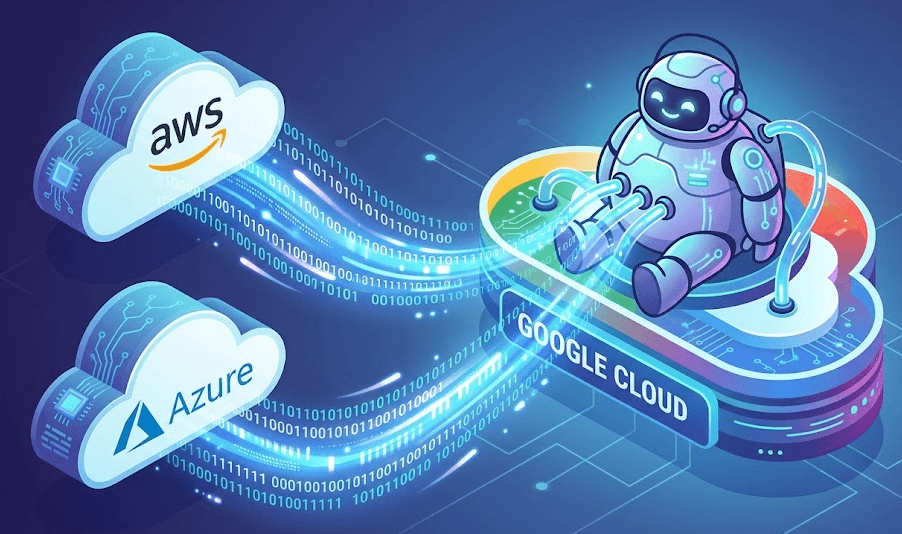
A key addition is the borderless Lakehouse, built on the open-source Apache Iceberg table format. This feature allows companies to query data stored in AWS and Microsoft Azure directly from Google Cloud without incurring egress fees. Retrieved data blocks are automatically cached within Google Cloud to accelerate subsequent queries, addressing a long-standing multicloud challenge. AlloyDB now integrates with Iceberg, enabling users to query external tables using standard PostgreSQL without copying data.
Knowledge Catalog improves AI accuracy and efficiency
The updated Knowledge Catalog scans unstructured data from platforms like Google Workspace, Jira, SharePoint, and GitHub, converting it into structured Open Knowledge Format sets. Early adopters report that this reduces AI agent hallucinations by improving accuracy up to four times and cutting token consumption by 75%. The feature is enabled by default in Gemini, resolving issues around business metric definitions and access controls.
Gemini adds autonomous machine learning
Gemini now supports autonomous machine learning capabilities for both technical and non-technical users. Data engineers can describe a business outcome in natural language, and Gemini will generate PySpark code, run notebooks, and fix pipeline errors. Business users can generate real-time operational reports by simply requesting them. The Data Agent Kit, now generally available, brings Model Context Protocol tooling into IDEs like VS Code and Claude Code, allowing developers to define business intent in natural language to automate pipeline creation and testing.
New performance benchmarks for AlloyDB and BigQuery
AlloyDB Express, a scalable database for rapid agent prototyping, now supports sub-two-second provisioning and can handle three million queries per second. BigQuery Graph, now generally available, enables petabyte-scale graph analytics with zero ETL, integrating relational and graph data seamlessly. Predictive analytics models TimesFM 3.0 and TabFM are also in preview.
Related developments in AI infrastructure
Google Cloud’s updates follow its recent webinar on the Gemini Enterprise Agent Platform, where it introduced tools for building and scaling AI agents. The company had previously announced that it would offer OpenAI, Gemini, and Claude models on its platform, positioning itself as a multicloud-friendly alternative to competitors like Snowflake and SAP. This aligns with broader trends in enterprise AI, where open-source formats like Apache Iceberg and interoperability with legacy tools such as Looker and dbt are increasingly critical.
What this means
Lazyfounder analysis — our interpretation, not reported fact.
Google Cloud’s updates to Agentic Data Cloud reflect a shift toward autonomous, self-correcting AI systems that operate across multicloud environments. For founders and operators, the borderless Lakehouse and Knowledge Catalog address two persistent pain points: the cost and friction of moving data between clouds and the unreliability of AI outputs. The autonomous machine learning features in Gemini could reduce the need for specialized data engineering talent, lowering barriers for startups to deploy AI-driven workflows. For investors, this move signals Google Cloud’s ambition to capture enterprise AI spend by offering tools that integrate with existing stacks while competing directly with Snowflake and AWS-native solutions.
Key takeaways
- Borderless Lakehouse removes egress fees and data movement costs for startups operating across AWS and Azure, reducing cloud spending overhead.
- Knowledge Catalog’s fourfold accuracy improvement and 75% token reduction could lower AI operational costs and improve output reliability for enterprise use cases.
- Gemini’s autonomous ML capabilities may accelerate AI adoption for non-technical teams, allowing faster iteration on data pipelines and reports.
- BigQuery Graph’s zero-ETL petabyte-scale analytics could replace specialized graph databases for startups needing relational and graph data integration.
Related on Lazyfounder
Sources
- SiliconANGLE · 2026-11-04
Google fine-tunes its Agentic Data Cloud to support highly scalable autonomous AI workers
This story is an original summary drafted with AI by Lazyfounder from the reporting listed above and checked by automated validation. Facts are attributed to their original publishers; sections marked as analysis are Lazyfounder's. Where a source is in another language, facts were machine-translated and quotations are reported, not reproduced. Read the original coverage via the links, and see our AI policy and corrections policy.

About the author
Editor, Lazyfounder
Tarun Mottlia edits LazyFounders, covering Indian startups, funding rounds, AI and product launches. Every story on the site is AI-assisted and checked against its cited sources before publication.
More stories by Tarun MottliaGet the LazyFounder Brief
Startup, funding and AI news in a five-minute read. Join the early-access list.
