
Georgia Tech student's jet-powered drone hits 491 mph in record attempt
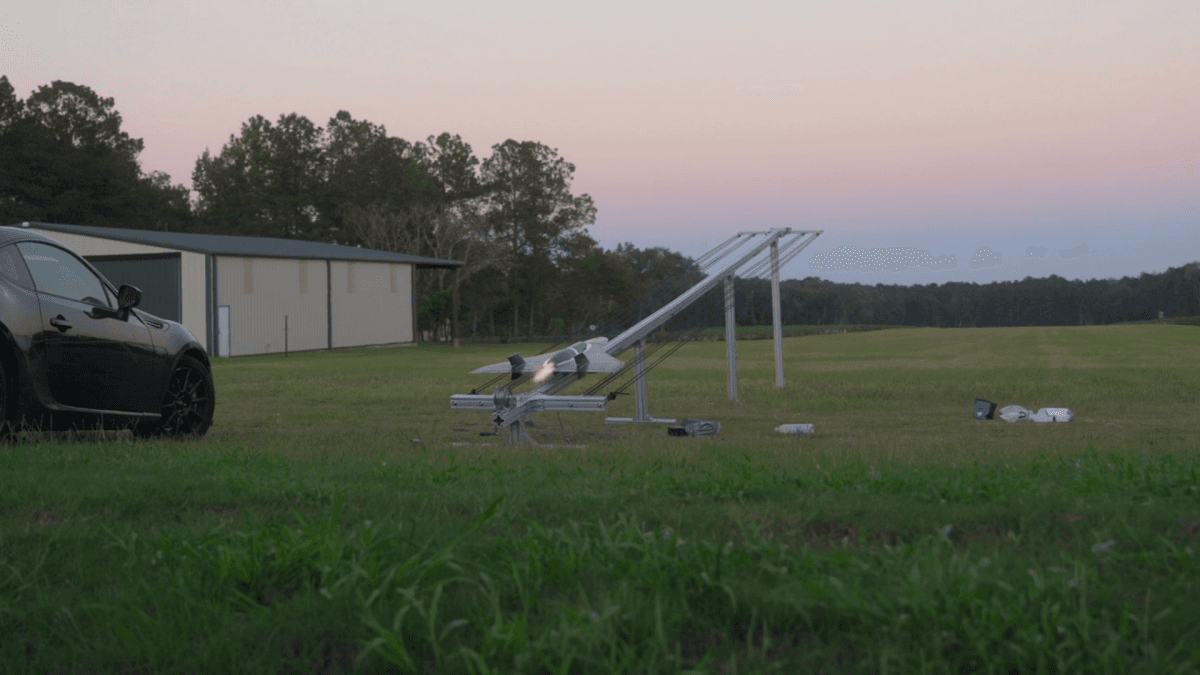
A jet-powered drone built by Tomas Salvo, an aerospace engineering student at Georgia Tech, has reached 491 mph (790 km/h) during a test flight, potentially setting a new world record. The project, backed by crowdfunding and personal investment, aims to break the sound barrier and compete for an $800,000 prize offered by Boom Supersonic.

Editor, Lazyfounder
30 SEC SUMMARY
- A Georgia Tech aerospace engineering student, Tomas Salvo, may have broken a world record with his custom-built Reaper RC drone, which reached 491 mph (790 km/h).
- The drone sustained this speed for four minutes and climbed to 6,500 feet during a test flight.
- The project aims to break the sound barrier and compete for an $800,000 prize offered by Boom Supersonic.
- Salvo has raised over $16,000 via GoFundMe, seeking a total of $50,000 to fund further development.
KEY HIGHLIGHTS
- The Reaper RC drone reached 491 mph (790 km/h) while carrying a 2.6-pound (1.2 kg) payload.
- The drone maintained this speed for four minutes and covered a 31-mile range at full speed.
- The project has incurred roughly $70,000 in costs, including $40,000 for engines and testing, $6,000 for fuel, and $20,000 for contingencies.
- Salvo’s GoFundMe campaign has raised over $16,000 toward a $50,000 goal.
- The drone’s next test flight is planned for late November or early December.
- Boom Supersonic’s $800,000 Boom Prize requires an amateur-built, radio-controlled aircraft to break the sound barrier.
The drone’s performance and costs
According to Mashable, the Reaper RC drone, designed by Tomas Salvo, reached 491 mph (790 km/h) while carrying a 2.6-pound (1.2 kg) payload. The drone sustained this speed for four minutes, climbed to 6,500 feet, and covered a 31-mile range at full throttle.
The project has cost approximately $70,000 so far. This includes $40,000 for engines and testing, $6,000 for fuel and fuel systems, and a $20,000 contingency for redesigns or replacements due to damage or underperformance.
Funding and next steps
Salvo’s GoFundMe campaign has raised over $16,000 toward a $50,000 goal. Contributors pledging $500 or more gain access to a private email list for updates, while those donating $5,000 or more can attend a test flight in person.
The next test flight of the Reaper M1 prototype is scheduled for late November or early December. To break the sound barrier—Mach 1—the drone will need to gain an additional 276 mph.
The Boom Prize and competition
The drone is competing for the $800,000 Boom Prize, offered by Boom Supersonic. The prize will be awarded to the first amateur-built, radio-controlled aircraft to break the sound barrier. The payout includes $750,000 in cash and $50,000 in Boom Supersonic stock.
Boom Supersonic, led by CEO Blake Scholl, is also developing a commercial supersonic airliner, positioning this prize as both a technical challenge and a recruiting tool for the broader aerospace industry.
What this means
Lazyfounder analysis — our interpretation, not reported fact.
For founders and operators, Salvo’s project is a case study in how audacious technical goals—even those pursued by students or small teams—can capture public imagination and funding. The $70,000 invested in the Reaper drone is a fraction of what established aerospace firms spend on similar experiments, yet it has delivered results that rival or exceed them. This underscores the potential for low-cost, high-risk innovation to disrupt industries traditionally dominated by deep-pocketed incumbents.
The Boom Prize itself reflects a shift in how aerospace breakthroughs are incentivized. Rather than relying solely on government contracts or institutional R&D, companies like Boom Supersonic are using prize-driven competition to attract talent and ideas. For startups in aerospace or adjacent fields, this model could offer an alternative path to validation and funding.
The project also highlights the practical challenges of supersonic flight, from engine costs to fuel efficiency. While breaking the sound barrier remains the headline goal, the real lessons may lie in how Salvo’s team solves—or fails to solve—these problems on a tight budget.
Key takeaways
- This project demonstrates how ambitious engineering goals can attract funding and attention, even from students with limited resources.
- The pursuit of the Boom Prize highlights a growing trend of private sector incentives driving aerospace innovation outside traditional institutions.
- The technical challenges of supersonic flight remain formidable, but projects like this could inspire similar low-cost, high-risk experiments in aerospace.
Related on Lazyfounder
Sources
- Mashable · 2026-11-01
A college student's jet-powered drone may have just broken a world record
This story is an original summary drafted with AI by Lazyfounder from the reporting listed above and checked by automated validation. Facts are attributed to their original publishers; sections marked as analysis are Lazyfounder's. Where a source is in another language, facts were machine-translated and quotations are reported, not reproduced. Read the original coverage via the links, and see our AI policy and corrections policy.

About the author
Editor, Lazyfounder
Tarun Mottlia edits LazyFounders, covering Indian startups, funding rounds, AI and product launches. Every story on the site is AI-assisted and checked against its cited sources before publication.
More stories by Tarun MottliaGet the LazyFounder Brief
Startup, funding and AI news in a five-minute read. Join the early-access list.
