
Dell expands AI Data Platform with knowledge graphs, semantic layers, and GPU acceleration
Dell Technologies Inc. has unveiled a major expansion of its AI Data Platform, adding features like a Unified Semantic Layer, Enterprise Knowledge Graph, and Knowledge Agents to enhance context and performance for enterprise AI applications. The updates also include GPU-accelerated data processing and security improvements for its PowerScale storage system.

Editor, Lazyfounder
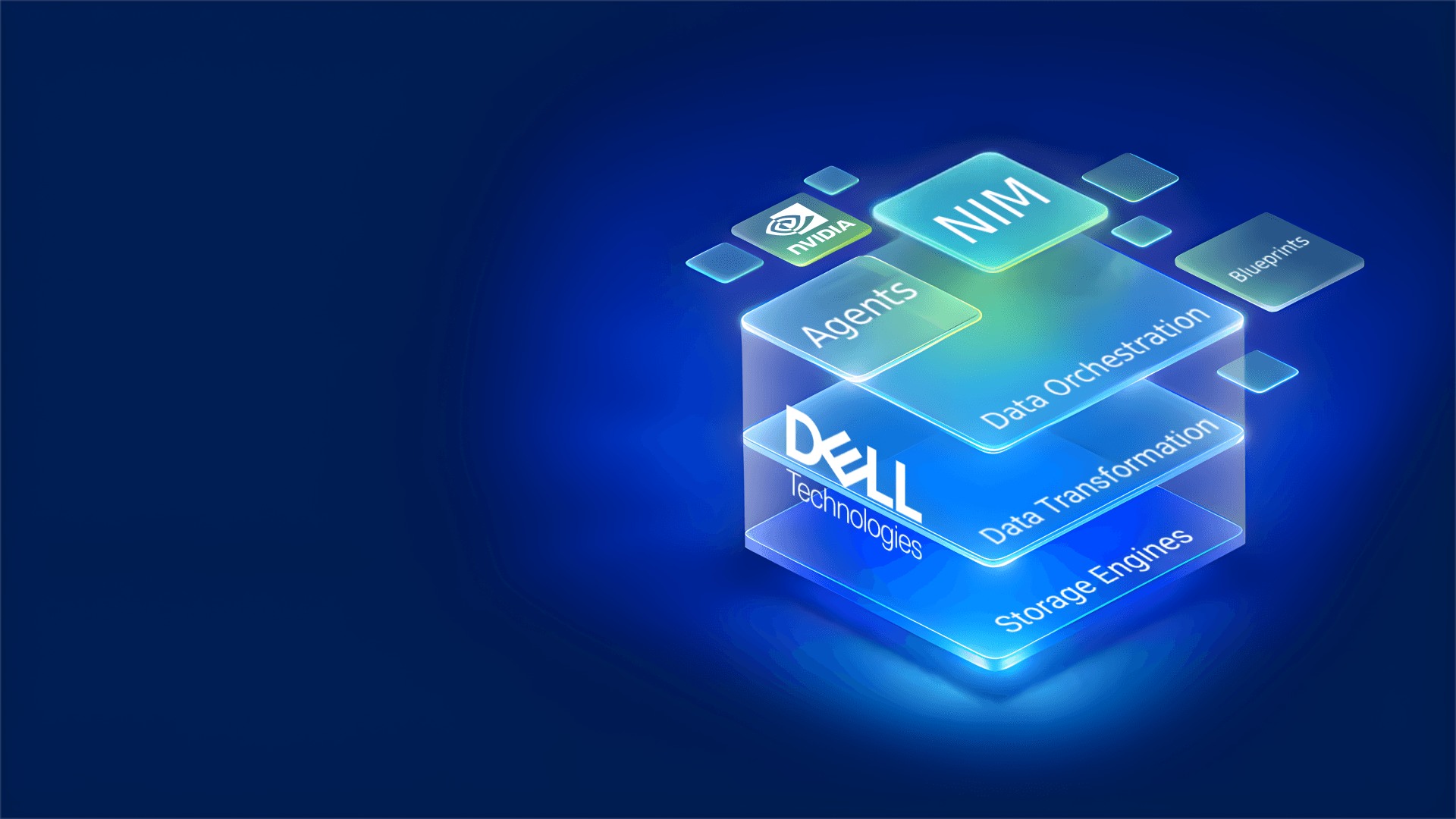
Dell Technologies Inc. has unveiled a major expansion of its AI Data Platform, adding features like a Unified Semantic Layer, Enterprise Knowledge Graph, and Knowledge Agents to enhance context and performance for enterprise AI applications. The updates also include GPU-accelerated data processing and security improvements for its PowerScale storage system.
30 SEC SUMMARY
- Dell Technologies has expanded its AI Data Platform with new features like a Unified Semantic Layer and Enterprise Knowledge Graph to enhance AI context and processing.
- New Knowledge Agents leverage Nvidia’s Nemotron Retriever models for reasoning and visual understanding within enterprise AI applications.
- The Dell Data Processing Engine, running on Nvidia GPUs, achieved up to 20.4-times speedup in Apache Spark jobs, per Dell’s tests.
- PowerScale storage updates include multitenancy support for up to 500 tenants and enhanced security features like mutual TLS encryption.
- All sensitive components run within the customer’s data center, ensuring data sovereignty and security.
TABLE OF CONTENTS
- Dell AI Data Platform gets knowledge graphs and semantic layers
- How the new features work
- Performance and security upgrades
- Timeline and deployment focus
- Nvidia’s role in the platform
- Context in the enterprise AI landscape
- What this means
- Key takeaways
- FAQ
- Sources
KEY HIGHLIGHTS
- Dell AI Data Platform now includes a Unified Semantic Layer and Enterprise Knowledge Graph for consistent AI context.
- Knowledge Agents leverage Nvidia’s Nemotron Retriever models for reasoning and visual understanding.
- Dell Data Processing Engine achieves up to 20.4-times speedup in Apache Spark jobs using Nvidia GPUs.
- PowerScale storage supports 500 tenants with mutual TLS encryption and role-based access control.
- All sensitive components run within the customer’s data center to ensure data security.
Dell AI Data Platform gets knowledge graphs and semantic layers
Dell Technologies Inc. has expanded its AI Data Platform with new features designed to improve context, processing speed, and security for enterprise AI applications. According to SiliconANGLE, the updates include a Unified Semantic Layer, an Enterprise Knowledge Graph, and Knowledge Agents, all aimed at providing AI applications with trusted, consistent context from enterprise data.
How the new features work
The Unified Semantic Layer standardizes business definitions and rules across applications, including existing ontologies maintained by enterprises. This ensures that AI models and applications operate with consistent terminology and logic, reducing conflicts or misinterpretations in data-driven workflows.
Built on top of this layer, the Enterprise Knowledge Graph organizes data into structured, interconnected formats. According to SiliconANGLE, Knowledge Agents operate within this graph, focusing on specific topics and utilizing only their assigned subsets of company data to perform tasks like reasoning or visual understanding.
These agents rely on Nvidia’s Nemotron Retriever models to handle advanced functions, such as interpreting visual data or making logical inferences.
Performance and security upgrades
The platform also includes the Dell Data Processing Engine, which runs on Nvidia GPUs using the cuDF library. SiliconANGLE reports that Dell’s internal tests showed this engine achieved up to 20.4-times speedup in Apache Spark jobs, a critical advantage for data-heavy AI workloads.
For storage, Dell’s PowerScale system has been updated to support multitenancy, allowing up to 500 tenants on a single system. Security enhancements include mutual Transport Layer Security (TLS) encryption for file traffic over the Network File System (NFS) protocol, alongside role-based access control. These updates are slated for release in November 2026.
Timeline and deployment focus
The Unified Semantic Layer, Enterprise Knowledge Graph, and Knowledge Agents are scheduled for release in the first half of 2027, according to SiliconANGLE. All sensitive components, including the Knowledge Graph and processing engine, will run inside the customer’s own data center, ensuring data sovereignty.
Dell is also expanding its implementation services to help customers move from deployment to production more efficiently. This includes support for defining and integrating semantic layers and knowledge graphs into existing workflows.
Nvidia’s role in the platform
Dell’s partnership with Nvidia Corp. is central to these updates. The Dell Data Processing Engine leverages Nvidia’s RTX PRO 4500 Blackwell Server Edition GPUs and the cuDF and Apache Arrow libraries to accelerate data processing tasks like Apache Spark jobs.
The collaboration extends to Nvidia’s Nemotron Retriever models, which provide reasoning and visual understanding capabilities for Knowledge Agents. This integration reflects broader industry trends, where hardware and software stacks are co-designed to optimize AI workloads.
Context in the enterprise AI landscape
Enterprise AI adoption has accelerated, with companies like IBM and CoreWeave Inc. partnering to address infrastructure challenges for AI agents, such as workload isolation and security. TOTVS S.A., a Brazilian enterprise software provider, has similarly expanded its AI foundation, LYNN, to integrate operational data and infrastructure, exploring partnerships with Dell Technologies.
Startups like Metaview are also scaling AI-driven platforms, raising significant funding to automate workflows in sectors like recruiting. These developments highlight the growing demand for AI solutions that combine context-awareness, performance, and security.
What this means
Lazyfounder analysis — our interpretation, not reported fact.
Dell’s latest updates to its AI Data Platform reflect a broader industry push to make enterprise AI more practical and secure. By adding a semantic layer and knowledge graph, Dell is addressing a critical gap: ensuring AI agents operate with consistent, trusted context rather than siloed or conflicting data. This is especially relevant for large organizations where business definitions and ontologies vary across teams.
The focus on GPU-accelerated processing and multitenancy storage is also timely. Enterprises are scaling AI workloads rapidly, but performance bottlenecks and security concerns remain major hurdles. Dell’s integration with Nvidia’s hardware and software stack—combined with in-house optimizations like the Data Processing Engine—positions the platform as a viable alternative to cloud-centric AI solutions. The emphasis on keeping sensitive components on-premises further targets regulated industries like healthcare and finance, where data sovereignty is non-negotiable.
However, the success of these updates will depend on how easily customers can adopt them. Semantic layers and knowledge graphs require significant upfront effort to define and maintain, and not all enterprises have the resources or expertise to implement them effectively. Dell’s expansion of implementation services suggests recognition of this challenge, but the proof will be in real-world deployments.
Key takeaways
- Dell’s AI Data Platform now includes a Unified Semantic Layer and Enterprise Knowledge Graph to standardize AI context across applications.
- Knowledge Agents use Nvidia’s Nemotron Retriever models to provide reasoning and visual understanding within constrained data slices.
- The Dell Data Processing Engine, optimized for Nvidia GPUs, delivers significant speedups for Apache Spark jobs.
- PowerScale storage updates enable multitenancy for up to 500 tenants with enhanced security features like mutual TLS encryption.
- All updates prioritize data sovereignty, with sensitive components running inside the customer’s data center.
FAQ
What is the Unified Semantic Layer in Dell’s AI Data Platform?
The Unified Semantic Layer standardizes business definitions, rules, and ontologies across applications, ensuring that AI models and workloads operate with consistent context and terminology.
How do Knowledge Agents work in Dell’s platform?
Knowledge Agents are built on top of the Enterprise Knowledge Graph and operate within specific slices of company data. They use Nvidia’s Nemotron Retriever models to perform reasoning and visual understanding tasks.
What performance improvements does the Dell Data Processing Engine offer?
The Dell Data Processing Engine, running on Nvidia GPUs, achieved up to 20.4-times speedup in Apache Spark jobs, according to Dell’s internal tests.
When will the new features be available?
PowerScale’s multitenancy and security updates are scheduled for November 2026, while the Unified Semantic Layer, Enterprise Knowledge Graph, and Knowledge Agents are expected in the first half of 2027.
How does Dell ensure data security with these updates?
All sensitive components, including the Knowledge Graph and processing engine, run inside the customer’s data center. PowerScale storage also includes mutual TLS encryption and role-based access control for enhanced security.
Related on Lazyfounder
Sources
- SiliconANGLE · 2026-10-06
Dell’s AI Data Platform gets a knowledge graph for agents and faster Nvidia processing
This story is an original summary drafted with AI by Lazyfounder from the reporting listed above and checked by automated validation. Facts are attributed to their original publishers; sections marked as analysis are Lazyfounder's. Where a source is in another language, facts were machine-translated and quotations are reported, not reproduced. Read the original coverage via the links, and see our AI policy and corrections policy.

About the author
Editor, Lazyfounder
Tarun Mottlia edits LazyFounders, covering Indian startups, funding rounds, AI and product launches. Every story on the site is AI-assisted and checked against its cited sources before publication.
More stories by Tarun MottliaGet the LazyFounder Brief
Startup, funding and AI news in a five-minute read. Join the early-access list.
