

Rubrik executive: Cybersecurity must shift from prevention to resilience
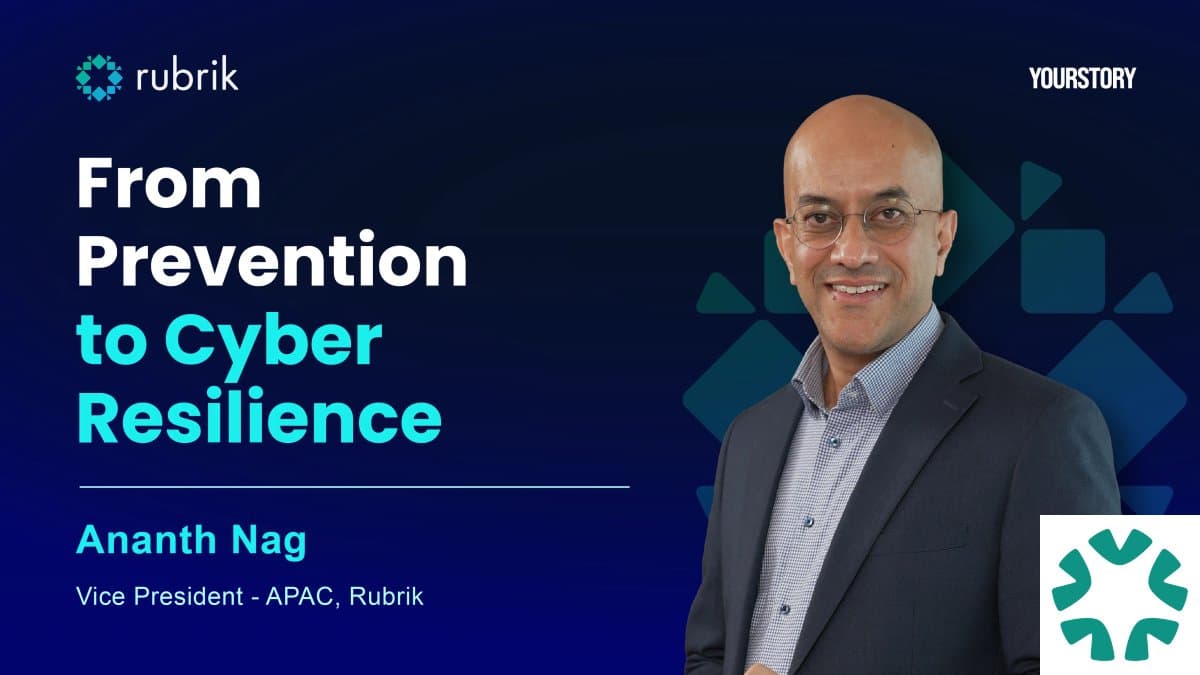
Rubrik’s APAC Vice President Ananth Nag discusses why enterprises can no longer rely on prevention alone for cybersecurity. In a conversation with YourStory, he explains the growing importance of cyber resilience—recovering data, restoring operations, and responding to attacks at machine speed.

Editor, Lazyfounder
Why prevention alone is insufficient
According to YourStory, Ananth Nag of Rubrik argues that assuming an organization will not be breached is a critical mistake. Cyberattacks are accelerating in speed and sophistication, making prevention strategies alone inadequate for modern threats.
Nag emphasizes that enterprises must prepare for breaches as an inevitability, rather than a possibility. This shift in mindset requires focusing on what happens after an attack—recovery speed, data integrity, and operational restoration—rather than solely trying to block threats.
The role of AI in cyber resilience
Nag highlights the role of AI in transforming cybersecurity, particularly in incident response. According to the report, AI can enable faster detection, analysis, and recovery by automating processes that traditionally rely on manual intervention.
He describes "agentic AI" as a tool that can enhance decision-making during cyber incidents. This form of AI is designed to act autonomously, reducing response times and improving accuracy in identifying and mitigating threats.
Recovery as the new security metric
The conversation underscores that recovery speed is becoming the most critical metric for cybersecurity. According to YourStory, enterprises are increasingly measured by how quickly they can restore trusted data and resume operations after an attack.
Nag advises business leaders to prioritize resilience strategies, including regular backups, secure data storage, and AI-driven recovery tools. The goal is to minimize downtime and ensure business continuity, even in the face of sophisticated cyber threats.
What this means
Lazyfounder analysis — our interpretation, not reported fact.
For founders and operators, this shift signals a need to reallocate resources and attention toward resilience. Preventing breaches remains important, but the ability to recover quickly and reliably can be a competitive advantage—especially in sectors where downtime directly impacts revenue or customer trust. The emphasis on AI also suggests that startups offering automation tools for incident response or recovery could find growing demand, while operators should assess whether their current security stack includes these capabilities.
Sources
- yourstory.com
[Video] From Prevention to Cyber Resilience
This story is an original summary drafted with AI by Lazyfounder from the reporting listed above and checked by automated validation. Facts are attributed to their original publishers; sections marked as analysis are Lazyfounder's. Where a source is in another language, facts were machine-translated and quotations are reported, not reproduced. Read the original coverage via the links, and see our AI policy and corrections policy.

About the author
Editor, Lazyfounder
Tarun Mottlia edits LazyFounders, covering Indian startups, funding rounds, AI and product launches. Every story on the site is AI-assisted and checked against its cited sources before publication.
More stories by Tarun MottliaGet the LazyFounder Brief
Startup, funding and AI news in a five-minute read. Join the early-access list.
