
CSIRO researchers document 2.8 million eels aggregating at Tasmanian seamount
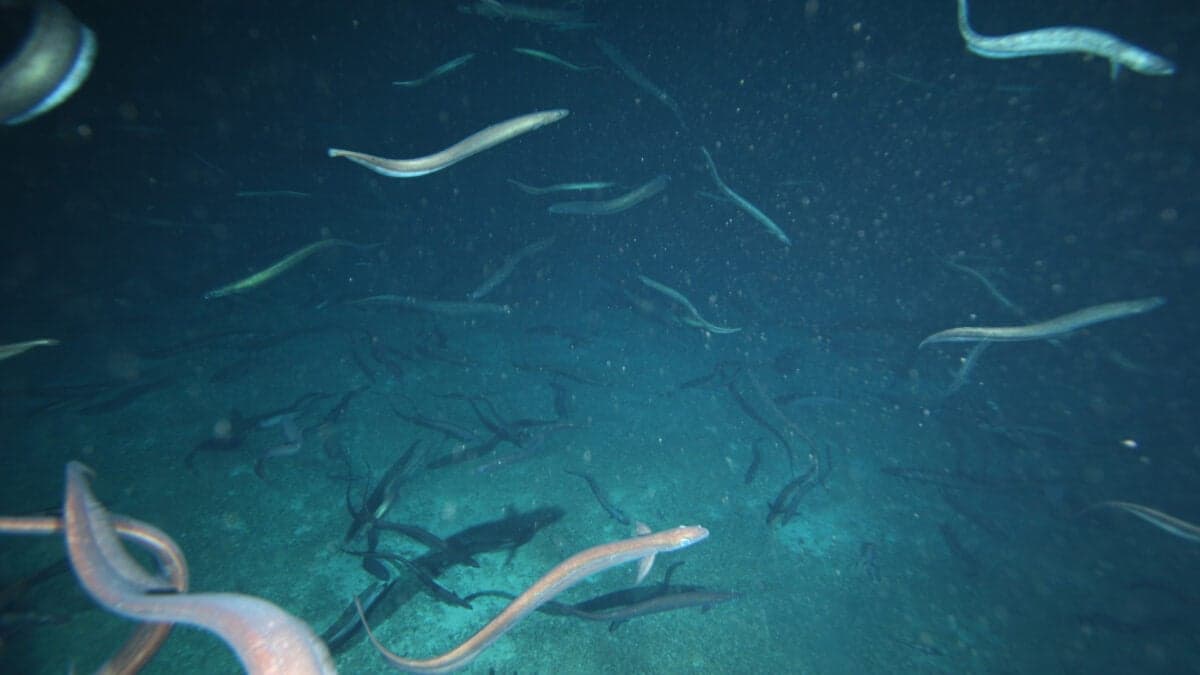
Researchers from Australia’s Commonwealth Scientific and Industrial Research Organisation (CSIRO) have documented an unprecedented aggregation of approximately 2.8 million basketwork eels at Patience Seamount in Tasmania’s Huon Marine Park. While scientists suspect the eels gather for mating, the exact cause of this phenomenon remains unresolved after years of study.

Editor, Lazyfounder
KEY HIGHLIGHTS
- Researchers from Australia’s Commonwealth Scientific and Industrial Research Organisation (CSIRO) quantified an aggregation of approximately 2.8 million basketwork eels at Patience Seamount in Tasmania’s Huon Marine Park.
- The aggregation spans 3 kilometers long and 2 kilometers wide, extending several hundred meters into the water column.
- The phenomenon was first observed in 2007, with follow-up surveys in 2015 and 2018 confirming the eels' consistent presence.
- Scientists hypothesize the eels gather to mate, but the exact reason remains unclear.
- Patience Seamount is the only known site among 120 seamounts in the Huon Marine Park where such an aggregation occurs.
A rare and unexplained phenomenon
In a study led by CSIRO researcher Ben Scoulding, scientists quantified an aggregation of approximately 2.8 million basketwork eels at Patience Seamount, a site in Tasmania’s Huon Marine Park. The aggregation spans roughly 3 kilometers long and 2 kilometers wide, extending several hundred meters into the water column.
The phenomenon was first observed in 2007 during the establishment of the Huon Marine Park. Follow-up surveys in 2015 and 2018 confirmed the eels’ consistent presence, though their exact reasons for gathering remain unclear. Scientists hypothesize that mating is the most likely explanation, but no definitive evidence has been found.
Seamount characteristics and species distribution
Patience Seamount rises to a peak depth of 857 meters from a base of 1,250 meters. It is the only site among the 120 seamounts in the Huon Marine Park where such a large aggregation of basketwork eels has been observed. Fishers dubbed the site ‘Eel Hill’ in the 1980s due to its association with the species.
The seamount’s topography appears to influence species distribution. Basketwork eels prefer flatter terrain at depths greater than 1,050 meters, while orange roughy, another deep-sea species, occupy shallower areas near the peak and steep slopes at around 1,000 meters.
Unanswered questions and future research
While the aggregation’s numbers peak between March and May, scientists do not know when the eels arrive or disperse. The reproductive condition of sampled eels suggests spawning activity, but low catch rates during research could indicate either gear limitations or reduced feeding during this period.
Researchers aim to gather more direct evidence to confirm whether the eels are gathering for reproduction. They also seek to understand the eels’ post-spawning movements and larval drift patterns, which could provide insights into their life cycle and conservation needs.
What this means
Lazyfounder analysis — our interpretation, not reported fact.
The discovery of such a massive eel aggregation underscores how little is known about deep-sea ecosystems, even in protected areas. For marine researchers and conservationists, this phenomenon presents an opportunity to study species behavior in extreme environments, which could inform policies for protecting underwater habitats. Startups working in marine technology or deep-sea exploration may find value in developing tools to monitor or analyze such aggregations, particularly as demand for oceanographic data grows. The fact that this aggregation is unique to Patience Seamount also raises questions about what makes the site special—answers that could redefine our understanding of seamount ecology.
Key takeaways
- This discovery highlights the need for further deep-sea research to understand species behavior, which could inform marine conservation strategies and policies.
- The unique aggregation at Patience Seamount may offer insights into how underwater ecosystems function, particularly in seamount environments.
- For startups and researchers in marine technology or conservation, this phenomenon presents opportunities to develop specialized tools for deep-sea observation and data collection.
Related on Lazyfounder
Sources
- Gizmodo · 2026-10-30
2.8 Million Eels Keep Swarming This Underwater Mountain—and Scientists Still Don’t Know Why
This story is an original summary drafted with AI by Lazyfounder from the reporting listed above and checked by automated validation. Facts are attributed to their original publishers; sections marked as analysis are Lazyfounder's. Where a source is in another language, facts were machine-translated and quotations are reported, not reproduced. Read the original coverage via the links, and see our AI policy and corrections policy.

About the author
Editor, Lazyfounder
Tarun Mottlia edits LazyFounders, covering Indian startups, funding rounds, AI and product launches. Every story on the site is AI-assisted and checked against its cited sources before publication.
More stories by Tarun MottliaGet the LazyFounder Brief
Startup, funding and AI news in a five-minute read. Join the early-access list.
