Xi and Trump Discuss AI Governance in White House Meeting
Chinese President Xi Jinping and former US President Donald Trump met at the White House to discuss artificial intelligence (AI) governance, marking a rare high-level dialogue between the two nations. The meeting, which followed the first US-China AI dialogue, underscored contrasting approaches to regulation and cooperation amid ongoing trade negotiations.
Editor, LazyFounders
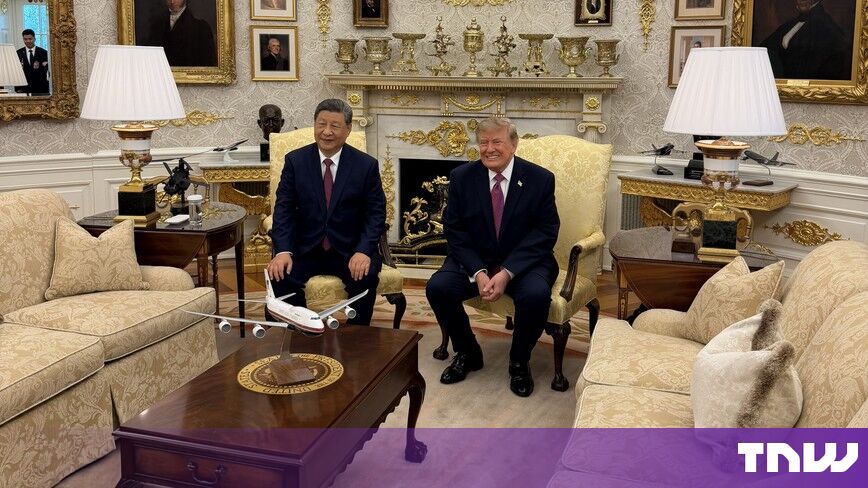

Chinese President Xi Jinping and former US President Donald Trump met at the White House to discuss artificial intelligence (AI) governance, marking a rare high-level dialogue between the two nations. The meeting, which followed the first US-China AI dialogue, underscored contrasting approaches to regulation and cooperation amid ongoing trade negotiations.
30 SEC SUMMARY
- Chinese President Xi Jinping and former US President Donald Trump met at the White House to discuss AI governance and cooperation, marking a rare high-level dialogue between the two nations.
- The meeting followed the first US-China AI dialogue, held alongside trade negotiations, where both sides emphasized preventing AI misuse.
- Trump referred to AI as 'Super Intelligence' and reiterated his stance against heavy regulation, rejecting global AI control mechanisms.
- The US proposed AI incident alerts for national security threats, though this was not mentioned in China’s official readout.
- Tech leaders like Sam Altman, Jensen Huang, and Mark Zuckerberg attended a state dinner hosted by Trump during Xi’s visit.
TABLE OF CONTENTS
- A rare dialogue on AI governance
- Contrasting visions for AI regulation
- Trade negotiations and national security
- Tech leaders at the table
- Background: US-China tech tensions
- What this means
- Key takeaways
- FAQ
- Sources
KEY HIGHLIGHTS
- Xi Jinping and Donald Trump met at the White House to discuss AI governance and cooperation, emphasizing the need to prevent AI misuse.
- The meeting followed the first US-China AI dialogue, held alongside trade negotiations led by Vice Premier He Lifeng and Treasury Secretary Scott Bessent.
- Trump referred to AI as 'Super Intelligence' and rejected calls for global AI regulation, aligning with his deregulatory stance.
- The US proposed AI incident alerts for national security threats, though China’s official readout did not mention this proposal.
- The trade teams extended a truce until January 10 and announced a new joint arrangement between the two countries.
A rare dialogue on AI governance
Chinese President Xi Jinping and former US President Donald Trump met at the White House on September 24 to discuss artificial intelligence (AI) governance and cooperation. According to The Next Web, Xi emphasized the need for continued dialogue between the two nations to prevent AI misuse and abuse. The meeting followed the first US-China AI dialogue, which took place earlier during trade negotiations in Washington.
Xi reportedly called for a 'people-centred' approach to AI, framing it as a tool that should serve the progress of humanity. The Chinese Commerce Ministry’s spokesperson, He Yadong, did not provide further details on the specifics of the discussion but confirmed the dialogue’s focus on joint prevention of AI risks.
Contrasting visions for AI regulation
The meeting highlighted divergent approaches to AI governance. Trump, who has previously referred to AI as 'Super Intelligence' (SI), reiterated his preference for minimal regulation. According to The Next Web, he told the UN General Assembly that the US would 'encourage AI technology, not rein it in.' Trump also dismissed the idea of a global mechanism to control AI, aligning with his broader deregulatory agenda.
This stance contrasts with calls from other global leaders and organizations. For instance, Dario Amodei, CEO of Anthropic, recently urged the UN Security Council to support a ban on AI-driven bioweapons. Trump’s position also diverges from China’s push for a collaborative, human-centered framework for AI governance.
Trade negotiations and national security
The AI dialogue was held alongside broader trade negotiations between the US and China. Leading the discussions were China’s Vice Premier He Lifeng and US Treasury Secretary Scott Bessent. According to The Next Web, the US proposed establishing AI incident alerts to cover national security threats, though this proposal was not mentioned in China’s official readout of the talks.
The trade teams agreed to extend a truce—originally set to expire on November 10—until January 10. Xi Jinping also announced that the two sides had reached a 'new joint arrangement,' though details of this agreement were not disclosed.
Tech leaders at the table
Prominent US tech leaders were present at a state dinner hosted by Trump during Xi’s visit. Among the attendees were OpenAI CEO Sam Altman, Nvidia CEO Jensen Huang, Meta CEO Mark Zuckerberg, Microsoft CEO Satya Nadella, Google CEO Sundar Pichai and co-founder Sergey Brin, Apple Chairman Tim Cook, AMD CEO Lisa Su, and Anthropic CEO Dario Amodei. Their participation underscores the private sector’s role in shaping US-China tech diplomacy.
Elon Musk, who has been vocal about AI risks but opposes heavy regulation, was also present. The gathering reflected the intertwining of corporate interests and geopolitical strategy in AI development.
Background: US-China tech tensions
US-China relations in technology and AI have been marked by competition and mistrust, with both nations imposing restrictions on exports, investments, and collaborations in sensitive areas. Despite these tensions, recent dialogues signal a cautious willingness to engage on shared challenges like AI governance.
The meeting between Xi and Trump follows a broader trend of high-level engagements aimed at stabilizing relations. However, fundamental disagreements remain, particularly around regulatory approaches and the role of international bodies in overseeing AI development.
What this means
LazyFounders analysis — our interpretation, not reported fact.
This meeting signals a potential thaw in US-China tech diplomacy, but the disconnect in priorities is stark. While China frames AI governance as a global, human-centered issue, the Trump administration’s resistance to regulation—let alone international oversight—leaves little room for substantive collaboration. For founders, the takeaway is clear: geopolitical tensions will continue to shape AI development, but any joint frameworks will likely be limited to narrow, practical agreements rather than broad governance. The inclusion of US tech leaders at the state dinner also underscores how deeply the private sector is entwined in these discussions, whether as stakeholders or leverage.
Key takeaways
- Xi Jinping and Donald Trump’s White House meeting focused on AI governance, emphasizing joint efforts to prevent misuse.
- The discussion followed the first US-China AI dialogue, held during broader trade negotiations.
- Trump’s deregulatory stance on AI contrasts with China’s call for a 'people-centred' approach to global AI governance.
- The US proposed AI incident alerts for national security, though China’s readout omitted this detail.
- A truce in trade tensions was extended until January 10, alongside a new joint arrangement between the two nations.
- Prominent US tech leaders attended a state dinner during Xi’s visit, highlighting industry’s role in diplomatic discussions.
FAQ
What was the main focus of the Xi-Trump meeting?
The meeting focused on AI governance and cooperation, with both leaders emphasizing the need for dialogue to prevent misuse and abuse of AI technology.
How do the US and China differ on AI regulation?
The US, under Trump, advocates for minimal regulation and opposes global AI control mechanisms. China, meanwhile, calls for a 'people-centred' approach to ensure AI serves humanity and supports joint governance efforts.
What was the outcome of the trade negotiations held alongside the AI dialogue?
The trade teams extended a truce until January 10 and announced a 'new joint arrangement,' though details of this agreement were not disclosed.
Why were US tech leaders present at the state dinner?
The presence of tech leaders like Sam Altman, Jensen Huang, and Mark Zuckerberg highlights the private sector’s influence in US-China tech diplomacy and the strategic importance of AI in bilateral relations.
Related on LazyFounders
Sources
- The Next Web · 2026-09-25
Xi tells Trump the US and China can jointly prevent AI misuse and abuse
This story is an original summary drafted with AI by LazyFounders from the reporting listed above and checked by automated validation. Facts are attributed to their original publishers; sections marked as analysis are LazyFounders's. Where a source is in another language, facts were machine-translated and quotations are reported, not reproduced. Read the original coverage via the links, and see our AI policy and corrections policy.
Get the LazyFounder Brief
Startup, funding and AI news in a five-minute read. Join the early-access list.