
Rewiring Enterprise Value Delivery with AI: Insights from EY GDS Partner Tanu Garg
Discover how AI is reshaping enterprise value delivery, beyond automation, with insights from EY GDS Partner Tanu Garg at DevSparks Bengaluru 2026.
LazyFounders
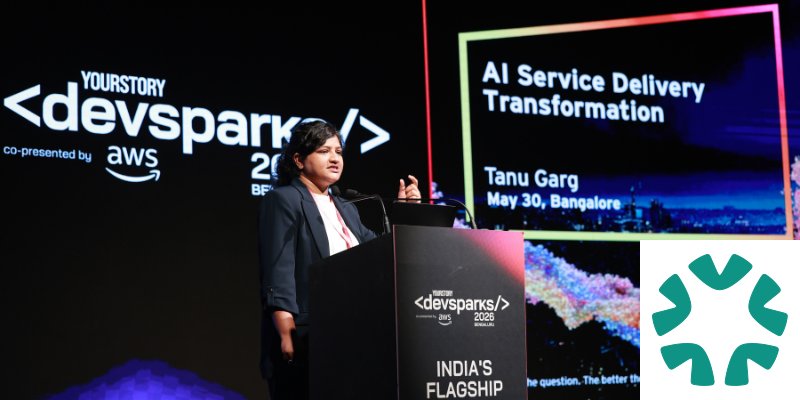

Rewiring Enterprise Value Delivery with AI: Insights from EY GDS Partner Tanu Garg
30 SEC SUMMARY
In a pivotal session at DevSparks Bengaluru 2026, EY GDS Partner Tanu Garg emphasized that AI's role extends beyond automation to fundamentally reshape how enterprises deliver value. She highlighted the importance of process redesign, scaling AI initiatives, and ensuring workforce readiness and governance for successful AI transformation.
TABLE OF CONTENTS
- Introduction
- AI Beyond Automation
- Critical Areas for AI Transformation
- Measuring Value Realization
- Changing Workforce Roles
- The Next Phase: Outcome-First AI
- Conclusion
- FAQs
KEY HIGHLIGHTS
- AI is about rewiring how enterprises deliver value, not just automation.
- Process redesign, scaling AI initiatives, and workforce readiness are critical for transformation.
- Measuring performance through outcomes like speed to market and revenue growth.
- AI shifts workforce roles towards oversight and decision-making.
- The next phase of AI focuses on embedding AI into the operating model for meaningful business value.
Introduction
When EY GDS Partner Tanu Garg addressed the audience at DevSparks Bengaluru 2026, she challenged a prevalent assumption about enterprise AI: its primary role is automation. According to Garg, AI's true potential lies in fundamentally rewiring how enterprises deliver value.
AI Beyond Automation
Garg, who leads AI Service Delivery Transformation at EY Global Delivery Services, believes that AI is reshaping how work is designed, decisions are made, and value is delivered across the enterprise. Historically, service delivery was built around human capacity and linear workflows. Today, human expertise, digital agents, and intelligent workflows are beginning to operate together, changing how work moves across teams and how decisions are made.
Critical Areas for AI Transformation
Garg identified three critical areas for enterprise AI transformation:
Process Redesign
Garg emphasized the importance of process redesign around outcomes rather than activities. She referenced EY.ai Value Blueprints as an approach to help organizations examine workflows end-to-end, identify bottlenecks and decision points, and rethink how outcomes are produced.
Scaling AI Initiatives
Garg highlighted the challenge of scaling AI beyond pilots into production environments. She pointed to the AI Engine Room as an example of how organizations can move AI initiatives from experimentation into business operations through reusable assets and governance mechanisms.
Workforce Readiness and Governance
Garg stressed that trust, explainability, and accountability should be embedded into AI programs from the beginning rather than treated as compliance requirements added later.
Measuring Value Realization
Traditional service delivery models often measured performance through hours worked, resources deployed, and activities completed. Garg argued that AI is changing this equation. As routine work becomes increasingly automated, organizations are placing greater emphasis on outcomes such as speed to market, quality improvement, process simplification, workforce effectiveness, and revenue growth.
Changing Workforce Roles
Garg was equally clear that AI is changing the role of people. As AI takes on more routine activities, roles across engineering, architecture, product management, and risk are increasingly shifting toward oversight, orchestration, and decision-making.
To illustrate this, Garg shared an AI-enabled product development example in which a car booking application for a US travel management firm was delivered in three and a half weeks with a six-person team. A traditional approach would have required roughly 12 professionals over four months.
The Next Phase: Outcome-First AI
Garg's session reflected a broader shift taking place across enterprise AI conversations. Early adoption focused on tools, pilots, and productivity gains. Organizations are now examining how AI changes the way work is designed, decisions are made, and value is delivered. Her central message was that AI delivers meaningful business value when it becomes part of the operating model rather than an isolated technology initiative.
Conclusion
As enterprises move beyond experimentation, the challenge is increasingly about scaling AI in ways that improve business outcomes while maintaining trust, accountability, and human judgment.
FAQs
What is the primary role of AI in enterprises?
AI's primary role is not just automation but fundamentally rewiring how enterprises deliver value.
How can organizations scale AI initiatives?
Organizations can scale AI initiatives by moving successful use cases into day-to-day operations through reusable assets and governance mechanisms, as exemplified by the AI Engine Room.
Why is workforce readiness important in AI transformation?
Workforce readiness ensures trust, explainability, and accountability are embedded into AI programs from the beginning, which is crucial for successful AI transformation.
Call-to-Action
For more insights on enterprise AI transformation, visit blogy.in.
Sources
This story is an original summary and analysis written by LazyFounders from the reporting listed above. Facts are attributed to their original publishers; sections marked as analysis are LazyFounders's opinion. Where a source is in another language, facts were machine-translated and quotations are reported, not reproduced. Read the original coverage via the links.
