
India's Rooftop Solar Revolution: PM Surya Ghar Milestone in 2026
Discover how India's PM Surya Ghar: Muft Bijli Yojana reached 50.06 lakh households in 2026, marking a significant leap in rooftop solar adoption.
LazyFounders

India's Rooftop Solar Revolution: PM Surya Ghar Milestone in 2026
30 SEC SUMMARY
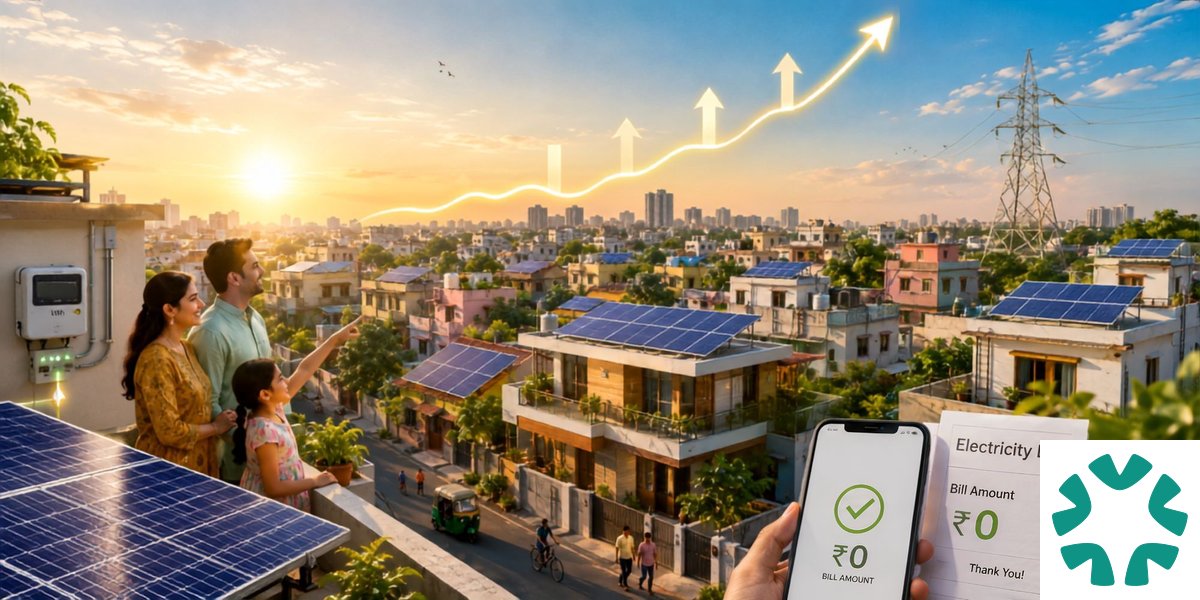
India's rooftop solar program, PM Surya Ghar: Muft Bijli Yojana, has reached a significant milestone in 2026, connecting over 50.06 lakh households in just two years. This rapid growth is driven by streamlined processes, financial incentives, and expanding access.
TABLE OF CONTENTS
- Introduction
- Program Achievements
- Driving Factors Behind the Surge
- Financial Incentives and Vendor Support
- Net Metering and Earnings
- Future Prospects
- FAQs
- Conclusion
- Call-to-Action
KEY HIGHLIGHTS
- India's rooftop solar program reached 50.06 lakh households in 2026.
- Daily installations have increased 3.2 times over nine months.
- Over 14.8 GW of rooftop capacity has been commissioned.
- Nearly 19 lakh households receive zero electricity bills.
- The program is expanding to government buildings and urban areas.
Introduction
In 2026, India's Ministry of New and Renewable Energy announced a remarkable achievement for its flagship rooftop solar program, PM Surya Ghar: Muft Bijli Yojana. The program has connected over 50.06 lakh households to rooftop solar systems, a significant leap from the 7.94 lakh installations achieved in the previous decade.
Program Achievements
The program has seen an exponential rise in installations, with daily connections increasing from 5,038 in October 2025 to nearly 16,328 in July 2026. This rapid growth is attributed to several factors, including streamlined processes, financial incentives, and expanded access.
Driving Factors Behind the Surge
Streamlined Processes
The program's process has been fully digitized, from application to subsidy release. Integration with the Public Financial Management System (PFMS) ensures that subsidies are cleared within 15 days. Application programming interfaces link the national portal with over 80 DISCOMs, and net metering agreements are signed digitally.
Financial Incentives
Concessional loans at 5.75% have been sanctioned for 21.87 lakh applicants, with 17.5 lakh installations completed on loan financing. Jan Samarth integration enables paperless processing, and the vendor base has grown to 34,219 registered firms, of whom 29,469 are active.
Financial Incentives and Vendor Support
Vendor Support
Consumers can see star ratings for vendors before choosing one, addressing long-standing complaints about installation quality. Over 2.32 lakh people have been trained under capacity-building programs, and around 23,000 third-party quality inspections have been carried out.
Access Expansion
Under the Utility-Led Aggregation model, 1.6 lakh installations have been completed for PMAY, BPL, and SC/ST households across four states, with the model cleared for rollout in 12. Rooftop systems up to 10 kW now get deemed approval and a feasibility waiver, and 32 states and union territories have scrapped application and net metering charges.
Net Metering and Earnings
A rooftop system often generates more electricity than the home consumes during the day. Net metering allows the surplus to flow back into the grid, with the meter recording both what the household draws and what it sends out. The household is billed only on the difference. When exports exceed imports over a billing cycle, the DISCOM pays for the balance. Nearly 19 lakh households are now receiving zero electricity bills.
For some, the panels have become a small source of income. More than 12 lakh households together earned Rs 421 crore from surplus power in FY 2024-25, working out to roughly Rs 3,500 a year for each home exporting to the grid.
Future Prospects
Reaching 1 crore homes means roughly doubling the count achieved so far. The ministry is widening the program beyond households. About 1.06 lakh government buildings have been solarised, a City Accelerator Programme is running across 46 cities, and a payment security mechanism has been introduced to draw RESCO bidders into state solarisation projects by lowering the risk of delayed payments.
FAQs
What is PM Surya Ghar: Muft Bijli Yojana?
It is India's flagship rooftop solar program aimed at providing free solar systems to households.
How does net metering work?
Net metering allows surplus power generated by a rooftop system to flow back into the grid, with the meter recording both what the household draws and what it sends out. The household is billed only on the difference.
What financial incentives are available?
Concessional loans at 5.75% are available for applicants, and subsidies are paid directly into beneficiary bank accounts.
Conclusion
India's rooftop solar program has made remarkable strides in 2026, reaching 50.06 lakh households and setting a strong foundation for future growth. With continued support and expansion, the program is poised to significantly impact the nation's renewable energy landscape.
Call-to-Action
For more information on India's rooftop solar program and how you can benefit, visit blogy.in.
Sources
This story is an original summary and analysis written by LazyFounders from the reporting listed above. Facts are attributed to their original publishers; sections marked as analysis are LazyFounders's opinion. Where a source is in another language, facts were machine-translated and quotations are reported, not reproduced. Read the original coverage via the links.
