
AI100's Eighth Cohort: Transforming Enterprise Infrastructure with Quiet AI
Discover AI100's eighth cohort: Druva, Innovaccer, and Sirion. Learn how these companies are transforming enterprise infrastructure with quiet, dependable AI.
LazyFounders
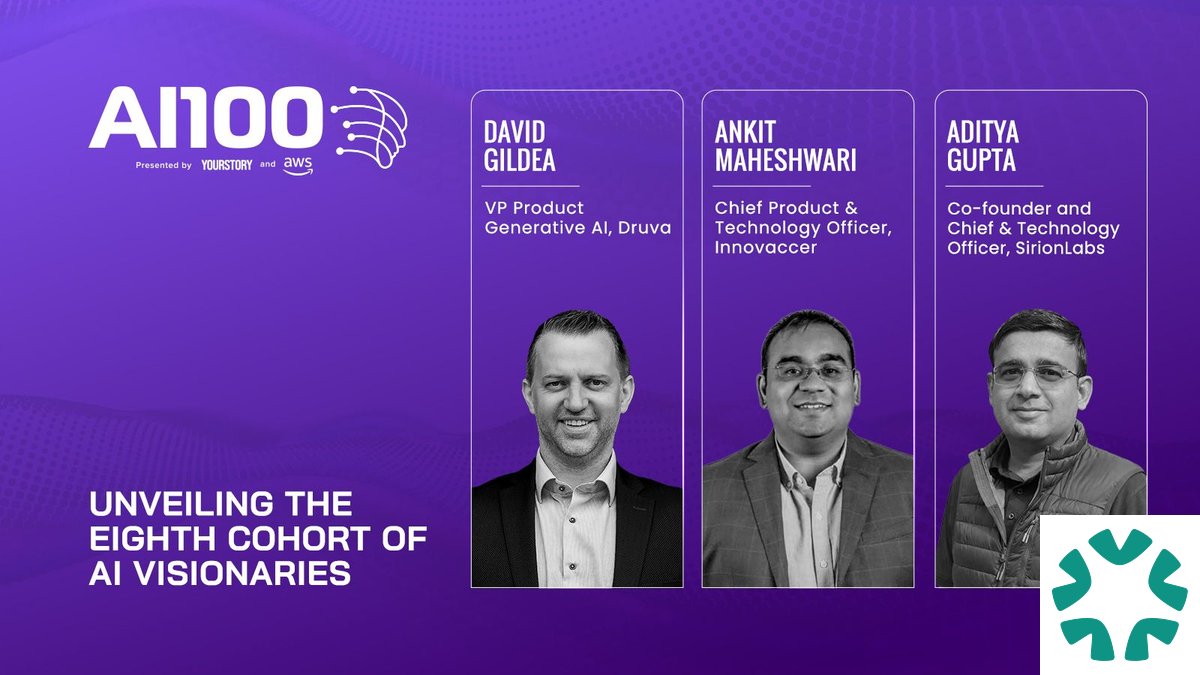

AI100's Eighth Cohort: Transforming Enterprise Infrastructure with Quiet AI
30 SEC SUMMARY
Discover how AI100's eighth cohort, featuring Druva, Innovaccer, and Sirion, is revolutionizing enterprise infrastructure. These companies are leveraging quiet, dependable AI to enhance data security, healthcare data unification, and contract management, making intelligence an integral part of enterprise operations.
TABLE OF CONTENTS
- Introduction
- Druva: Simplifying Data Security
- Innovaccer: Connecting Healthcare Data
- Sirion: Transforming Contracts with AI
- Conclusion
- Call-to-Action
KEY HIGHLIGHTS
- Druva simplifies complex data security with AI-driven solutions.
- Innovaccer connects healthcare data to enhance patient care.
- Sirion transforms contracts into intelligent, actionable systems.
- AI100's eighth cohort focuses on responsible AI engineering.
Introduction
The most useful artificial intelligence may not always announce itself with a chatbot or a flashy new interface. Sometimes, it is working quietly in the background — scanning a backup for an anomaly, bringing a patient's scattered history into focus, or turning a dense contract into a set of obligations a business can actually act on. That quiet shift, from AI as an exciting add-on to AI as dependable enterprise infrastructure, is at the heart of AI100's eighth cohort.
Druva: Simplifying Data Security
David Gildea's Journey
David Gildea's journey towards AI began with a question he heard repeatedly as a consultant: "Can I just get this data in Excel?" Behind the request was a larger problem. Organizations had enormous volumes of information, but accessing, interpreting, and securing it remained painfully complex.
Gildea's early grounding was in data security and cryptography. Fresh out of college, his first publication explored how medical information could be stored securely on credit cards and made available to doctors when needed. Later, a startup immersed him in AWS and cloud-native design, where he saw how API-driven platforms could remove infrastructure friction and speed up problem-solving. That thinking led him to found CloudRanger, a SaaS company protecting customer data in cloud environments, which was eventually acquired by Druva.
Druva's Mission
Today, as VP of Product for Generative AI at Druva, Gildea leads the labs team looking two to three years ahead. His aim is deceptively simple: hide enormous security complexity behind plain-language, objective-driven experiences. Compliance teams can query systems for ISO or NIST reviews, while AI agents surface gaps, estimate timelines and costs, and outline remediation. Druva also analyzes backup data across workloads to identify anomalies and support investigations, while its Managed Detection and Response service flags suspicious patterns before incidents escalate. DruAI now resolves 68% of customer issues directly.
For Gildea, however, speed cannot come at the cost of safety. Druva has delayed full MCP deployment while security specifications mature - a reminder that, in cyber defence, caution is part of the product. Transparency matters just as much. "Sunlight is the best cleanser," he says. His larger mission is to democratize data security without diluting the enterprise-grade protection beneath it.
Innovaccer: Connecting Healthcare Data
Ankit Maheshwari's Vision
If Gildea is stripping complexity out of security, Ankit Maheshwari is tackling one of healthcare's oldest technology problems: intelligence cannot travel through data that does not connect.
Maheshwari, Chief Product and Technology Officer and founding team member at Innovaccer, remembers the first time a few lines of code created something real. By his second year of engineering, he was working in his college's software incubator, experimenting with an early lecture-transcription and indexing tool as well as a camera-based attendance system. Those projects shaped a belief that still guides him: intelligent systems should amplify human capability, not replace it.
Innovaccer's Approach
Innovaccer began as a horizontal data and analytics company, helping researchers at institutions including Stanford, Harvard, Wharton, and MIT work with analytics-ready datasets. After projects across sectors, including NASA and Walt Disney, the team encountered a healthcare customer in Des Moines, Iowa. The engagement exposed a vast contradiction: the US spent nearly $4 trillion a year on healthcare, yet siloed information still kept patient histories and timely insights away from providers. Innovaccer made a decisive pivot to healthcare.
Maheshwari's architecture philosophy is infrastructure-first. Instead of bolting chatbots onto legacy systems, Innovaccer starts with data unification, analytics, and longitudinal patient context, then builds actionable intelligence for care teams. The platform now supports more than 80 million lives and powers seven of the top 10 health systems in the US.
The hard part is not only technical. Healthcare comes with strict compliance, decades-old systems, and clinicians whose workflows cannot be disrupted for novelty's sake. New tools must earn trust and fit naturally into the working day. Looking ahead, Maheshwari is watching edge AI for faster, more secure on-device intelligence and robotics for AI that can operate in the physical world. But the near-term lesson remains grounded: clean data, reliable infrastructure, and human-centred design are what turn AI ambition into better care. Off the clock, cricket, non-fiction, and poker give him three very different ways to think about performance, leadership, probability, and people.
Sirion: Transforming Contracts with AI
Aditya Gupta's Innovation
For Aditya Gupta, the next enterprise interface may be hiding in a document most people open reluctantly: the contract.
The Co-founder and Chief Technology Officer of Sirion wants to transform contracts from static files into intelligent systems that can understand context, surface risk, track obligations, and participate in business workflows. His approach has roots in an unlikely place - autonomous robots designed for Mars exploration.
At IIT Kharagpur, Gupta worked on systems that had to function with limited human intervention, communication gaps, and uncertain conditions. The experience taught him to decompose ambiguity into manageable parts and design for reliability - lessons that now inform technology used at enterprise scale.
Sirion's Mission
Founded in 2012 by Gupta, Ajay Agarwal, and Claude Marais, Sirion builds AI-powered contract lifecycle management software. The founders saw that contracts govern critical relationships and outcomes, yet enterprises often treated them as rigid documents scattered across repositories. Sirion instead breaks contracts into actionable components so obligations can be monitored, risks analyzed, and decisions informed by historical context.
AI is not a layer on top of that system. It sits at the core, supporting clause extraction, risk analysis, obligation tracking, drafting, negotiation, and post-signature management. As the platform moves towards agentic systems, AI can guide next steps and, in high-confidence scenarios, take action within a workflow.
In legal technology, though, "almost correct" is not good enough. Sirion grounds its models with a legal knowledge graph and ontology, pairs recommendations with references, and designs for explainability, auditability, and scale. Gupta describes AI decisions as probabilistic: moving towards 98-99% confidence helps, but trust ultimately comes from grounding an answer and showing users why it is reliable. His principle is clear: "AI should augment human judgment, not replace it." Daily reading keeps his technical curiosity moving; conversations with his children often supply the unexpected questions that open a new perspective.
Conclusion
Across Druva, Innovaccer, and Sirion, AI is becoming most powerful when it recedes from view. The interface gets simpler, while the system underneath grows more rigorous. Security needs transparency. Healthcare needs connected data and workflow trust. Contracts need domain context and explainable decisions.
That is the common thread running through AI100's eighth cohort: before AI can act intelligently, it must be engineered responsibly. Gildea, Maheshwari, and Gupta are not simply adding AI to enterprise software. They are rebuilding the foundations so intelligence can work where the stakes are highest.
Call-to-Action
Ready to explore more about how AI is transforming enterprise infrastructure? Visit blogy.in for more insights and innovations.
Sources
This story is an original summary and analysis written by LazyFounders from the reporting listed above. Facts are attributed to their original publishers; sections marked as analysis are LazyFounders's opinion. Where a source is in another language, facts were machine-translated and quotations are reported, not reproduced. Read the original coverage via the links.
