
The AI Factory Is the New Computer—and It’s Redefining the Semiconductor Race
The semiconductor industry is undergoing a seismic shift, moving from individual chips like GPUs to integrated systems known as "AI factories." This transition is redefining the economics, competitive dynamics, and geopolitical implications of artificial intelligence infrastructure, with memory, power, and custom silicon emerging as critical battlegrounds.
LazyFounders
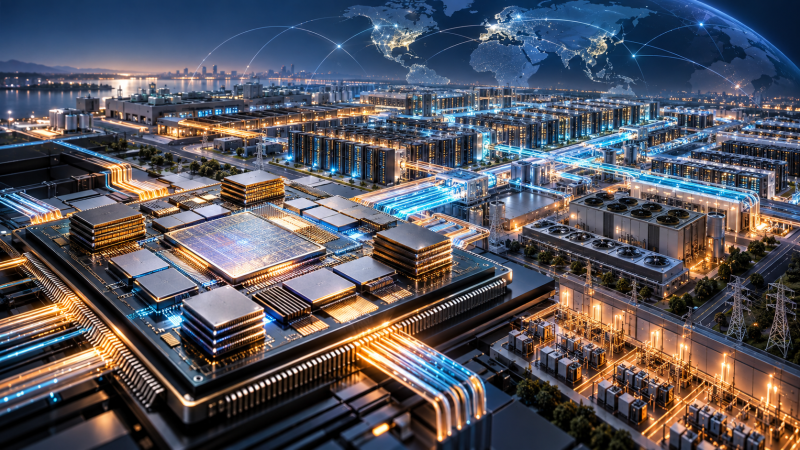

The semiconductor industry is undergoing a seismic shift, moving from individual chips like GPUs to integrated systems known as "AI factories." This transition is redefining the economics, competitive dynamics, and geopolitical implications of artificial intelligence infrastructure, with memory, power, and custom silicon emerging as critical battlegrounds.
30 SEC SUMMARY
- The semiconductor industry is shifting from individual chips like GPUs to integrated "AI factories," combining compute, memory, networking, and software into a unified systems architecture.
- Memory and power consumption are becoming central constraints in AI system design, driving innovation in data movement and energy efficiency.
- Custom accelerators and chiplets are enabling workload-specific optimizations, with hyperscalers and AI companies developing their own silicon.
- AI is beginning to assist in semiconductor design, accelerating development cycles and introducing an "engineering-velocity law" alongside Moore’s Law.
- Sovereign AI is emerging as a geopolitical consideration, focusing on control over intelligence infrastructure rather than self-sufficiency.
TABLE OF CONTENTS
- The rise of the AI factory
- Memory and power as bottlenecks
- Custom silicon and workload optimization
- AI-driven chip design
- The geopolitics of AI infrastructure
- What this means
- Key takeaways
- FAQ
- Sources
KEY HIGHLIGHTS
- The AI infrastructure landscape is shifting from individual GPUs to integrated systems called "AI factories."
- Memory, power, and data movement are emerging as critical constraints in AI system design.
- Custom accelerators, chiplets, and advanced packaging are enabling workload-specific optimizations.
- AI is accelerating semiconductor design, reducing development cycles from years to months.
- Sovereign AI is becoming a key consideration for nations seeking control over their intelligence infrastructure.
The rise of the AI factory
According to SiliconANGLE, the semiconductor industry is entering a new phase where artificial intelligence infrastructure is no longer defined by individual chips like GPUs. Instead, the focus is shifting toward integrated systems dubbed "AI factories," which combine compute, memory, networking, packaging, power, and software into a unified architecture.
For years, the conversation around generative AI centered on accelerators, particularly GPUs. Nvidia became the defining company of this cycle, but the discussion is now expanding to include CPUs, custom XPUs, memory, networking, chiplets, advanced packaging, optics, cooling, and power. This transition reflects a broader industry trend: the AI factory is becoming the new computer.
Memory and power as bottlenecks
As AI systems scale, memory bandwidth, capacity, and power consumption are emerging as central constraints. SiliconANGLE reports that data movement is now a key determinant of system performance, turning the AI infrastructure race into a "data-movement race."
Power is another critical limitation. The industry is now planning AI clusters and campuses measured in gigawatts, with training environments alone consuming multiple gigawatts of electricity. These constraints are forcing a rethink of how AI systems are designed, moving away from a focus on individual components toward holistic system-level innovation.
Custom silicon and workload optimization
The shift to AI factories is accelerating the adoption of custom silicon and modular architectures. According to SiliconANGLE, broad-purpose CPUs and GPUs remain essential, but chiplets and workload-specific configurations are gaining traction. AMD’s Venice designs, for example, are tailored for emerging agentic workloads.
Hyperscalers and frontier AI companies are deepening their investments in custom accelerators. Google’s tensor processing units (TPUs), Amazon Web Services’ Trainium and Inferentia, Microsoft’s Maia, and OpenAI’s Jalapeño (developed with Broadcom) exemplify this trend. These custom designs optimize for kernels, memory movement, networking, and serving patterns specific to AI workloads.
Developing custom silicon requires significant workload volume, software-stack ownership, and predictable demand to justify the investment. However, the payoff is clear: workload-specific optimizations can deliver performance gains that generic chips cannot.
AI-driven chip design
AI is not only transforming end-user applications but also how semiconductors are designed. SiliconANGLE highlights that AI is beginning to assist in the development of semiconductor infrastructure itself. For instance, OpenAI’s Jalapeño chip was designed in roughly nine months using AI models, compressing timelines that traditionally spanned years.
This acceleration introduces a new dynamic in semiconductor innovation: an "engineering-velocity law" that complements Moore’s Law. The next wave of performance gains will stem from system-level innovation, combining process technology, chiplets, custom silicon, high-bandwidth memory (HBM), advanced packaging, networking, and power engineering.
The geopolitics of AI infrastructure
As AI factories become strategic industrial infrastructure, questions of control and sovereignty are gaining prominence. According to SiliconANGLE, sovereign AI is less about self-sufficiency and more about understanding, managing, and controlling critical dependencies. A country or organization can deploy thousands of GPUs and still lack meaningful control over its intelligence infrastructure.
The competitive unit in AI is no longer just the GPU, large language model, or data center. Instead, it is the entire "intelligence-production system," encompassing everything from silicon to software. This shift underscores the need for nations and enterprises to develop end-to-end capabilities to maintain strategic autonomy.
What this means
LazyFounders analysis — our interpretation, not reported fact.
This shift toward AI factories marks a fundamental change in how the tech industry approaches AI infrastructure. For founders and operators, the implications are clear: vertical integration is becoming table stakes.
Startups that rely solely on off-the-shelf GPUs or cloud APIs risk falling behind as incumbents and hyperscalers optimize their stacks from silicon to software. If you're building in AI, consider how memory, power, and data movement constraints might shape your architecture—and whether custom silicon or advanced packaging could unlock performance gains.
For hardware startups, the bar for differentiation is rising. Generic accelerators won’t cut it; workload-specific optimizations are the new battleground. Meanwhile, AI-driven chip design tools could democratize access to custom silicon, reducing development costs and timelines. If this trend accelerates, we may see a wave of niche accelerators tailored for specific industries or applications.
The geopolitical dimension adds another layer of complexity. Sovereign AI isn’t just a policy buzzword—it’s a signal that AI infrastructure is becoming a strategic asset. Founders should think about how their supply chains, partnerships, and dependencies could become vulnerabilities in an era where control over intelligence infrastructure is a competitive advantage.
Key takeaways
- AI infrastructure is evolving from individual chips to integrated systems called "AI factories," reshaping the semiconductor landscape.
- Memory bandwidth, power consumption, and data movement are now critical bottlenecks in AI system performance.
- Hyperscalers and AI companies are investing in custom silicon and advanced packaging to optimize for specific workloads.
- AI-driven chip design is compressing development timelines, introducing new possibilities for innovation.
- The concept of «sovereign AI» highlights the need for nations and organizations to control their intelligence infrastructure.
FAQ
What is an AI factory?
An AI factory is an integrated system that combines compute, memory, networking, packaging, power, and software into a unified architecture. It represents a shift from individual components like GPUs to a holistic approach to AI infrastructure.
Why are memory and power becoming bottlenecks in AI systems?
As AI models grow in size and complexity, the demands for memory bandwidth, capacity, and power consumption are skyrocketing. Data movement and energy requirements are now central constraints, driving innovation in system-level design.
How are hyperscalers and AI companies using custom silicon?
Companies like Google, Amazon, Microsoft, and OpenAI are developing custom accelerators and chiplets to optimize performance for specific workloads. These designs improve efficiency by tailoring hardware to the unique demands of AI tasks.
What is sovereign AI?
Sovereign AI refers to the ability of nations or organizations to control and manage their intelligence infrastructure, rather than relying on external providers. It emphasizes understanding and mitigating critical dependencies in the AI supply chain.
Related on LazyFounders
Sources
- SiliconANGLE · 2026-09-23
The AI factory is becoming the computer and it’s changing the semiconductor race
This story is an original summary and analysis written by LazyFounders from the reporting listed above. Facts are attributed to their original publishers; sections marked as analysis are LazyFounders's opinion. Where a source is in another language, facts were machine-translated and quotations are reported, not reproduced. Read the original coverage via the links.
