
Anthropic launches Claude Duet, a proactive AI agent for subscribers
Anthropic has released Claude Duet, an AI personal agent designed to complete tasks autonomously for Claude Pro and Max subscribers in the US. The feature is in preview and requires users to join a waitlist. Anthropic plans to include Duet as part of its $20 per month Pro plan, positioning it as a competitor to OpenAI’s Dot agents.

Editor, Lazyfounder
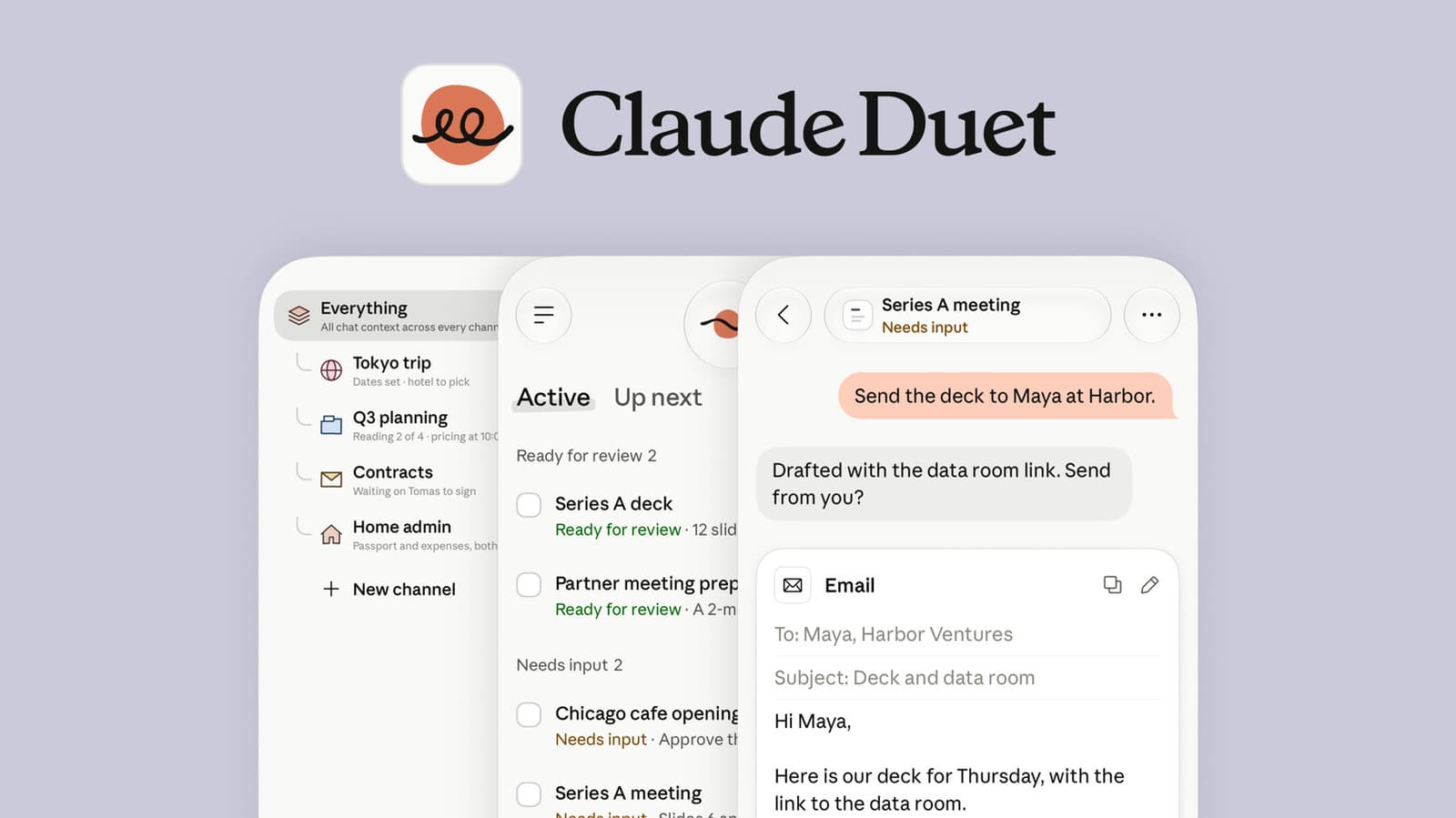
What Claude Duet offers
Anthropic has introduced Claude Duet, a proactive AI personal agent designed to complete tasks autonomously, even when the user is offline. The agent runs on its own virtual machine and can access a dedicated browser to perform tasks such as scheduling meetings, creating forecasts, or building web apps.
Claude Duet generates briefings and action items based on connected apps and data stored in the user’s Claude account, including information written to the chatbot’s memory. Its proactivity relies on the integration of these connected accounts and stored data.
Availability and pricing
Claude Duet is currently in preview and limited to Claude Pro and Max subscribers in the US. Interested users must join a waitlist by providing their name, company, and email address. Anthropic has not announced when the feature will exit preview.
The company plans to include Duet as a perk of its $20 per month Pro plan in the future. For now, it is not available to Team or Enterprise customers. During the preview phase, Duet shares usage limits with other Claude apps like Code and Cowork and checks connected accounts every few hours to manage consumption.
In contrast, OpenAI’s Dot agents are available starting at $100 per month, positioning Duet as a potentially more affordable alternative for individual users.
Why this matters for AI adoption
Claude Duet’s launch reflects the growing competition among AI labs to offer proactive, task-automating agents. While SpaceXSI, Meta, and OpenAI have already introduced similar tools, Anthropic’s entry could accelerate adoption by integrating the feature into its existing subscription model.
The agent’s reliance on connected apps and user data raises questions about digital privacy and trust. Founders and operators evaluating AI tools will need to weigh the productivity benefits against the risks of sharing sensitive data with third-party platforms.
What this means
Lazyfounder analysis — our interpretation, not reported fact.
Claude Duet’s introduction signals Anthropic’s push to compete in the AI agent space, where OpenAI and others have already staked claims. For founders and operators, this launch highlights two key trends:
-
Pricing as a differentiator: At $20 per month, Claude Pro undercuts OpenAI’s $100 entry point, making proactive AI tools more accessible to solo founders and small teams. If Duet delivers on its promises, it could pressure competitors to adjust pricing or feature sets.
-
The trust trade-off: AI agents require deep access to user data to function effectively, and Claude Duet is no exception. Companies testing these tools must prioritize transparent data policies and user control to mitigate privacy risks—a challenge that will only grow as more labs enter the space.
Related on Lazyfounder
Sources
- Engadget · 2026-10-31
How To Use Claude Duet When It Rolls Out To You
This story is an original summary drafted with AI by Lazyfounder from the reporting listed above and checked by automated validation. Facts are attributed to their original publishers; sections marked as analysis are Lazyfounder's. Where a source is in another language, facts were machine-translated and quotations are reported, not reproduced. Read the original coverage via the links, and see our AI policy and corrections policy.

About the author
Editor, Lazyfounder
Tarun Mottlia edits LazyFounders, covering Indian startups, funding rounds, AI and product launches. Every story on the site is AI-assisted and checked against its cited sources before publication.
More stories by Tarun MottliaGet the LazyFounder Brief
Startup, funding and AI news in a five-minute read. Join the early-access list.
