

Nigerian inventor develops AI glasses to assist visually impaired users
A 20-year-old inventor from Nigeria, Khalifa Aminu, is developing AI-powered glasses designed to assist visually impaired users by converting visual information into audio guidance. The device aims to improve mobility and independence using accessible technology.

Editor, Lazyfounder
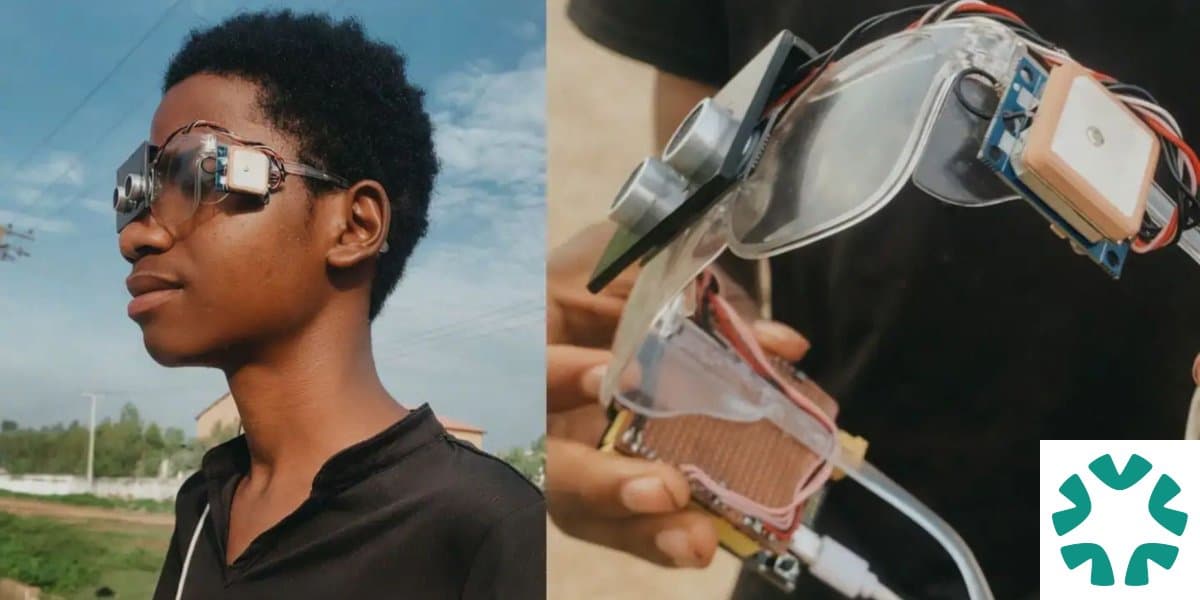
TABLE OF CONTENTS
KEY HIGHLIGHTS
- A 20-year-old inventor from Nigeria is developing AI-powered glasses to assist visually impaired users.
- The glasses use a camera, AI, and voice feedback to detect obstacles and provide audio guidance.
- Features include GPS for location awareness and a tracking system to share the wearer’s location via WhatsApp or email.
- Early prototypes used ultrasonic and infrared sensors, refined based on feedback from a visually impaired tester.
- The technology is still in development and not yet validated as a replacement for established mobility aids.
How the glasses work
The glasses combine a camera, artificial intelligence, and voice feedback to detect obstacles and describe the wearer’s surroundings. According to YourStory, the system turns visual data into audio cues, helping users navigate their environment more independently.
Key features and development
Early prototypes relied on ultrasonic and infrared sensors to trigger alerts, but feedback from a visually impaired tester led to refinements. These included smaller hardware, a wireless switch, and clearer voice prompts instead of simple beeps.
The device also includes GPS for location awareness and a tracking feature. This allows the wearer’s location to be shared with a caregiver via WhatsApp or email, adding a layer of safety for users.
Aminu is working on a version with voice interaction, enabling the glasses to "speak" to the user about their surroundings. The goal is to make the technology more intuitive and practical for daily use.
Current stage and limitations
The technology is still in development and has not been validated as a replacement for established mobility aids like white canes or guide dogs. YourStory notes that further testing and iteration are needed to ensure reliability in real-world conditions.
Aminu demonstrated progress in a post on X on August 19, 2026, highlighting the integration of AI, sensors, and GPS for obstacle detection and location awareness.
Potential impact
If proven reliable, such glasses could complement existing assistive tools by converting visual scenes into audio feedback. This could support safer, more independent travel for visually impaired users.
The project also emphasizes affordability by using accessible components, which could lower costs and broaden availability. Location-sharing features may provide additional reassurance for families and caregivers.
What this means
Lazyfounder analysis — our interpretation, not reported fact.
This project underscores how accessible hardware and AI can be combined to address specific, high-impact needs—particularly in markets where traditional assistive technologies may be costly or unavailable. For founders, it demonstrates the value of iterative testing with end-users and the potential of niche hardware solutions to scale. The focus on affordability and caregiver integration could also inspire similar ventures in other sectors.
Key takeaways
- This project highlights the potential for wearable AI to address niche but critical mobility challenges for visually impaired users.
- Founders in assistive technology may see opportunities to refine or scale similar low-cost, sensor-based solutions.
- The use of accessible components and feedback-driven iteration could serve as a model for hardware startups targeting underserved markets.
- Regulatory validation and real-world testing remain key hurdles before such devices can be reliably commercialized.
Sources
This story is an original summary drafted with AI by Lazyfounder from the reporting listed above and checked by automated validation. Facts are attributed to their original publishers; sections marked as analysis are Lazyfounder's. Where a source is in another language, facts were machine-translated and quotations are reported, not reproduced. Read the original coverage via the links, and see our AI policy and corrections policy.

About the author
Editor, Lazyfounder
Tarun Mottlia edits LazyFounders, covering Indian startups, funding rounds, AI and product launches. Every story on the site is AI-assisted and checked against its cited sources before publication.
More stories by Tarun MottliaGet the LazyFounder Brief
Startup, funding and AI news in a five-minute read. Join the early-access list.
