
4,000-year-old dog paw prints found on Bronze Age mudbrick in Türkiye
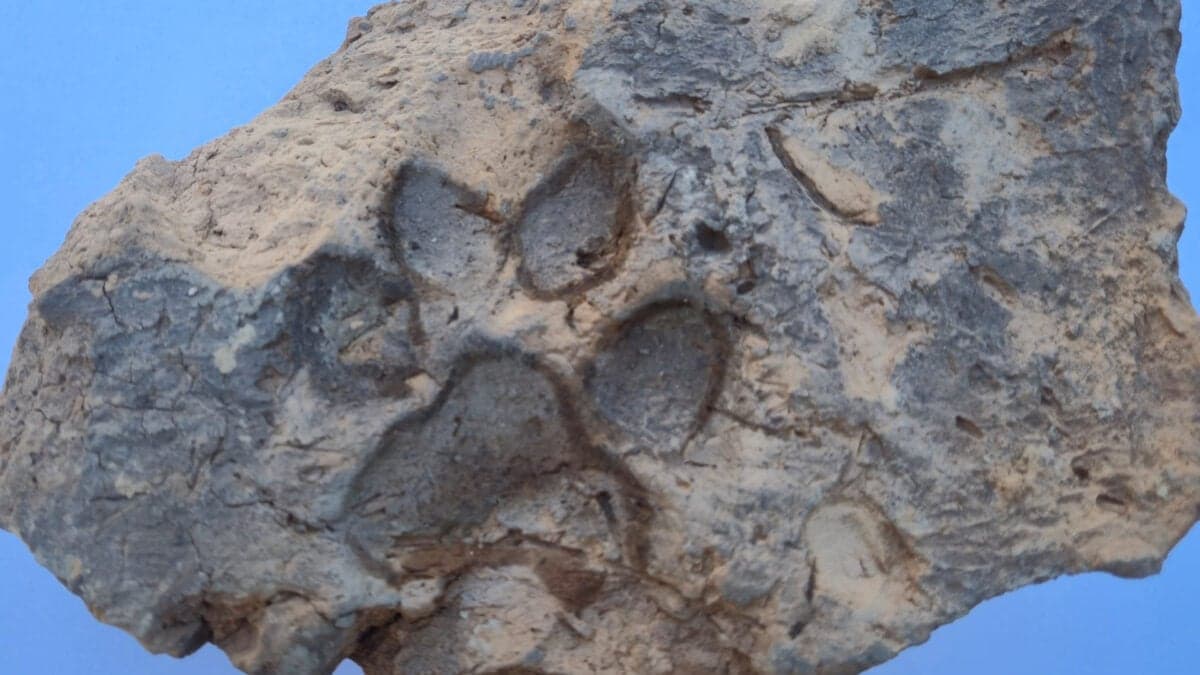
Archaeologists have uncovered approximately 4,000-year-old dog paw prints on a mudbrick at the Tavşanlı Höyük site in Western Anatolia. The discovery, highlighted by Türkiye’s Minister of Culture and Tourism, offers new insights into the daily lives of Bronze Age communities and their relationship with animals.

Editor, Lazyfounder
Discovery at Tavşanlı Höyük
Türkiye’s Minister of Culture and Tourism, Mehmet Nuri Ersoy, shared images of approximately 4,000-year-old dog paw prints found on a mudbrick at the archaeological site of Tavşanlı Höyük in Western Anatolia. The prints, preserved on what is believed to be part of a Bronze Age building, offer a rare glimpse into daily life during that period.
The site, spanning about 111 acres, is one of the largest Bronze Age settlements in the region. Excavations led by archaeologist Erkan Fidan from Bilecik Şeyh Edebali University have been ongoing since 2021. Radiocarbon analysis suggests human settlement at Tavşanlı Höyük dates back as far as 8,000 years, making it a site of significant archaeological value.
Significance of the findings
The discovery of the paw prints adds to the growing body of evidence about the relationship between humans and animals in ancient societies. According to researchers, such traces provide context for understanding how domesticated animals were integrated into daily life during the Bronze Age.
Tavşanlı Höyük has yielded evidence of both human and natural fires, further enriching the narrative of its historical occupation. The site’s continuous use over millennia makes it a critical resource for studying the evolution of early settlements in Western Anatolia.
This finding follows other notable discoveries of animal marks in history, such as cat paw prints on a medieval manuscript in 2013, underscoring how animals have long left their imprint on human civilization.
What this means
Lazyfounder analysis — our interpretation, not reported fact.
For founders and operators in the technology and research sectors, this discovery is a reminder of how cutting-edge tools—such as radiocarbon dating, 3D scanning, and AI-assisted analysis—are transforming archaeology. The ability to extract precise insights from physical artifacts could inspire innovation in fields like historical preservation, digital reconstruction, or even AI-driven pattern recognition for ancient materials. While the direct commercial applications may not be obvious, the methodologies used here could overlap with industries focused on data extraction, material science, or cultural heritage digitization.
Related on Lazyfounder
Sources
- Gizmodo · 2026-10-27
Dog Paw Prints on 4,000-Year-Old Brick Are Adorably Relatable
This story is an original summary drafted with AI by Lazyfounder from the reporting listed above and checked by automated validation. Facts are attributed to their original publishers; sections marked as analysis are Lazyfounder's. Where a source is in another language, facts were machine-translated and quotations are reported, not reproduced. Read the original coverage via the links, and see our AI policy and corrections policy.

About the author
Editor, Lazyfounder
Tarun Mottlia edits LazyFounders, covering Indian startups, funding rounds, AI and product launches. Every story on the site is AI-assisted and checked against its cited sources before publication.
More stories by Tarun MottliaGet the LazyFounder Brief
Startup, funding and AI news in a five-minute read. Join the early-access list.
