
Zerodha’s FY26 revenue shifts: 32% from interest income, broking share drops to 44%
Zerodha’s financial results for FY26 reveal a major shift in its revenue mix, with interest income accounting for 32% of total revenue—more than four times the share of competitor Groww. Broking revenue, once the bulk of its business, now represents just 44% of revenue, down from 70% in FY21. The company’s margin trading funding loan book has also surged, posing new opportunities and risks.

Editor, Lazyfounder
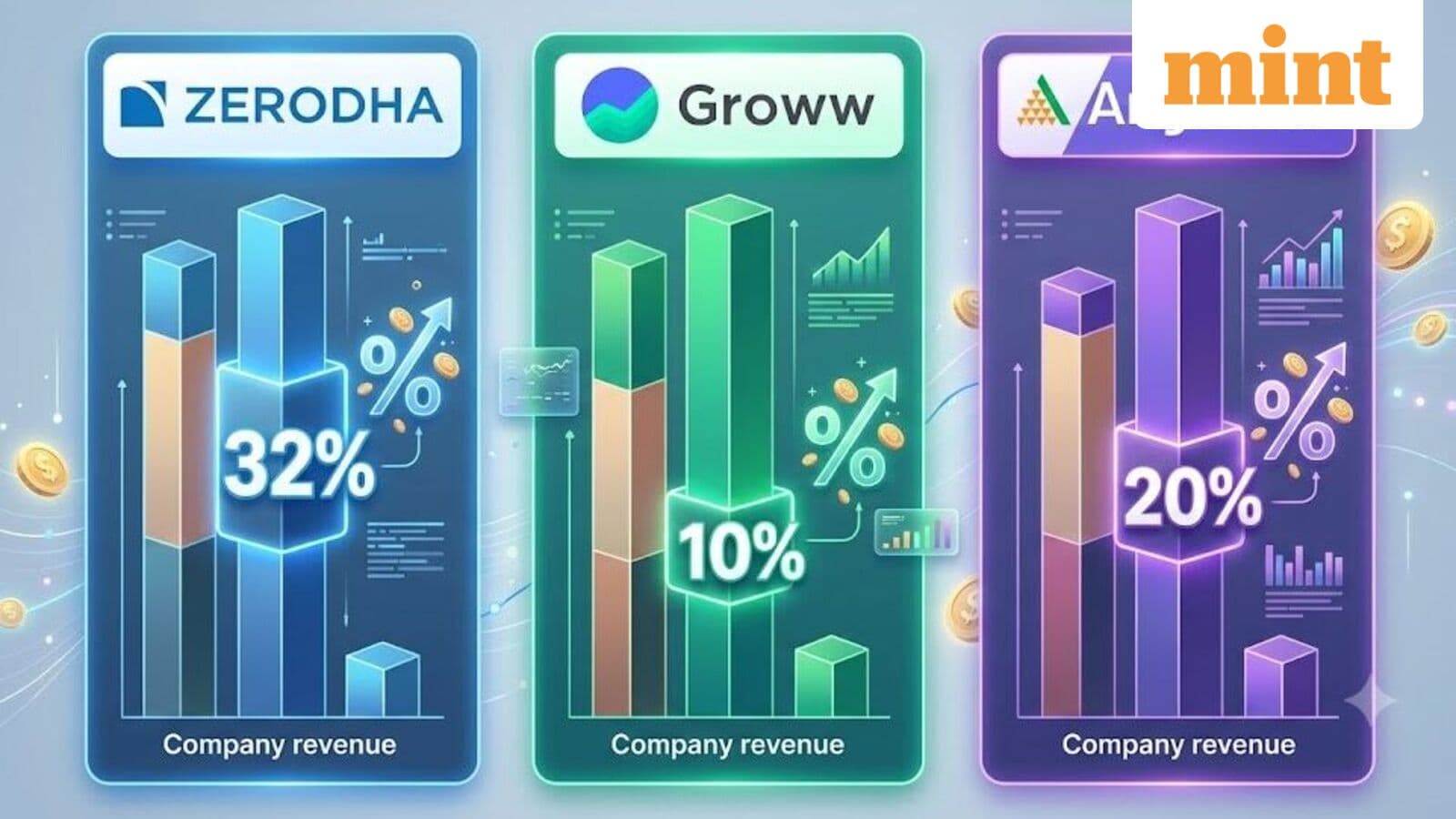
TABLE OF CONTENTS
Revenue mix shift for FY26
Zerodha’s financial performance for FY26 reflects a strategic pivot in its revenue sources. Interest income from customer funds contributed 32% of its total revenue, a share more than four times higher than that of rival Groww, according to data reported by Mint (Technology). Broking revenue, historically the core of Zerodha’s business, now accounts for 44% of its revenue, down from 70% in FY21.
Comparison with competitors
Groww and Angel One, Zerodha’s listed competitors, rely far less on interest income. Groww reported that over 70% of its revenue came from broking, while Angel One earned about 31% of its revenue from interest sources, including loans, margin trading funding (MTF), and customer float. Unlike Zerodha, both competitors maintain a more diversified broking revenue mix, with significant contributions from equity delivery and commodities.
Growth in margin trading funding
Margin trading funding has become a key growth driver for brokers, including Zerodha, as regulatory curbs on derivatives trading increase. Zerodha’s MTF loan book expanded over sixfold to ₹5,368 crore as of 30 June 2026, up from ₹852 crore at the end of March 2025. MTF now contributes 8% of Zerodha’s total revenue, compared with 10% for Groww in the September quarter. ICRA noted that while MTF offers growth opportunities, it also exposes brokers to credit and market risks associated with capital market lending.
Financial strength and risks
Zerodha reported ₹8,500 crore in revenue and ₹4,300 crore in net profit for FY26. ICRA highlighted the company’s strong capital base, with a standalone net worth of ₹19,659 crore and no borrowings. However, the agency also cautioned that Zerodha’s revenue remains heavily dependent on broking and float income—particularly from Futures and Options (F&O), which accounted for 85% of its broking revenue—and is vulnerable to market volatility.
What this means
Lazyfounder analysis — our interpretation, not reported fact.
Zerodha’s FY26 revenue mix signals a deliberate shift away from transaction-heavy broking toward interest-based income, a segment where it now leads its peers. For Indian brokers, this trend highlights two realities:
First, regulatory pressures on derivatives trading are pushing firms to diversify into lending products like MTF, which can generate higher yields but also introduce new risks. Zerodha’s sixfold growth in its MTF loan book shows how quickly these products can scale, but ICRA’s caution about credit and market risks is a reminder that lenders must invest in risk management infrastructure.
Second, the divergence between Zerodha and its rivals—Groww’s focus on broking and Angel One’s broader revenue streams—shows that there is no single winning playbook. Zerodha’s ability to generate 32% of its revenue from interest income, while maintaining near-zero leverage, suggests it is optimizing for capital efficiency, not just scale. For competitors, this raises a strategic question: is it better to chase broking volumes or build lending products that monetize idle customer balances?
Founders and operators should also note the concentration risk: 85% of Zerodha’s broking revenue comes from F&O trading. While this reflects India’s retail trading boom, it leaves the company exposed to regulatory or market shifts that could curb derivatives activity. The lesson is clear—diversification is not optional, but it must be balanced with risk controls.
Related on Lazyfounder
Sources
- Mint (Technology) · 2026-10-28
Interest income contributes 32% of Zerodha revenue: How it compares with Groww, Angel One
This story is an original summary drafted with AI by Lazyfounder from the reporting listed above and checked by automated validation. Facts are attributed to their original publishers; sections marked as analysis are Lazyfounder's. Where a source is in another language, facts were machine-translated and quotations are reported, not reproduced. Read the original coverage via the links, and see our AI policy and corrections policy.

About the author
Editor, Lazyfounder
Tarun Mottlia edits LazyFounders, covering Indian startups, funding rounds, AI and product launches. Every story on the site is AI-assisted and checked against its cited sources before publication.
More stories by Tarun MottliaGet the LazyFounder Brief
Startup, funding and AI news in a five-minute read. Join the early-access list.
