

Vimag Labs raises ₹43 crore for rare-earth-free electric motor
Bengaluru-based Vimag Labs has secured ₹43 crore (~$5 million) to commercialise its Virtual Magnet Synchronous Motor, which eliminates rare-earth magnets in electric vehicles and industrial systems. The company is running pilot projects with vehicle manufacturers as it expands its technology beyond EVs.

Editor, Lazyfounder
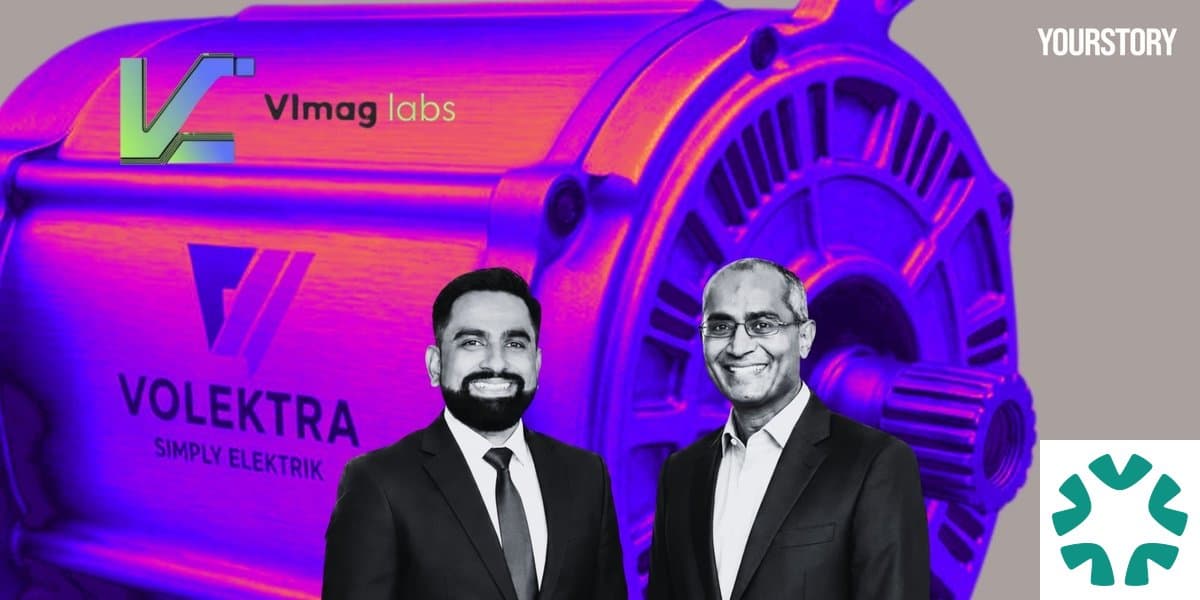
TABLE OF CONTENTS
KEY HIGHLIGHTS
- Vimag Labs, founded in Bengaluru in September 2025, has developed a rare-earth-free Virtual Magnet Synchronous Motor (VMSM).
- The company has raised ₹43 crore (~$5 million) in funding led by Accel, with participation from Chakra Growth Fund and Thinkuvate.
- Vimag Labs holds five granted Indian patents, with additional applications pending.
- The motor prototype delivers 6 kW continuous and 10 kW peak power, with torque ranging from 48 to 58 Newton metres.
- Pilot projects are underway with unnamed two-wheeler and passenger vehicle manufacturers.
What Vimag Labs does
Vimag Labs, based in Bengaluru, has developed a Virtual Magnet Synchronous Motor (VMSM) that operates without rare-earth magnets. The technology replaces permanent magnets with electronically generated magnetic fields, controlled in real time by software and power electronics.
The company was founded in September 2025 by Manish Seth and Piyush Desai. It targets electric vehicles (EVs) and industrial systems, including HVAC and refrigeration, where rare-earth dependency poses supply chain risks.
How the motor works
The VMSM design uses windings on the rotor instead of fixed magnets. A rotating transformer delivers power to the rotor without physical contact, addressing the traditional challenge of brush wear in wound-rotor motors.
The company describes the magnetic flux as software-defined, allowing real-time adjustments to optimize performance under varying loads. This contrasts with permanent magnet motors, which produce a fixed magnetic field.
The prototype delivers 6 kW continuous and 10 kW peak power, with torque ranging from 48 to 58 Newton metres. Vimag Labs claims the motor’s efficiency and performance are comparable to conventional permanent magnet motors.
Intellectual property and funding
Vimag Labs holds five granted Indian patents, including one for a rotating transformer-excited synchronous motor and its control, granted in July 2026. The company has ten additional patent applications and fifteen trademarks in progress.
In January 2026, the company raised ₹43 crore (~$5 million) in a funding round led by Accel, with participation from Chakra Growth Fund and Thinkuvate. The funds are earmarked for commercialising the motor platform and expanding engineering and manufacturing capabilities.
Pilot projects and market focus
Vimag Labs is running pilot projects with unnamed two-wheeler and passenger vehicle manufacturers. The company is also extending its technology to light and heavy commercial vehicles and industrial applications, where rare-earth supply chain risks are similarly critical.
No commercial contracts or production programmes have been announced yet. The company acknowledges that validation and integration into vehicle manufacturing timelines typically span years.
What this means
Lazyfounder analysis — our interpretation, not reported fact.
Vimag Labs’ rare-earth-free motor technology addresses a critical vulnerability in the EV supply chain: dependence on rare-earth magnets. For founders and operators in the EV and industrial motor sectors, this development signals two possibilities. First, it introduces a potential alternative to conventional motor designs, which could reduce procurement risks and costs. Second, it may accelerate competition in the space, pushing incumbents to explore or invest in similar technologies.
The funding and patent portfolio suggest that investors and the market see value in software-defined motor architectures. For startups working on EV components or industrial systems, this could open doors for collaboration or highlight the need to differentiate their own offerings.
Key takeaways
- Rare-earth dependency is a procurement risk for EV manufacturers; Vimag Labs’ technology eliminates this risk by removing the need for rare-earth magnets.
- The software-defined motor design could offer adaptability across driving conditions, potentially improving efficiency and performance.
- Startups and manufacturers in the EV and industrial motor sectors may face new competition or collaboration opportunities as Vimag Labs scales.
- The funding and patent portfolio signal confidence in alternative motor technologies, which could accelerate innovation in the sector.
Sources
This story is an original summary drafted with AI by Lazyfounder from the reporting listed above and checked by automated validation. Facts are attributed to their original publishers; sections marked as analysis are Lazyfounder's. Where a source is in another language, facts were machine-translated and quotations are reported, not reproduced. Read the original coverage via the links, and see our AI policy and corrections policy.

About the author
Editor, Lazyfounder
Tarun Mottlia edits LazyFounders, covering Indian startups, funding rounds, AI and product launches. Every story on the site is AI-assisted and checked against its cited sources before publication.
More stories by Tarun MottliaGet the LazyFounder Brief
Startup, funding and AI news in a five-minute read. Join the early-access list.
