
Ukrainian developers test 3D-printed airless wheels for battlefield robots
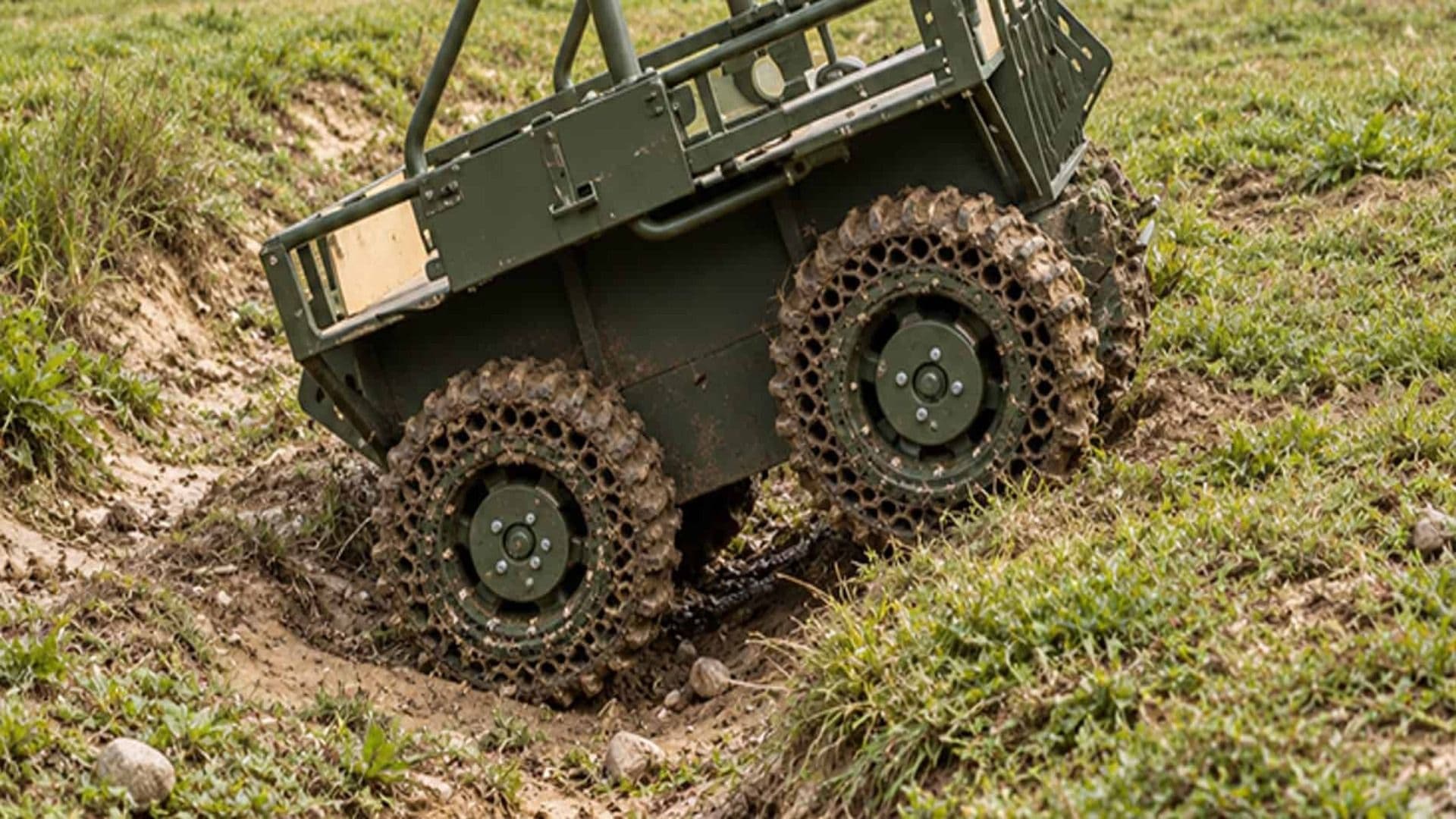
Ukrainian developers Print&Live UA and iSCALE 3D have completed combat trials of 3D-printed airless wheels designed for ground robotic vehicles. The wheels are intended to improve resistance to punctures, explosions, and other battlefield damage while enhancing mobility and energy efficiency.

Editor, Lazyfounder
30 SEC SUMMARY
- Ukrainian developers Print&Live UA and iSCALE 3D have completed combat trials of 3D-printed airless wheels for ground robotic vehicles.
- The wheels are designed to resist punctures, explosions, and battlefield damage while improving mobility and energy efficiency.
- The airless design eliminates the need for inflation and routine pressure maintenance, enhancing reliability in combat conditions.
- The complete wheel set weighs 32–56 kg, significantly lighter than foreign alternatives (88–144 kg).
- Limited production is underway for delivery to combat units, though independent operational evidence is still needed.
TABLE OF CONTENTS
KEY HIGHLIGHTS
- Ukrainian engineers have developed 3D-printed airless wheels for ground robotic vehicles to improve resistance to battlefield damage.
- The wheels feature a rounded tread, closed profile, and two-piece disc for better cross-country ability and energy efficiency.
- The design eliminates dependence on internal air pressure, reducing the risk of failure from punctures or explosions.
- The complete wheel set weighs between 32 and 56 kg, compared to 88–144 kg for foreign airless alternatives.
- A patented two-piece rim allows for easier field repairs without specialized machinery.
- Production is underway in limited quantities for delivery to combat units.
What the wheels offer for battlefield robotics
According to TechRadar, Ukrainian developers Print&Live UA and iSCALE 3D have completed combat trials of 3D-printed airless wheels designed for ground robotic vehicles. The wheels aim to address key challenges in battlefield operations, including resistance to punctures, explosions, and other forms of damage.
The airless design eliminates the need for inflation and routine pressure maintenance, a common vulnerability in traditional tyres. This feature is intended to enhance reliability and reduce downtime in combat conditions, where repairs or replacements may be difficult to perform.
The wheels incorporate a rounded tread, closed profile, and a two-piece disc. These elements are reported to improve cross-country ability, energy efficiency, and overall mobility of robotic platforms. The enclosed construction and curved tread geometry also help prevent the accumulation of dirt, stones, and ice, which can impair performance.
The internal structure of the wheels uses a digitally adaptable lattice made from durable elastomers and composite polymers. This allows engineers to adjust stiffness, shock absorption, and geometry based on a robot’s weight and operational requirements, offering flexibility in deployment.
Weight and efficiency advantages
One of the standout features of the Ukrainian wheels is their weight. The complete set weighs between 32 and 56 kg, which is significantly lighter than foreign airless alternatives, which range from 88 to 144 kg. This reduction in unsprung and rotating mass could ease mechanical demands on gearboxes and electric drive systems, potentially improving the lifespan of robotic platforms.
The developers claim the design could extend the operating distance of ground robotic vehicles by up to 30% compared to foreign alternatives. This improvement in energy efficiency could be critical for missions requiring extended range or endurance in challenging environments.
Field repairs and production status
The wheels feature a patented two-piece rim, which simplifies field servicing. Damaged tyres can be installed or replaced without conventional tyre-changing machinery, a significant advantage in environments where workshop facilities are unavailable. According to the developers, this design removes the need for specialized presses, making repairs more accessible for frontline units.
Production of the wheels is already underway, though in limited quantities. They are being delivered to combat units for further testing and operational use. However, independent evidence is still needed to verify their performance under sustained use, repeated impacts, and varying battlefield conditions.
What this means
Lazyfounder analysis — our interpretation, not reported fact.
For founders and operators in robotics, defense, or advanced manufacturing, this development underscores the strategic value of adaptable, resilient components in extreme environments. The shift toward airless, 3D-printed wheels highlights how additive manufacturing can address specific pain points—like maintenance and durability—while offering modularity for different use cases.
However, the claims remain unproven in large-scale, independent trials. Startups in this space should watch for operational feedback from combat units, as real-world performance data could validate or challenge the technology’s advantages. If successful, this approach could inspire similar innovations in civilian robotics, logistics, or off-road vehicles, where durability and low maintenance are also critical.
Key takeaways
- Founders in robotics and defense should monitor the performance of these wheels in real-world conditions, as successful trials could accelerate adoption of airless tyres in both military and civilian applications.
- The use of 3D printing for adaptable, lightweight components demonstrates how additive manufacturing can solve niche problems in extreme environments, potentially opening doors for startups in other industries.
- The two-piece rim design highlights the importance of field-repairable systems in scenarios where traditional maintenance infrastructure is unavailable—a consideration for startups targeting remote or high-risk operations.
- The claimed 30% improvement in operating distance could be a game-changer for battery-powered robotic platforms, but independent validation is essential before scaling.
- Startups should assess whether the trade-offs—such as production cost or material limitations—outweigh the benefits of airless designs for their specific use cases.
FAQ
How do these 3D-printed wheels improve upon traditional tyres in combat?
The wheels are airless, eliminating the risk of punctures or deflation from battlefield damage. Their design also reduces weight, improves energy efficiency, and allows for easier field repairs without specialized machinery.
What materials are used in the wheels?
The wheels use a digitally adaptable lattice made from durable elastomers and composite polymers, which allows for adjustments in stiffness, shock absorption, and geometry.
Are these wheels already in use by Ukrainian combat units?
Limited production is underway, and the wheels are being delivered to combat units for further testing. However, independent operational evidence is still needed to confirm their performance in sustained combat conditions.
Related on Lazyfounder
Sources
- TechRadar · 2026-10-14
3D-printed airless wheels could be a game changer for Ukraine's ground robotic vehicles — ultralight no-deflation tyres improve resistance to punctures and explosions
This story is an original summary drafted with AI by Lazyfounder from the reporting listed above and checked by automated validation. Facts are attributed to their original publishers; sections marked as analysis are Lazyfounder's. Where a source is in another language, facts were machine-translated and quotations are reported, not reproduced. Read the original coverage via the links, and see our AI policy and corrections policy.

About the author
Editor, Lazyfounder
Tarun Mottlia edits LazyFounders, covering Indian startups, funding rounds, AI and product launches. Every story on the site is AI-assisted and checked against its cited sources before publication.
More stories by Tarun MottliaGet the LazyFounder Brief
Startup, funding and AI news in a five-minute read. Join the early-access list.
