
UiPath CEO Daniel Dines emphasizes human accountability in AI at Dubai event
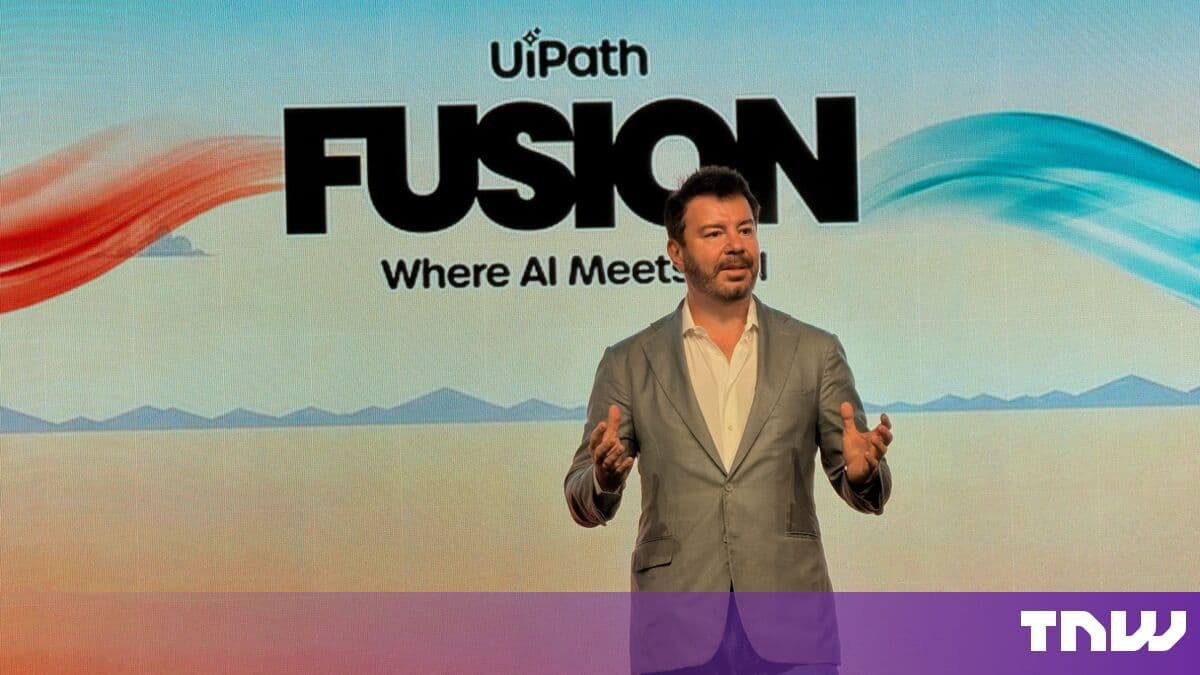
UiPath founder and CEO Daniel Dines addressed customers at the FUSION event in Dubai, advocating for human oversight in AI deployment. He also highlighted AI’s limitations and the need for education reform to align with an AI-driven economy. UiPath’s partnerships with UAE industries, including banking and government, underscored the region’s role in adopting advanced automation.

Editor, Lazyfounder
30 SEC SUMMARY
- UiPath CEO Daniel Dines spoke at the FUSION event in Dubai about human accountability in AI deployment.
- Dines criticized the current education system as outdated for an AI-driven world and outlined AI’s limitations.
- UiPath’s Cartographer product was launched in Las Vegas in September, with growing adoption in the UAE.
- UAE industries like banking, government, and oil and gas are engaging with UiPath for advanced automation.
KEY HIGHLIGHTS
- UiPath CEO Daniel Dines emphasized the need for human accountability in steering AI and delegating work to it.
- Dines identified three limits of AI: accountability, lack of on-the-job learning, and lack of exactness.
- He advised against using AI for tasks that traditional software can handle reliably.
- UiPath’s Cartographer was launched in Las Vegas in September.
- The UAE government was highlighted as a progressive partner in AI adoption.
- UiPath is working with UAE industries such as banking, government, retail, and oil and gas for advanced automation.
Human accountability in AI deployment
According to The Next Web, Dines stressed that companies will increasingly delegate tasks to AI but must retain human accountability for its actions. He argued that AI cannot learn on the job or deliver exact results, making human oversight critical, especially in scenarios with legal or financial consequences—such as sending an email to a customer.
Dines advised companies to avoid using AI for tasks that traditional software can handle reliably. Instead, he suggested using AI to build software, with humans reviewing and testing it before deployment.
AI’s limitations and education reform
Dines outlined three key limitations of AI: accountability, lack of on-the-job learning, and lack of exactness. He illustrated this with an example of AI learning the law from books but failing to understand its application within a specific company.
He also criticized the current education system as outdated, arguing it was designed for the industrial revolution to produce disciplined factory workers rather than adaptable thinkers. Dines suggested companies will need fewer narrow specialists and more generalists who understand entire systems.
UiPath’s expansion and UAE partnerships
UiPath’s Cartographer product, launched in Las Vegas in September, reflects the company’s push into advanced automation tools. At the FUSION event, Dines highlighted the UAE government as a progressive partner in AI adoption, noting that companies in the region that automated early were better equipped to handle disruptions.
UiPath is actively engaging with industries in the UAE, including banking, government, retail, and oil and gas, to implement what it terms 'agentic automation.' Karl Crowther, UiPath’s Regional Vice President for the Middle East and Africa, emphasized the region’s growing role in adopting such technologies.
What this means
Lazyfounder analysis — our interpretation, not reported fact.
Dines’ remarks at FUSION underscore a critical tension in AI adoption: while AI can augment workflows, its limitations demand human oversight—particularly in high-stakes industries like banking and government. For founders and operators, this signals a need to design AI systems with built-in accountability mechanisms, such as audit trails or human review gates. His critique of the education system also hints at a broader shift in hiring, favoring generalists who can oversee AI systems over narrow specialists. The UAE’s rapid adoption of UiPath’s tools suggests the region may serve as a testbed for how AI-driven automation scales in regulated industries.
Key takeaways
- Founders and operators must design AI systems with clear human oversight, especially in regulated industries like banking and government.
- UiPath’s focus on 'agentic automation' in the UAE signals a growing market for AI-driven process management in the region.
- Dines’ critique of the education system suggests a shift toward hiring generalists who can oversee AI systems rather than narrow specialists.
Related on Lazyfounder
Sources
- The Next Web · 2026-11-02
UiPath’s Dines says people must steer AI and answer for what it does
This story is an original summary drafted with AI by Lazyfounder from the reporting listed above and checked by automated validation. Facts are attributed to their original publishers; sections marked as analysis are Lazyfounder's. Where a source is in another language, facts were machine-translated and quotations are reported, not reproduced. Read the original coverage via the links, and see our AI policy and corrections policy.

About the author
Editor, Lazyfounder
Tarun Mottlia edits LazyFounders, covering Indian startups, funding rounds, AI and product launches. Every story on the site is AI-assisted and checked against its cited sources before publication.
More stories by Tarun MottliaGet the LazyFounder Brief
Startup, funding and AI news in a five-minute read. Join the early-access list.
