
TVS family files caveats across courts amid succession dispute
The TVS family, a prominent name in India’s automotive and manufacturing sectors, is embroiled in a succession dispute that has led to legal filings across multiple judicial forums. Both factions of the family have filed caveats to ensure their arguments are heard before any judgement is passed, signaling a protracted legal battle.

Editor, Lazyfounder
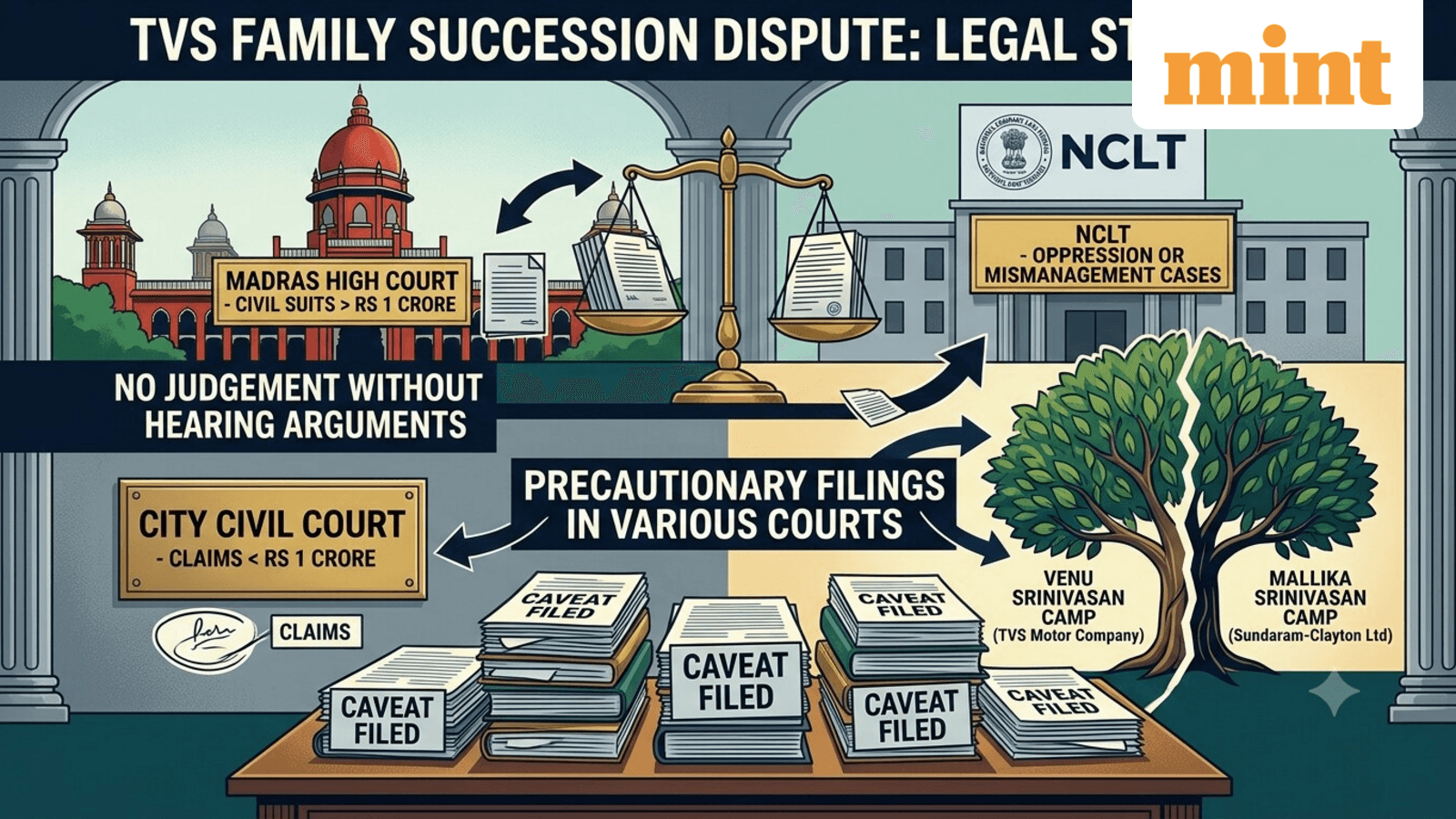
Legal manoeuvres in the TVS succession dispute
The TVS family, led by Venu Srinivasan, chairman and managing director of TVS, and his wife Mallika Srinivasan, chairperson of Sundaram-Clayton Ltd (SCL), is currently split into two camps amid a succession dispute. The dispute involves their children, Sudarshan Venu, chairman and managing director of TVS Motor Company, and Lakshmi Venu, head of SCL.
According to legal filings reviewed by Mint, both factions have filed caveats in Chennai’s City Civil Court, the Madras High Court, and the National Company Law Tribunal (NCLT). Caveats are legal notices that prevent courts from passing orders without hearing the party that filed them. This move suggests that neither side is willing to risk an adverse judgement without presenting their case.
The dispute reportedly surfaced in April 2025 after TVS Holdings disclosed that Sudarshan Venu had been named a Significant Beneficial Owner (SBO) through trust structures. This development appears to have triggered disagreements over the division of family wealth and control of group companies.
Jurisdiction and legal strategy
The choice of judicial forums reflects the valuation and nature of the legal claims. Lawsuits valued at over ₹1 crore fall under the jurisdiction of the Madras High Court, while those below this threshold, or those seeking injunctions, are handled by the City Civil Court. Cases involving allegations of oppression or mismanagement are directed to the NCLT.
In March 2024, the family signed a memorandum of understanding (MoU) covering brand usage and non-compete clauses. However, the MoU does not address economic settlement or wealth division, leaving these critical issues unresolved. Lakshmi Venu has reportedly sought fair discussions to resolve the dispute, but the caveats indicate a lack of consensus.
What this means
Lazyfounder analysis — our interpretation, not reported fact.
For founders and operators in family-run businesses, the TVS dispute is a stark reminder of the complexities surrounding succession planning. The legal filings highlight how unresolved disagreements over wealth division, control, and ownership can escalate into public and protracted legal battles. This case also underscores the importance of addressing economic settlements and governance structures in advance, rather than relying on interim agreements that leave critical issues unaddressed.
The involvement of multiple courts further complicates the dispute, as each forum has distinct procedures and timelines. For businesses with similar structures, this serves as a cautionary tale about the risks of delaying comprehensive succession planning.
Related on Lazyfounder
Sources
- Mint (Technology) · 2026-10-27
From city civil courts to Madras HC to NCLT: Why TVS camps are filing caveats across courts amid succession dispute
This story is an original summary drafted with AI by Lazyfounder from the reporting listed above and checked by automated validation. Facts are attributed to their original publishers; sections marked as analysis are Lazyfounder's. Where a source is in another language, facts were machine-translated and quotations are reported, not reproduced. Read the original coverage via the links, and see our AI policy and corrections policy.

About the author
Editor, Lazyfounder
Tarun Mottlia edits LazyFounders, covering Indian startups, funding rounds, AI and product launches. Every story on the site is AI-assisted and checked against its cited sources before publication.
More stories by Tarun MottliaGet the LazyFounder Brief
Startup, funding and AI news in a five-minute read. Join the early-access list.
