
Traversal raises $120 million Series B at $1 billion valuation for AI-driven SRE
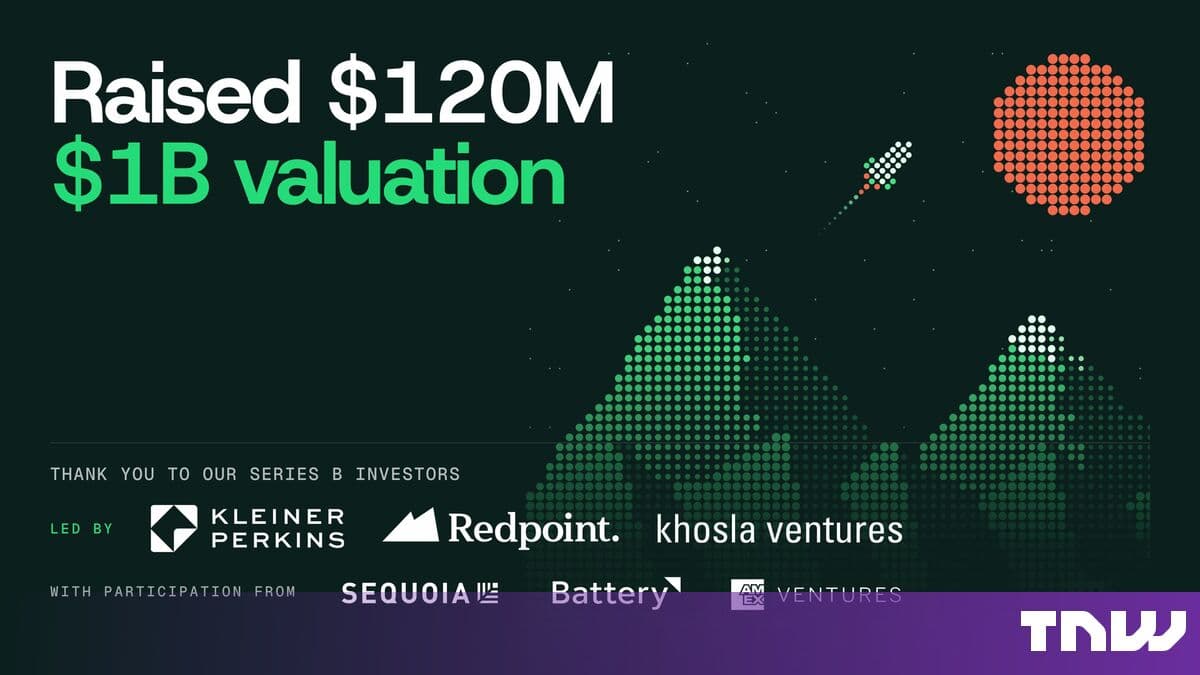
Traversal, a New York-based startup building AI agents for site reliability engineering (SRE), has closed a $120 million Series B funding round at a $1 billion valuation. The round was co-led by Kleiner Perkins, Redpoint Ventures, and Khosla Ventures, with participation from existing investors Sequoia Capital, Battery Ventures, and Amex Ventures.

Editor, Lazyfounder
30 SEC SUMMARY
- Traversal, a New York-based AI startup specializing in site reliability engineering (SRE), has raised $120 million in a Series B round.
- The funding round, co-led by Kleiner Perkins, Redpoint Ventures, and Khosla Ventures, values Traversal at $1 billion.
- Traversal’s AI agents automate debugging and incident resolution for enterprise IT infrastructure, addressing a $600 billion annual downtime problem.
- The company’s annual recurring revenue has grown ninefold since the start of the year, with over 150,000 investigations run last quarter.
TABLE OF CONTENTS
KEY HIGHLIGHTS
- $120 million Series B round values Traversal at $1 billion.
- Co-led by Kleiner Perkins, Redpoint Ventures, and Khosla Ventures, with participation from Sequoia Capital, Battery Ventures, and Amex Ventures.
- Traversal’s AI agents specialize in diagnosing and resolving IT infrastructure failures, addressing a $600 billion annual downtime cost for enterprises.
- Annual recurring revenue has grown ninefold since the start of the year, with over 150,000 investigations run last quarter.
AI agents for site reliability engineering
Traversal’s AI agents automate site reliability engineering (SRE) by identifying and resolving software failures in enterprise IT infrastructure. The startup’s technology targets a growing problem: enterprise downtime costs have surged over 50% in the last two years, totaling $600 billion annually worldwide, according to SiliconANGLE.
The company’s platform includes a Production World Model, which maps telemetry, code, and deployment history into a format readable by AI; a Causal Search Engine, which tests thousands of potential causes simultaneously; and Traversal Workers, which initiate investigations as soon as alerts trigger. A fourth component, Traversal MCP, shares incident learnings with AI coding agents to prevent future failures.
Traversal also developed ORCA-bench, a benchmark for evaluating AI agents in SRE, in collaboration with Cornell Tech and Columbia University. The benchmark, which assesses agents on 1,079 root-cause analysis tasks, revealed that even the best frontier AI models achieved only 25.3% accuracy on medium-difficulty incidents, with hallucination rates exceeding 40%. Traversal claims its AI outperforms these models in SRE tasks.
Growth and customer adoption
Traversal’s annual recurring revenue has grown ninefold since the start of the year, while its monthly active users have multiplied by 20. Customers ran over 150,000 investigations on the platform last quarter, up from just 513 earlier in the year.
The startup’s customer base includes Nubank, Harvey, DigitalOcean, PepsiCo, American Express, and Blackstone. Over two-thirds of Traversal’s usage now extends beyond root-cause analysis, covering alert triage, release risk assessment, and security.
Team and funding background
The founding team includes Anish Agarwal (CEO), Raj Agrawal, Raaz Dwivedi, and Ahmed Lone, who bring backgrounds from academia and quantitative trading. Agarwal and Dwivedi retain faculty positions at Columbia University and Cornell Tech, respectively.
Traversal emerged from stealth in June 2025 with $48 million in funding from Sequoia Capital and Kleiner Perkins. Amex Ventures joined as an investor in December 2025. The latest round brings the company’s total funding to $173 million.
Investor confidence and expansion plans
Kleiner Perkins, Redpoint Ventures, and Khosla Ventures co-led the Series B round, with existing investors Sequoia Capital and Battery Ventures increasing their stakes. The participation of Amex Ventures, a corporate investor, highlights traction in financial services.
Traversal plans to expand its research, engineering, and go-to-market teams, leveraging the new funding to scale its platform and customer base.
Related trends in AI and venture capital
Traversal’s funding round reflects broader investor interest in AI-driven enterprise tools, particularly those addressing critical inefficiencies like IT downtime. This aligns with Sequoia Capital’s recent focus on consolidating its early-stage and growth teams, as reported in LazyFounder’s earlier coverage, signaling a preference for scalable, high-impact startups.
The startup’s use of AI agents for specialized tasks echoes findings from experiments in simulated environments, such as those in Minecraft, where AI models developed bureaucracies and specialized languages. While Traversal’s agents operate in a more structured domain, the underlying trend of AI systems evolving to handle complex, real-world problems is consistent.
What this means
Lazyfounder analysis — our interpretation, not reported fact.
Traversal’s $1 billion valuation and rapid revenue growth underscore the urgency of solving enterprise IT failures—a $600 billion annual problem that manual processes and generic AI models have struggled to address. For founders and operators in enterprise software, this deal signals three things:
First, the SRE automation market is attracting capital at scale. Traversal’s funding round, co-led by top-tier VCs, suggests that startups tackling niche but high-cost inefficiencies in IT operations can command premium valuations. Competitors in this space may see heightened investor interest, but they will also face pressure to demonstrate similarly robust benchmarks for accuracy and reliability.
Second, the participation of corporate investors like Amex Ventures and adoption by financial services giants (Nubank, American Express, Blackstone) point to a clear enterprise appetite for AI-driven incident resolution. Startups in adjacent verticals—cybersecurity, FinTech, or cloud operations—might explore partnerships or product expansions to tap into this demand.
Third, Traversal’s ORCA-bench benchmark highlights a critical gap in frontier AI models: their inability to perform complex, real-world tasks like root-cause analysis without hallucinating. Founders building AI agents for enterprise use cases should prioritize domain-specific training and causality-driven models, as generic large language models may not suffice for high-stakes environments.
Key takeaways
- Enterprise downtime costs ($600B annually) are creating a compelling market for AI-driven SRE tools, with Traversal’s $1B valuation reflecting investor confidence in automation.
- Traversal’s benchmarks reveal that generic AI models underperform in SRE tasks, signaling demand for specialized, causality-driven AI agents in enterprise IT.
- Corporate adoption (Nubank, PepsiCo, American Express) and investor participation (Amex Ventures) highlight traction in financial services, a key vertical for SRE automation.
- Founders in AI-driven infrastructure tools should focus on scalability and measurable accuracy, as investors prioritize startups with clear benchmarks and rapid revenue growth.
Related on Lazyfounder
Sources
- The Next Web · 2026-11-04
Traversal raises $120M at a $1B valuation to fix what AI code breaks - SiliconANGLE · 2026-11-04
Autonomous site reliability engineering startup Traversal bags $120M in funding at a $1B valuation
This story is an original summary drafted with AI by Lazyfounder from the reporting listed above and checked by automated validation. Facts are attributed to their original publishers; sections marked as analysis are Lazyfounder's. Where a source is in another language, facts were machine-translated and quotations are reported, not reproduced. Read the original coverage via the links, and see our AI policy and corrections policy.

About the author
Editor, Lazyfounder
Tarun Mottlia edits LazyFounders, covering Indian startups, funding rounds, AI and product launches. Every story on the site is AI-assisted and checked against its cited sources before publication.
More stories by Tarun MottliaGet the LazyFounder Brief
Startup, funding and AI news in a five-minute read. Join the early-access list.
