

Supertails grows revenue to ₹200 Cr, prioritizes unit economics over expansion
Supertails, an Indian pet care startup, has grown its operating revenue to over ₹200 Cr in FY26 while maintaining stable losses. The company is now shifting its focus from expansion to unit economics and profitability as it aims for financial sustainability within the next 24-36 months.

Editor, Lazyfounder
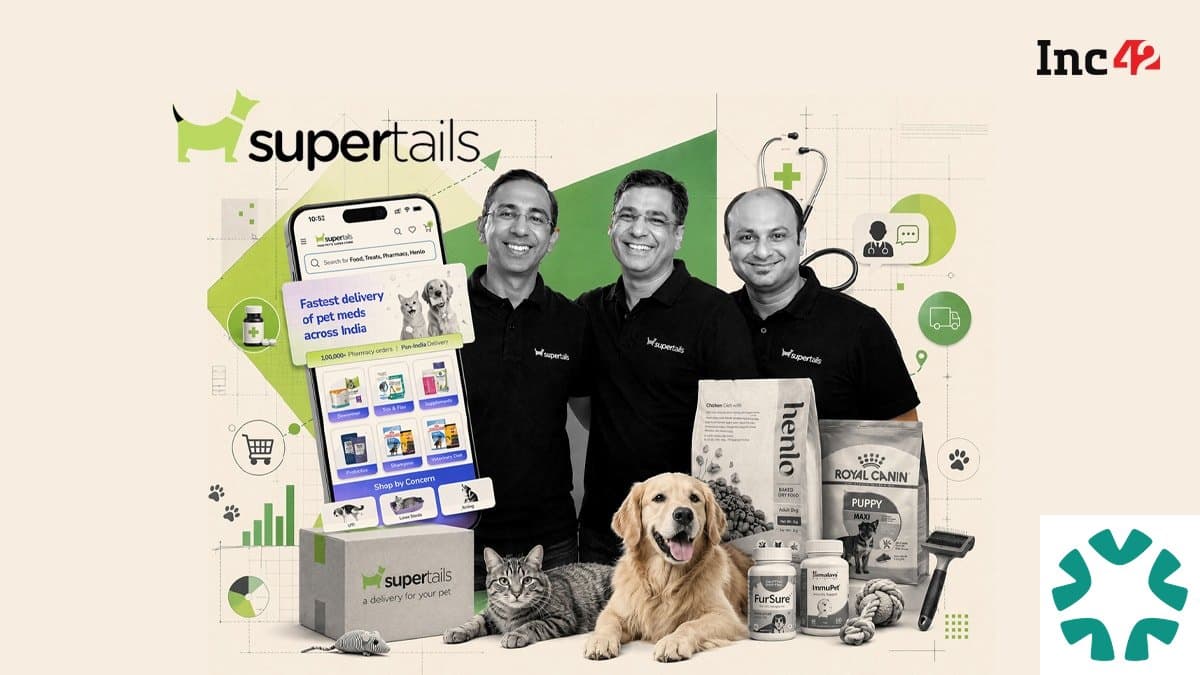
TABLE OF CONTENTS
KEY HIGHLIGHTS
- Supertails reports operating revenue growth from ₹109 Cr in FY25 to over ₹200 Cr in FY26, with losses remaining stable despite infrastructure investments.
- The startup now serves nearly one million pet parents and expects revenue of ₹350 Cr-₹400 Cr in the current financial year.
- Supertails has expanded into veterinary clinics (12 in Bengaluru), quick commerce (45 dark stores), private-label pet food, and AI-driven recommendations.
- The company aims for financial sustainability within 24-36 months, with a longer-term goal of going public.
Revenue growth and financial outlook
According to Inc42, Supertails’ operating revenue increased from ₹109 Cr in FY25 to more than ₹200 Cr in FY26. The startup reported that losses remained broadly unchanged during this period, despite significant investments in clinics, dark stores, and healthcare infrastructure.
Supertails expects to achieve revenue of ₹350 Cr-₹400 Cr in the current financial year. The company now serves nearly one million pet parents, a milestone that reflects its expansion across multiple categories in the pet care ecosystem.
Expansion across the pet care value chain
Supertails has built a vertically integrated platform spanning pet food, accessories, pharmacy, teleconsultations, veterinary clinics, and quick commerce. The startup operates 12 veterinary clinics in Bengaluru and employs over 110 veterinarians. It has also launched 45 partner-operated dark stores across three cities to support its quick commerce vertical.
The company introduced its premium private-label pet food brand, Henlo, to address gaps in the market between imported and domestic products. This move aims to improve margins and offer specialized diets recommended by its veterinarians.
Supertails is leveraging AI to build a recommendation engine that uses customer data, including purchase history and veterinary records, to personalize product suggestions and improve retention.
Strategic shift toward sustainability
Supertails is prioritizing the utilization of its existing infrastructure over aggressive expansion into new cities or categories. The startup believes that increasing customer engagement across its verticals—such as food, healthcare, and quick commerce—will drive sustainable growth.
Vineet Khanna, cofounder of Supertails, stated that the company has entered a phase where unit economics and profitability are critical. The focus is now on making the existing ecosystem more productive, rather than simply adding new revenue streams.
The startup is targeting financial sustainability within the next 24-36 months and has expressed ambitions of going public in the longer term.
Challenges and metrics for the next phase
Supertails’ quick commerce business is growing at double-digit month-on-month rates, but the company must prove that faster delivery creates incremental demand rather than cannibalizing existing orders.
The startup’s clinics and private-label products are key to improving margins, but their success depends on higher adoption and utilization. Recommendations based on customer data must translate into increased retention and purchase frequency to justify the infrastructure investments.
Three metrics will be critical for Supertails’ next phase: customer retention and purchase frequency across categories, utilization of healthcare and delivery infrastructure, and the margin contribution of private labels and owned products.
What this means
Lazyfounder analysis — our interpretation, not reported fact.
Supertails’ journey highlights a critical phase for ecosystem-driven startups: the transition from rapid expansion to sustainable unit economics. For founders, this signals that investors may increasingly prioritize profitability and operational efficiency over mere topline growth, even in high-potential markets like pet care. The startup’s bet on consolidating multiple services under one platform could also pressure competitors to either specialize or follow a similar path, reshaping how pet care is delivered in India.
Key takeaways
- Supertails’ expansion into healthcare, quick commerce, and private labels reflects a broader trend in India’s pet care market, where startups are consolidating fragmented services to drive recurring revenue.
- The startup’s focus on unit economics and infrastructure utilization signals a shift in growth strategy for vertically integrated platforms, which founders in similar sectors may need to monitor.
- With public listing ambitions, Supertails’ ability to balance growth with profitability could set a benchmark for other ecosystem-driven startups in consumer sectors.
Sources
- inc42.com · 2026-08-25
Supertails Has Built The Pet-Care Ecosystem, But Can It Make The Economics Work?
This story is an original summary drafted with AI by Lazyfounder from the reporting listed above and checked by automated validation. Facts are attributed to their original publishers; sections marked as analysis are Lazyfounder's. Where a source is in another language, facts were machine-translated and quotations are reported, not reproduced. Read the original coverage via the links, and see our AI policy and corrections policy.

About the author
Editor, Lazyfounder
Tarun Mottlia edits LazyFounders, covering Indian startups, funding rounds, AI and product launches. Every story on the site is AI-assisted and checked against its cited sources before publication.
More stories by Tarun MottliaGet the LazyFounder Brief
Startup, funding and AI news in a five-minute read. Join the early-access list.
