

Engineer quits job to clean Patna’s Ganga ghats, builds volunteer network
Subham Kumar, a former civil engineer, left his job in 2018 to clean Patna’s Ganga ghats after witnessing their pollution. His solo effort has grown into the Being Helper Foundation, which has removed 2.47 lakh kg of waste and mobilized over 1,100 volunteers. The foundation now works on waste segregation, recycling, and civic infrastructure across multiple districts in Bihar.

Editor, Lazyfounder
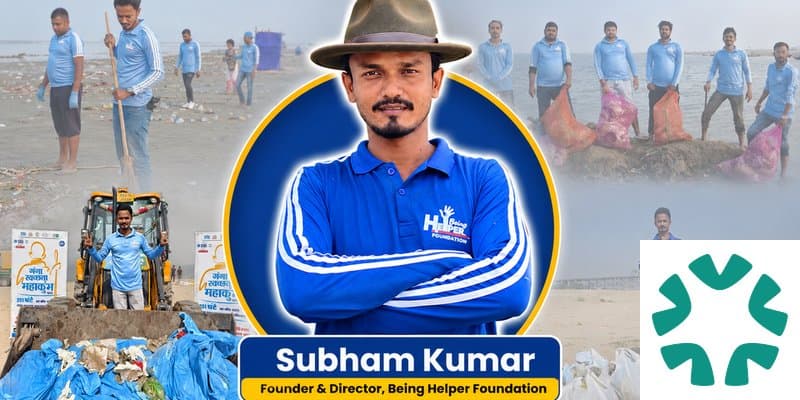
TABLE OF CONTENTS
KEY HIGHLIGHTS
- Subham Kumar, a civil engineer, quit his job in 2018 to clean Patna’s Digha Ganga Ghat.
- His initiative grew into the Being Helper Foundation, now involving over 1,100 volunteers.
- The foundation has removed 2.47 lakh kg of waste and collected over 3 lakh plastic bottles for recycling.
- It has set up 45 Bottle Banks in Patna to collect 11,000 plastic bottles weekly.
- The work includes waste segregation, civic awareness, and infrastructure like changing rooms for women at 12 ghats.
From engineering to environmental action
Subham Kumar, a civil engineer from Bihar, left his job in Bengaluru in 2018 to address waste pollution on Patna’s Ganga ghats. According to YourStory, he was inspired after visiting Varanasi, where he observed the Ganga’s role in culture, tourism, and local livelihoods. The stark contrast with Patna’s polluted ghats prompted him to start cleaning alone, later gaining support from friends and local residents.
Growth of the Being Helper Foundation
The Being Helper Foundation, founded by Kumar, has expanded from a solo effort to a network of over 1,100 volunteers. YourStory reports that the foundation has removed 2.47 lakh kg of waste and collected more than 3 lakh plastic bottles for recycling. Its activities now include waste segregation, civic awareness campaigns, and infrastructure improvements like changing rooms for women at 12 ghats.
Waste management and community solutions
Kumar’s approach evolved from cleanup drives to sustainable waste management. The foundation has set up 45 Bottle Banks across Patna, which collect 11,000 plastic bottles every week, as reported by YourStory. It has also repurposed 1.40 lakh PET bottles for environmental uses, such as tree protection and drip irrigation. These efforts aim to integrate cleanliness and civic responsibility into daily habits rather than one-time activities.
Beyond cleanups: Civic infrastructure and employment
The foundation’s work extends beyond cleaning. YourStory highlights its focus on dignity and inclusivity, such as building changing rooms for women at ghats. It has also launched Mission Civic Sense to promote civic responsibility in schools and communities, linking environmental conservation to local employment opportunities.
What this means
Lazyfounder analysis — our interpretation, not reported fact.
Subham Kumar’s story highlights how grassroots initiatives can turn local problems into scalable community-led models. For founders and operators, his work offers three actionable insights:
-
Environmental problems as business opportunities—His focus on waste segregation, recycling, and Bottle Banks shows how circular economy models can be built around local waste challenges. Startups in waste management or sustainability can study his approach to combine social impact with economic viability.
-
Community trust as a growth lever—Kumar’s shift from skepticism to widespread volunteer support underscores that early traction often depends on visible, consistent action rather than funding or marketing. This is especially relevant for startups targeting public adoption, where credibility is built through on-ground impact.
-
Infrastructure gaps as unmet needs—His addition of changing rooms for women at ghats reveals how startups can address overlooked but critical civic infrastructure. Such gaps exist across Indian cities, presenting opportunities for solutions that balance dignity, affordability, and scalability.
Key takeaways
- Waste management and recycling efforts, like Bottle Banks, provide a replicable model for startups in climate-tech or circular economy spaces.
- Community-led initiatives can scale by focusing on behavior change, not just cleanup—offering lessons for startups relying on public adoption.
- Overlooked civic infrastructure, such as changing rooms for women, highlights unmet needs that startups can address with low-cost, high-impact solutions.
Sources
This story is an original summary drafted with AI by Lazyfounder from the reporting listed above and checked by automated validation. Facts are attributed to their original publishers; sections marked as analysis are Lazyfounder's. Where a source is in another language, facts were machine-translated and quotations are reported, not reproduced. Read the original coverage via the links, and see our AI policy and corrections policy.

About the author
Editor, Lazyfounder
Tarun Mottlia edits LazyFounders, covering Indian startups, funding rounds, AI and product launches. Every story on the site is AI-assisted and checked against its cited sources before publication.
More stories by Tarun MottliaGet the LazyFounder Brief
Startup, funding and AI news in a five-minute read. Join the early-access list.
