

Singapore hackathon funds brain-controlled robots and cheap drone killers
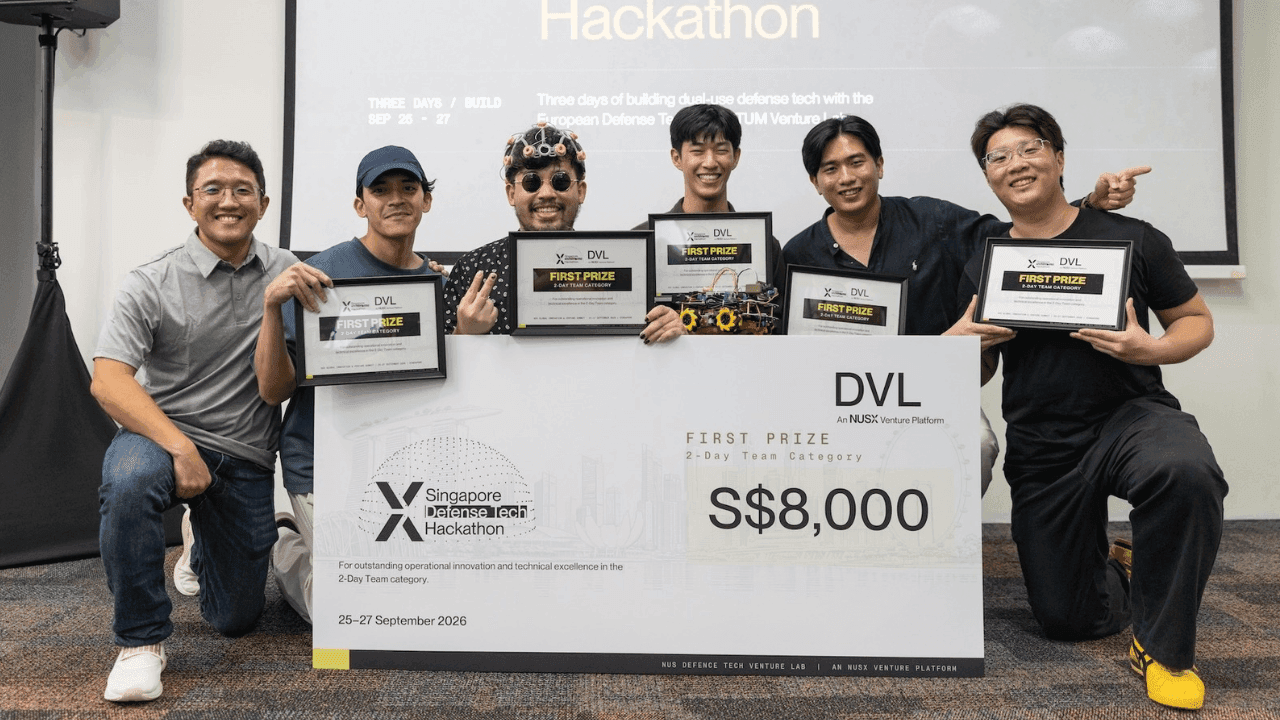
A Singapore hackathon has handed out over S$50,000 for defence innovations including brain-controlled robots, ultra-low-cost drone interceptors and 3D-printable rocket systems. The event, organised by NUSX, the European Defense Tech Hub and TUM Venture Labs, drew more than 1,000 applicants. Teams showed how off-the-shelf parts and academic research could meet urgent military needs.

Editor, Lazyfounder
30 SEC SUMMARY
- A Singapore hackathon organised by NUSX, the European Defense Tech Hub and TUM Venture Labs drew over 1,000 applicants and awarded more than S$50,000 in prizes for defence innovations.
- Winning teams demonstrated brain-controlled robots, low-cost drone interceptors priced at S$470 each, and 3D-printable rocket systems designed to counter drone swarms at speeds over 1,000 km/h.
- The NUS Defence Venture Lab offers startups incubation support worth over S$100,000, taking equity while letting founders keep their intellectual property.
- Singapore’s defence deeptech ecosystem includes startups like BeeX, which began as an NUS robotics club project and now operates autonomous underwater drones in the UK and Germany.
- The event highlighted how academic research, defence needs and entrepreneurship intersect in Singapore’s strategy to build homegrown defence and deeptech startups.
TABLE OF CONTENTS
KEY HIGHLIGHTS
- Over 1,000 applied; 300 competed in a defence-tech hackathon organised by NUSX, the European Defense Tech Hub and TUM Venture Labs.
- NeuroMech won the 48-hour challenge with a brain-computer interface for hands-free control of unmanned ground vehicles.
- SmartFalcon built a drone interceptor for S$470 (€315), using off-the-shelf parts and onboard computer vision.
- MAELSTROM, an NUS student team, took the S$10,000 top prize for a 3D-printable rocket interceptor targeting drone swarms at 1,000 km/h.
- Team Felix boosted emergency shelter rates from 68% to 82% in a simulated flash-flood scenario.
- NUS Defence Venture Lab offers over S$100,000 in incubation support per startup.
1,000 applicants, S$50,000 in prizes
More than 1,000 applicants vied for a spot in Singapore’s latest defence-tech hackathon. Only 300 made the cut. The event, run by NUSX, the European Defense Tech Hub and Munich’s TUM Venture Labs, doled out over S$50,000 in prizes, according to Tech.eu.
Brain-controlled bots, S$470 drone killers and 3D-printable rockets
NeuroMech clinched the 48-hour challenge with a brain-computer interface for unmanned ground vehicles. Electrodes near the visual cortex pick up responses to flashing cues and convert them into robot commands. Soldiers could steer vehicles without touching a controller. Agnessa Pedersen, CEO of Norway’s Cerebionics, is chasing the same goal for defence clients.
SmartFalcon took third place in the three-month challenge. The team built a drone interceptor from off-the-shelf parts and onboard computer vision. At roughly S$470 (€315) per unit, it undercuts most military-grade systems. Vaikesh Manimaran, the project lead, said the goal was swarms of cheap interceptors that work together to neutralise threats.
MAELSTROM, a team of NUS students, won the S$10,000 top prize. Their rocket-propelled interceptor is designed to knock drone swarms out of the sky at speeds over 1,000 km/h. Every part, including the propellant, is 3D-printable and networked for real-time coordination.
Helping civilians and stitching systems together
Team Felix designed a platform to guide civilians to safety during disasters. In a simulated flash flood, the system raised the share of people reaching shelter from 68% to 82%.
Other prizes recognised collaboration. A ‘Lord of the Rings’ award went to teams whose technologies—AI command software, acoustic sensors and autonomous interceptors—could plug into larger defence networks. Tech.eu noted that integrating these disparate systems remains tricky, requiring precise alignment of simulations and sensor data.
From campus club to defence startup
The hackathon aimed to turn academic ideas into startups. The NUS Defence Venture Lab, a key backer, offers over S$100,000 in incubation support per team. It takes equity but lets founders retain their intellectual property.
Singapore’s government backs this model. Temasek Laboratories, set up in 2000 by NUS and the Ministry of Defence, partners with universities to push defence research forward. The approach has already produced startups like BeeX, a marine-robotics company spun out of an NUS robotics club in 2018. BeeX now operates autonomous underwater drones in the UK and Germany, inspecting offshore energy assets and coastal infrastructure.
Guillaume Sartoretti, an assistant professor at NUS, pointed to BeeX as proof that civilian-academic projects can pivot to defence. Gary Ang, NUS’s Professor of Practice for Defence Innovation, added that the lab’s equity-light model reduces founders’ risk while giving the military access to agile, cutting-edge technology.
Precision tech: from atomic clocks to drone swarms
Singapore’s push into precision technology extends beyond defence. Earlier this year, researchers at the Centre for Quantum Technologies built the world’s most accurate atomic clocks, surpassing records set by the US and China. The hackathon, focused on drones and robotics, reflects the same drive for precision and innovation. As Benjamin Wolba, co-founder of the European Defense Tech Hub, put it: "These competitions aren’t just about ideas—they’re about building things that work, fast."
What this means
Lazyfounder analysis — our interpretation, not reported fact.
Singapore is using hackathons and venture labs to turn university research into startups that compete with global defence contractors on cost and speed—without relying on traditional prime vendors.
Key takeaways
- Hackathons are proving grounds: teams like MAELSTROM and SmartFalcon moved from prototypes to potential spin-outs in months, not years.
- Cost matters: a S$470 drone interceptor could shift the economics of counter-drone warfare, especially against swarms.
- Civilian spillovers: brain-computer interfaces and emergency-response platforms show dual-use potential beyond military applications.
- Incubation models are evolving: equity-for-support deals attract founders who might otherwise avoid defence work.
Related on Lazyfounder
Sources
- Tech.eu · 2026-11-16
Hacking the future of defence: Inside Singapore's deeptech ecosystem
This story is an original summary drafted with AI by Lazyfounder from the reporting listed above and checked by automated validation. Facts are attributed to their original publishers; sections marked as analysis are Lazyfounder's. Where a source is in another language, facts were machine-translated and quotations are reported, not reproduced. Read the original coverage via the links, and see our AI policy and corrections policy.

About the author
Editor, Lazyfounder
Tarun Mottlia edits LazyFounders, covering Indian startups, funding rounds, AI and product launches. Every story on the site is AI-assisted and checked against its cited sources before publication.
More stories by Tarun MottliaGet the LazyFounder Brief
Startup, funding and AI news in a five-minute read. Join the early-access list.
