
Scientists replicate ancient Roman nanotech for color-changing glass
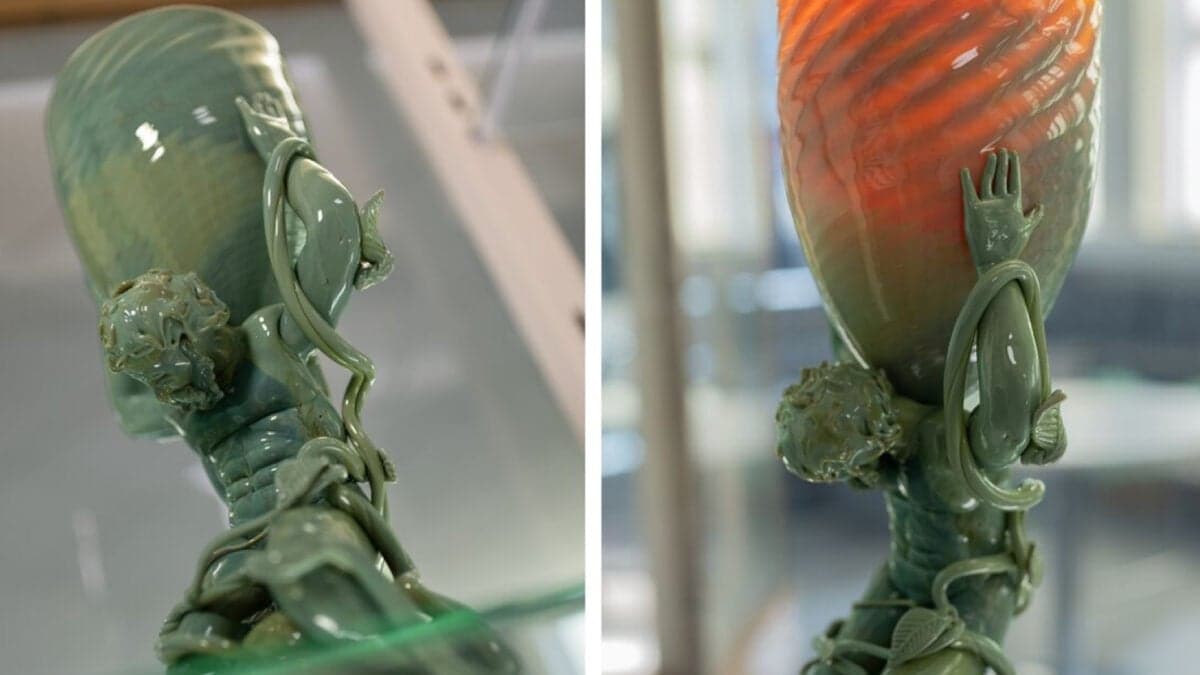
Researchers at the University of Sheffield have unlocked the secret behind the Lycurgus Cup, a 4th-century Roman artifact that shifts color from jade green to ruby red depending on lighting. The team, led by Lisa Hollands, developed a repeatable method to produce dichroic glass, a feat not achieved since the cup’s creation.

Editor, Lazyfounder
KEY HIGHLIGHTS
- Researchers at the University of Sheffield replicated the ancient Roman nanotechnology behind the Lycurgus Cup’s color-changing dichroic glass.
- The team, led by Lisa Hollands, developed a repeatable recipe for dichroic glass using gold and silver nanoparticles, achieving the effect in four months with minimal funding.
- The color shift—from jade green to ruby red—occurs due to nanoparticles approximately 50-80 nanometers in size, with a silver core and gold shell.
- A modern remake of the Lycurgus Cup, created by artist Elliot Walker, will be displayed at Sheffield’s Festival of the Mind and later at the Turner Museum of Glass.
How the Lycurgus Cup’s effect was recreated
The Lycurgus Cup, a 4th-century Roman artifact, owes its color-changing properties to dichroic glass embedded with gold and silver nanoparticles. When light passes through the glass, these nanoparticles—approximately 50-80 nanometers in size, with a silver core and gold shell—scatter green and blue wavelengths while allowing red and orange to transmit, creating the iconic shift from jade green to ruby red.
Lisa Hollands and her team at the University of Sheffield simulated the raw materials and techniques available to Roman artisans. They used gas-fired furnaces, which proved more effective than modern electric alternatives, to produce the effect. The glass "self-strikes," meaning the nanoparticles form without requiring complex heat treatment.
From outreach project to scientific breakthrough
The project began as a public outreach request from the university’s photonics team but evolved into a focused research effort. Within four months and with minimal funding, the team developed a repeatable recipe for dichroic glass, demonstrating that ancient nanotechnology could be replicated without advanced modern tools.
Hollands emphasized that the simplicity of the method was key: "We wanted to show that this effect could be achieved with the resources available to Roman artisans, and we did."
A modern remake for public display
To showcase the breakthrough, glass artist Elliot Walker created a modern reinterpretation of the Lycurgus Cup. The piece will debut at Sheffield’s Festival of the Mind before entering the permanent collection at the Turner Museum of Glass. Its display alongside historical artifacts will highlight the intersection of ancient innovation and modern scientific replication.
What this means
Lazyfounder analysis — our interpretation, not reported fact.
The successful replication of the Lycurgus Cup’s dichroic glass challenges assumptions about the limits of ancient technology. It proves that advanced optical effects could be achieved with relatively simple methods, suggesting that other "lost" techniques from antiquity might be recoverable with targeted experimentation. For founders and operators in materials science or nanotechnology, this project is a reminder that innovation doesn’t always require cutting-edge infrastructure—sometimes, the key lies in revisiting overlooked historical methods with modern analytical tools.
Key takeaways
- This replication demonstrates that advanced nanotechnology can be achieved with simple, historically plausible methods, lowering barriers for modern material science experiments.
- The project’s success under minimal funding and time constraints highlights the potential for low-cost innovation in niche scientific research.
- The dichroic effect’s reliance on nanoparticle composition could inspire new applications in optics, art, and decorative materials.
Related on Lazyfounder
Sources
- Gizmodo · 2026-10-26
Ancient Roman Nanotech Made This Cup Change Color. Scientists Finally Cracked the Formula
This story is an original summary drafted with AI by Lazyfounder from the reporting listed above and checked by automated validation. Facts are attributed to their original publishers; sections marked as analysis are Lazyfounder's. Where a source is in another language, facts were machine-translated and quotations are reported, not reproduced. Read the original coverage via the links, and see our AI policy and corrections policy.

About the author
Editor, Lazyfounder
Tarun Mottlia edits LazyFounders, covering Indian startups, funding rounds, AI and product launches. Every story on the site is AI-assisted and checked against its cited sources before publication.
More stories by Tarun MottliaGet the LazyFounder Brief
Startup, funding and AI news in a five-minute read. Join the early-access list.
